


Other Resources
ALL ARTICLES


Community
Lorem ipsum dolor sit amet, consectetur adipiscing elit. Suspendisse varius enim in eros elementum tristique. Duis cursus, mi quis viverra ornare, eros dolor interdum nulla, ut commodo diam libero vitae erat. Aenean faucibus nibh et justo cursus id rutrum lorem imperdiet. Nunc ut sem vitae risus tristique posuere.
Stay informed with out regularly updated resources. Each post convers a unique aspect of banking or finance to enhance your understanding and enable better financial decisions.
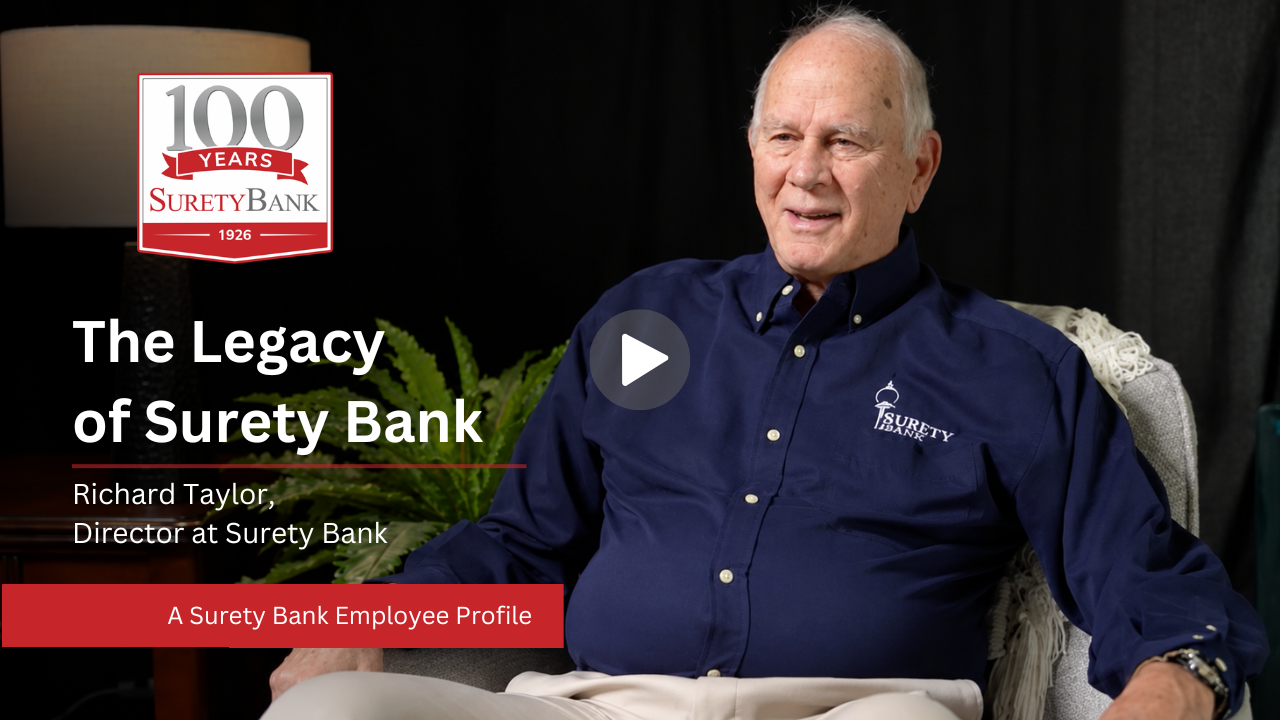
For Richard Taylor, Surety Bank has never simply been a place to bank. It has been part of his family and his community for generations.
His grandfather, Dr. Harold Taylor, served on Surety’s board and became president during a challenging period in the institution’s early history. His father later served as Surety’s attorney and on its Board of Directors. Richard’s own relationship with the bank began when he was a child.
“My earliest memory was at 110 North Florida,” Richard recalls. He believes that as soon as he was old enough to walk into Surety, he was bringing in a dime to start an account.
After leaving the Marine Corps in 1977, Richard eventually continued the family tradition by joining Surety’s Board of Directors himself.
His story provides a unique window into Surety Bank’s first 100 years and the principles that have allowed a local institution to continue serving its community through generations of change.
Surety was formed in 1926 as a mutual building and loan association, owned by its depositors and borrowers rather than traditional shareholders.
It wasn’t long before the young institution faced a major test.
Florida’s real estate boom collapsed before the Great Depression spread across the country. Richard grew up hearing stories about the banks around DeLand that failed during those difficult years. Surety, however, kept its doors open.
Richard believes the reason came down to the way Surety treated people.
“The reason it didn’t fold is because of two reasons. One, it was able to reason with the depositors and, two, because it acted reasonably with the borrowers.”
Instead of immediately turning to foreclosure when borrowers struggled, Richard says Surety did everything it could to work with them. At the same time, its leaders worked to maintain the confidence of depositors. That careful, personal approach helped Surety navigate one of the most difficult periods in American financial history without shutting down.
The story may be nearly a century old, but the philosophy behind it feels familiar: know the people you serve and be willing to work with them when it matters.
When Richard later joined the board, that personal knowledge of customers and the community was still an important part of how Surety operated.
He remembers sitting alongside directors who seemed to know the history behind nearly every property and family that came before them. When the bank considered making a loan, board members could personally visit the property, research comparable sales, and bring their own knowledge of the local market into the conversation.
For customers, it meant decisions were being made by people who understood the community.
“If you had a problem, you had somebody that you could go sit down across a desk and then talk to them about it.”
That ability to have a real conversation with the people behind your bank is something Richard remembers as an important part of Surety’s contribution to the community.
A lot has changed since those early days.
Richard remembers when customers carried physical books that recorded their payments and Surety used a large hand-operated calculating machine to figure interest. Today, technology has transformed nearly every part of the banking experience.
Surety has evolved with the industry. What began primarily as a building and loan association focused on residential homes has grown into a bank serving businesses and developing expertise in specialized areas of banking.
Richard describes that evolution as cautious, and that distinction is important.
Surety has continued to change without losing sight of what made it successful in the first place.
That perspective fits naturally with Surety Bank’s centennial message: “How we’ve always done it is how we’ll always do it.”
In many organizations, “how we’ve always done it” can imply a resistance to change. Surety’s history tells a different story. The tools have changed. The services have expanded. The way customers interact with their bank has evolved.
But the commitment to being thoughtful about how the bank grows and remaining connected to the people it serves has endured.
After all the changes Richard has witnessed, one characteristic stands out when he talks about what makes Surety different today.
“We are truly a local bank.”
For Richard, there is a difference between being called a community bank and actually being part of the community.
Surety’s roots are here. Its history is here. And generations of the people behind the bank have lived and worked alongside the customers they serve.
Richard describes Surety not only as a community bank, but as a community institution.
That connection has carried Surety through enormous changes in banking and in the community itself. Richard remembers a time when Surety did not need much advertising because local people already knew where to go when they needed a reliable place to borrow or deposit their money. Decades later, customers have more banking options than ever, but Surety continues to move steadily forward without chasing every passing trend.
Richard has seen Surety Bank move from passbooks and hand-operated calculators to modern banking. He has watched the institution expand beyond its original focus while continuing to take a careful approach to growth.
And when asked whether a bank that has already been here for 100 years can make it another 100, Richard sees no reason why it can’t.
That confidence comes from knowing where Surety has been.
For a century, the bank has adapted when necessary while holding onto the qualities that have carried it through generations: local roots, thoughtful decisions, and a commitment to the people it serves.
Richard Taylor’s family has been part of that story for generations, and his memories offer a rare look at just how much has changed since 1926.
They also show how much hasn’t.
That is the legacy of Surety Bank.


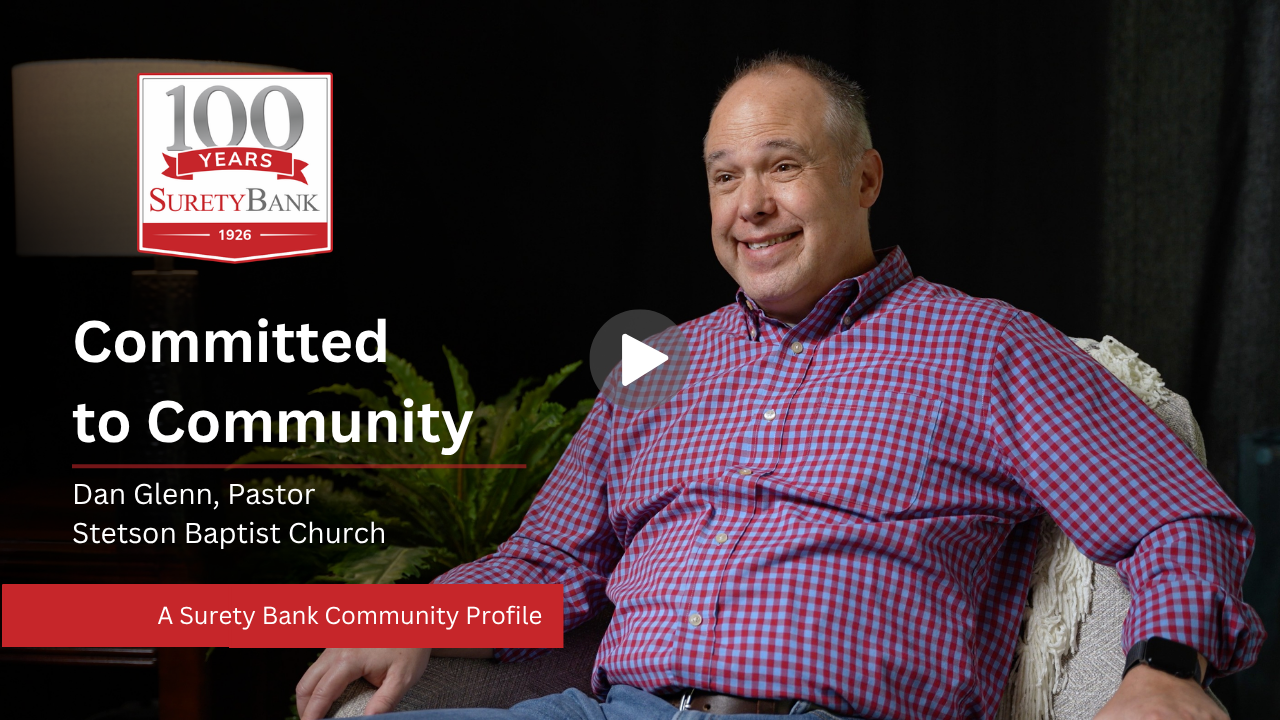
For Dan Glenn, Pastor of Stetson Baptist Church in DeLand, Surety Bank has become much more than the place where the church did its banking. Over the years, the initial banking relationship has grown into a partnership centered around a shared commitment to the community.
That partnership took on new meaning in 2018 when Stetson Baptist Church launched Night to Shine, an unforgettable prom experience for people with special needs held in partnership with the Tim Tebow Foundation.
Creating an experience like Night to Shine requires significant support, and Surety Bank was one of the event's earliest sponsors.
“Surety was one that came on very early saying, ‘Hey, we want to support that. We want to be a part of it.’”
For Dan, that moment marked a shift in the relationship. It became much more personal and community focused.
Surety continued supporting Night to Shine year after year, but one experience in particular showed Dan what that partnership truly meant.
After the first Night to Shine, Dan realized the church had never properly thanked Surety for its sponsorship. When it came time to plan the event again, he felt hesitant approaching Surety for another year of support.
The response surprised him.
There was no hesitation. Surety wanted to be involved again.
Years later, that commitment went even further when Surety reached out to the church without being asked and offered to increase its support.
“They have an intention to be generous, even when generosity may or may not be expected or requested.”
For Dan, that willingness to look for opportunities to make a greater impact is part of what distinguishes Surety Bank as a community organization.
Instead of simply waiting for someone to present a sponsorship request, Surety has been willing to ask a different question: How can we do more?
That philosophy extends beyond a single event.
Dan describes Surety not simply as a community bank, but as a “community-centered organization” that genuinely cares about DeLand and the relationships it has built throughout the city.
That personal connection is something Dan has experienced firsthand. His relationship with Surety isn't limited to the organization itself. It's also built through relationships with the people behind it.
As Surety Bank celebrates 100 years, Dan believes that commitment to people and community helps explain why the bank has remained part of DeLand for generations.
Over the past century, both the bank and the city have grown and changed. Yet Surety has continued to serve the community throughout that growth.
For Dan, that's exactly why Surety's 100th anniversary message, “How we've always done it is how we'll always do it,” resonates.
“The way they've always done things has been people centered, relationships centered, community centered.”
Those values create something that goes beyond banking. They create trust. They allow organizations like Stetson Baptist Church to know what to expect from a partner that has consistently shown up before and intends to continue showing up in the future.
After years of partnership, Dan hopes that part of Surety never changes.
This is how Surety Bank has always done it. It's how we will always do it.
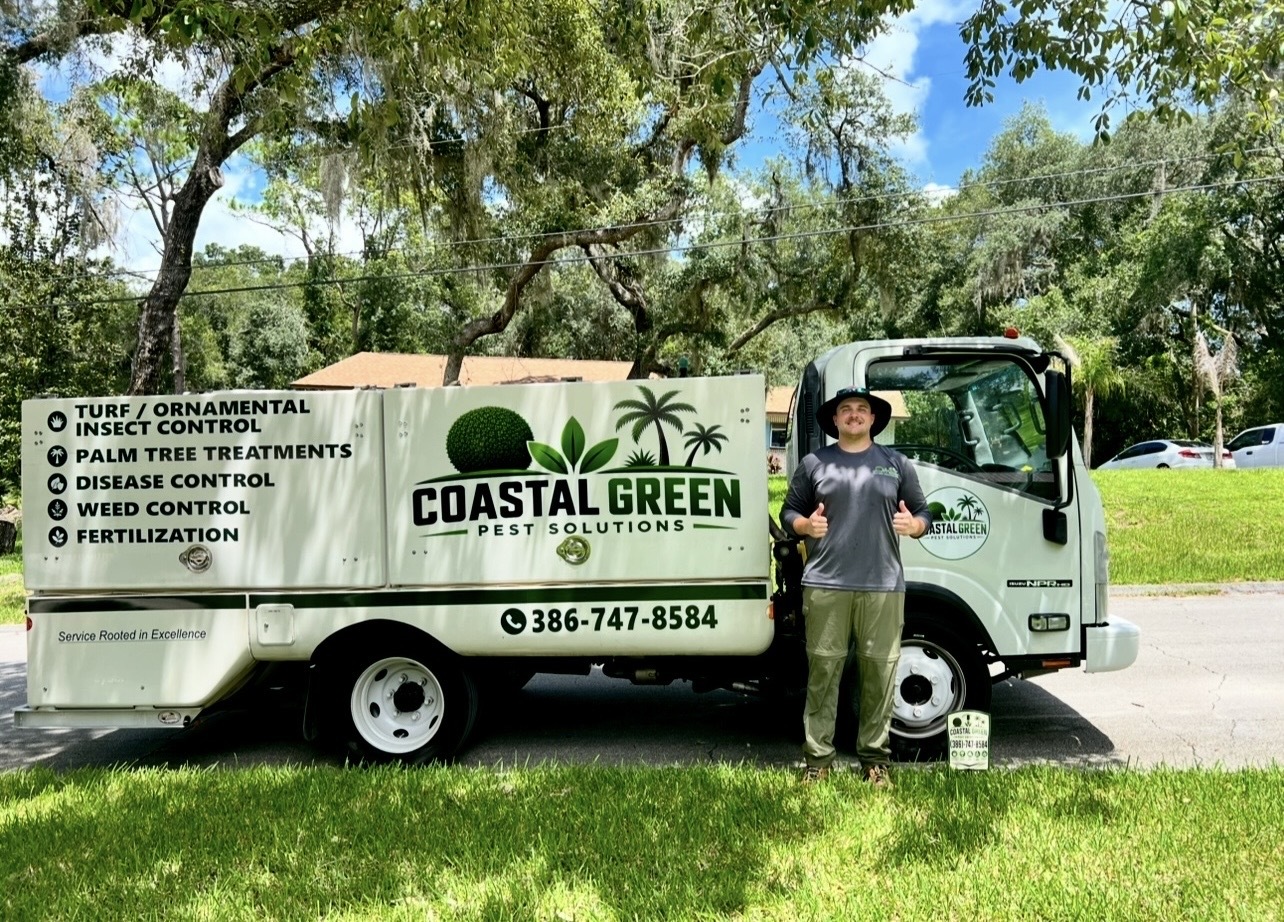
For Austin Scott, starting a business wasn’t the result of a lifelong plan. It was something that grew over time, much like the lawns he now helps his customers care for.
Born and raised in DeLand, Austin is the owner of Coastal Green Pest Solutions, a new Volusia County business specializing in lawn treatments, pest management, fertilization, and the care of palms and shrubs.
The company may be new, but Austin is far from new to the work.
Before entering the lawn and pest control industry, Austin was selling auto parts at O’Reilly Auto Parts. Then a landscaper friend suggested he take a job with a local pest control company.
He gave it a shot and discovered an industry that fascinated him.
“I like that I could learn something new every day,” Austin says. “You get to see different problems, and you get to see the benefits of your own labor making a lawn beautiful. You get to see it go from nothing to something.”
Austin spent nearly six years in the industry, gradually developing an understanding of not only what products to use, but why lawns develop problems in the first place.
Interestingly, the work even gave him a new appreciation for a subject he once struggled with: chemistry.
In school, chemistry had never come naturally to Austin. But working with fertilizers, herbicides, insecticides, fungicides, and nutrients gave those concepts a real-world application.
“You get to learn something and then apply it directly,” he says.
And the more Austin learned, the more he realized there was an opportunity to do things differently.
Austin believes one of the biggest shortcomings in the lawn and pest control industry isn't necessarily the products or treatment programs companies use. It's the communication that happens, or doesn't happen, between the company, technician, and homeowner.
A lawn problem can be the result of insects, fungus, nutrient deficiencies, irrigation issues, environmental stress, or a combination of factors. Simply treating the symptom doesn't always solve the underlying problem.
Austin wants Coastal Green Pest Solutions to be different.
“I take pride in being the solution and the end to the revolving door when it comes to these lawn programs,” he says.
That means spending time with homeowners, explaining what is happening on their property, and helping them understand what needs to change.
Austin compares a lawn or landscape to the human body. One problem can affect the health of the entire system. Killing an insect, for example, may address the immediate issue, but it doesn't necessarily explain why the lawn became susceptible to the pest in the first place.
“If you can be the middleman between the problem, the chemicals, and the customer, and you can explain all that smoothly, that's normally the end,” Austin says. “A lot of people don't take the time to talk to their customers and make sure they understand.”
It's an approach built around education and relationships as much as treatment.
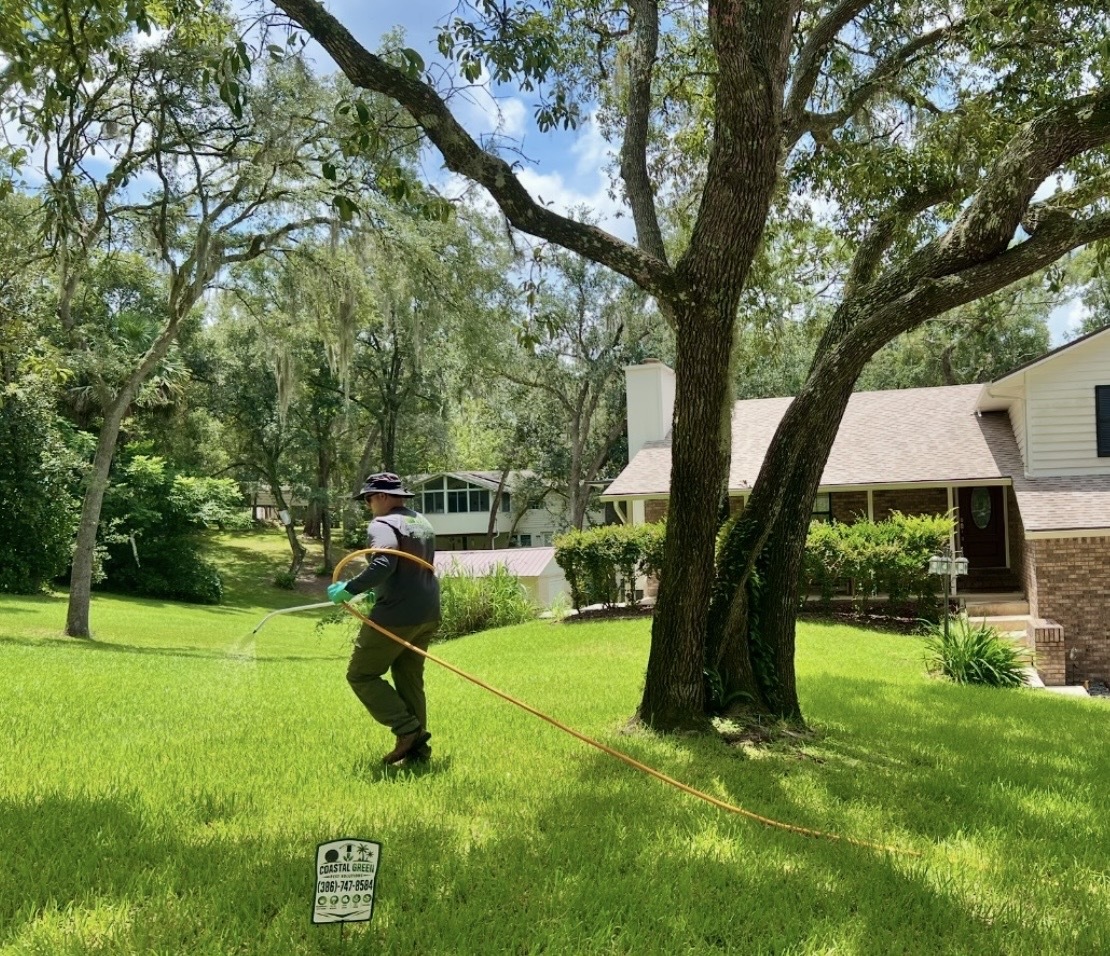
When the company Austin had worked for was sold, he saw an opportunity to take everything he'd learned and build something of his own.
Coastal Green Pest Solutions was born.
Today, Austin primarily works with residential customers throughout Volusia County who care about the long-term health and appearance of their properties.
His services include:
Austin's philosophy isn't about simply “spraying and praying,” as he puts it. Every property is different, so understanding what's actually happening comes before recommending a solution.
That philosophy also shapes how he plans to grow the business.
Starting a company requires more than expertise and ambition. There are trucks, equipment, products, operating expenses, and the reality that revenue doesn't necessarily arrive the moment the business opens its doors.
Austin knew he needed some financial breathing room as he got Coastal Green Pest Solutions off the ground.
That's where Surety Bank came in.
Austin first learned about Surety through his father, who had worked in real estate and developed a relationship with Surety Bank CEO Ryan James over the years.
When Austin was preparing to launch Coastal Green Pest Solutions, that local connection opened the door to a conversation.
“I was just looking for a good little loan—something to get me by, that way I had a little bit of breathing room,” Austin says. “I was very questionable on how I was going to make everything work, and honestly, I'm very grateful for Surety stepping in.”
Surety provided a business loan directly to Coastal Green Pest Solutions, giving Austin additional resources and flexibility during the critical early months of building the company.
For Austin, the experience demonstrated one of the advantages of working with a community bank: relationships matter.
Ryan knew Austin's family. He'd seen Austin working around town. And instead of Austin simply being another application, there was an opportunity to understand the person and business behind it.
That trust helped a local entrepreneur take the next step.
Just a couple of months into the business when we spoke with him, Austin already had big ambitions for Coastal Green Pest Solutions.
Eventually, he'd like to have multiple trucks on the road, a dedicated irrigation team, a sales team, and expanded services including home pest and termite control.
But he's in no hurry to grow simply for the sake of getting bigger.
Austin wants to make sure the service and customer experience that distinguish Coastal Green today remain intact as the company expands.
“If I'm not taking the time to personalize your service and making sure that I'm putting down what I'm promising, then there's no point in me opening up the next step,” he says.
He describes his philosophy simply as “natural growth or no growth.”
It's an especially fitting philosophy for someone who spends his days helping things grow.
For now, Austin is focused on building relationships, earning the trust of homeowners and landscapers throughout Volusia County, and developing Coastal Green one customer at a time.
And he's doing it in the community he has always called home.
“I still enjoy the small-town aspect of DeLand,” Austin says. “Raising a family here, having good friends here, it's very nice. DeLand's a good home base.”
As DeLand and Volusia County continue to grow, Austin hopes Coastal Green Pest Solutions will grow right alongside them, without losing the personal relationships that helped get the business started in the first place.
Coastal Green Pest Solutions serves homeowners throughout Volusia County. For homeowners who care about the health and appearance of their lawn and landscaping, Austin and Coastal Green provide personalized lawn treatment, pest management, fertilization, and plant health solutions.

Personal fraud continues to evolve, and scammers are finding increasingly sophisticated ways to target consumers. From AI-powered messages that appear surprisingly convincing to attempts to gain access to entire financial accounts. Recognizing the warning signs is becoming more important than ever.
While you can't prevent every fraud attempt, knowing what to watch for and taking a few proactive steps can make it much harder for scammers to succeed.
Artificial intelligence is making fraudulent calls and text messages feel more personal and legitimate. Scammers can use AI to create convincing communications designed to make you believe you're interacting with a trusted person or organization.
Be cautious when you receive an unexpected call or message asking for personal information, money, or access to an account. Before responding or taking action, reach out to Surety Bank directly to verify they are the ones calling. This step could mean not being scammed out of your money.
Fraudsters are increasingly looking beyond individual credit card numbers and attempting to gain access to entire financial profiles, including personal bank and investment accounts.
Protect your accounts by regularly reviewing activity for transactions you don't recognize and using multifactor authentication whenever it's available. Never provide your password, login credentials, or verification codes to someone who contacts you unexpectedly.
If you notice something unusual in your Surety Bank account, contact us promptly.
Older adults continue to be frequent targets of financial scams, particularly those involving tech support and investment-related schemes.
These scams often rely on urgency or fear to convince someone to act before they have an opportunity to question what's happening. Talk with older family members about common scams and encourage them to check with someone they trust before sending money or providing sensitive information in response to an unexpected request.
Taking a few minutes to verify a situation can help prevent a significant financial loss.
Protecting yourself doesn't require becoming a fraud expert. Start by being skeptical of unexpected requests for money or information, especially when someone pressures you to act immediately.
Use strong, unique passwords and enable multifactor authentication when available. Avoid clicking links in unexpected emails or text messages, and regularly review your bank accounts and credit reports for activity you don't recognize.
Most importantly, trust your instincts. If something doesn't feel right, stop and verify before taking action.
If you'd like to take additional steps to protect yourself, here are three resources worth exploring:
FTC IdentityTheft.gov
Best for someone who thinks their identity has already been compromised. The FTC provides a personalized recovery plan and steps for addressing identity theft.
Visit IdentityTheft.gov
FTC Credit Freeze & Fraud Alert Guide
Customers can place a free credit freeze, which can prevent identity thieves from opening new credit accounts in their name, or add a fraud alert.
Learn About Credit Freezes & Fraud Alerts
Aura
For those interested in a paid protection service, Aura offers identity and financial monitoring tools and other fraud-protection features. I’d position this as an optional third-party tool, not something Surety is recommending over other services.
Explore Aura
These resources are provided for informational purposes. Surety Bank does not endorse or guarantee any third-party product or service.
Fraud tactics will continue to change, but one of your strongest defenses is also one of the simplest: slow down.
Scammers often depend on creating urgency so you act before thinking. If you're unsure about a request involving your Surety Bank account, don't rely on the phone number, link, or contact information provided in the message. Contact Surety Bank directly through a trusted channel.
We're here to help you protect your financial information and recognize potential fraud before it becomes a loss.
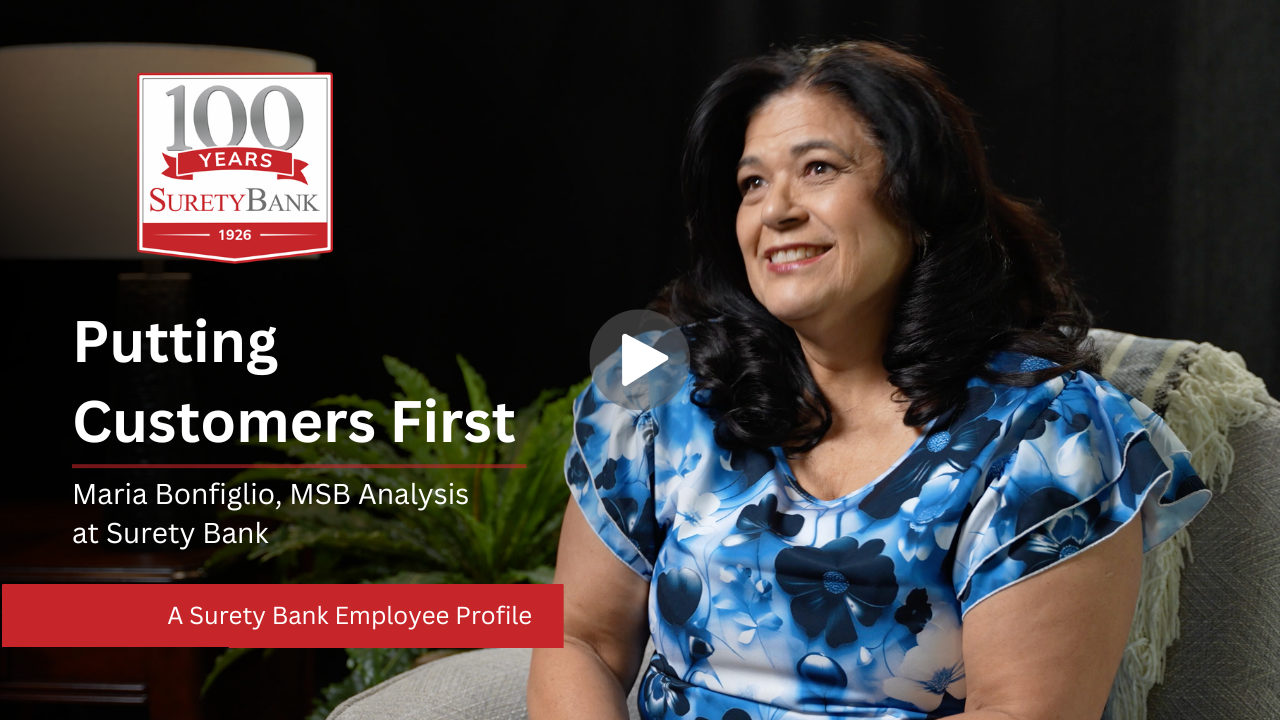
For Maria Bonfiglio, working at Surety Bank has always been about more than banking. It's about taking care of people.
Maria has been part of the Surety Bank family for nine years, but her journey began with a simple text message. A former boss she had stayed in touch with reached out years after they had worked together and told her, "I have the perfect job for you." Maria's response was simple: "Where should I sign?"
Nine years later, her enthusiasm hasn't changed.
"I love it. I love my job."
Over the years, Maria's role has evolved, giving her the opportunity to learn new skills and develop deeper relationships with customers. She has gotten to know some of them so well that she can recognize who is calling just by the sound of their voice. For Maria, those relationships are what make Surety feel less like a workplace and more like a family.
That personal connection also shapes the way Maria approaches protecting customers.
When something doesn't seem right, she isn't afraid to ask questions. Whether she's reviewing a check or helping someone resolve an issue with an account, Maria understands that taking a little extra time can make a significant difference.
"We really care about our customers," Maria explains. Even when customers may wonder why the bank is asking additional questions, she wants them to understand the reason behind it. "We don't want them to lose money."
For Maria, that care isn't limited to customers. She has experienced it personally as an employee.
During some of the most difficult moments of her life, including an extended hospital stay and the loss of her son, Maria remembers her Surety family checking on her, visiting her, and making sure she knew she wasn't alone. Those experiences showed her that the relationships Surety talks about aren't simply something customers experience. They're part of the culture inside the bank, too.
It's also why Maria believes Surety Bank has remained part of the community for 100 years. She has worked at other banks, but says Surety's involvement in the community feels different. The bank isn't trying to be the biggest. Instead, it has remained focused on the people and communities it serves.
That same philosophy comes through in Maria's relationships with her customers. Some have developed such a strong connection with her that when they call, they specifically ask for Maria. She takes pride in being someone they know they can turn to when they have a question or need assistance.
After nine years, Maria still says thank you for the opportunity that brought her to Surety Bank. Her story is a reminder that relationship banking begins with people who genuinely care about the people on the other side of the counter or phone.
This is how Surety Bank has always done it. It's how we will always do it.
.png)
For Lewis Long III, banking with Surety Bank is a relationship that has lasted more than five decades.
As one of Surety Bank's longest-standing customers, Lewis has watched the bank grow alongside the community since his connection to Surety began more than 50 years ago. He originally opened a savings account after hearing from neighbors that the bank consistently offered strong value and genuinely cared about its customers.
Over the years, Lewis has seen a lot of change. He remembers making deposits with a passbook while employees manually updated balances using a hand-cranked adding machine. What hasn't changed, however, is the way Surety Bank treats the people who walk through its doors.
For Lewis, that commitment extends beyond his own banking experience. When his sons were born, he opened accounts for each of them at Surety Bank, continuing a family tradition that has now spanned generations. One of his sons even participated in the ribbon-cutting ceremony when Surety Bank dedicated its current building in the early 1990s.
Throughout his life of military service, public service, and community involvement, Lewis has always returned to the same bank.
What has kept him loyal all these years?
The answer is simple: people.
"You couldn't ask for better service or better people," Lewis says. "I don't know how they remember everybody's name that walks in the door, but they do. They're just super folks. The people have always been a gift to us and to the community."
Lewis believes that the values Surety Bank was founded on continue to define the bank today. One story from the bank's early history has always stayed with him. During the Great Depression, he recalls hearing that Surety worked with customers rather than rushing to foreclose on them because they cared more about helping people than taking their property. That philosophy, he says, is still reflected in the way the bank serves its customers today.
It's one of the reasons Lewis has become an advocate for the bank wherever he goes.
Whether he's encouraging friends to open a money market account, sharing the bank's history, or even suggesting a new Surety branch for his hometown of Lake Helen, Lewis proudly recommends the bank he's trusted for more than half a century.
"I wouldn't champion the bank if I didn't believe in these folks and believe in this bank," he says. "Everybody is important. They see past whatever's bothering someone that day and still treat people with kindness and respect."
As Surety Bank celebrates 100 years of serving Central Florida, customers like Lewis remind us that while banking has evolved, some things should never change. Genuine relationships, exceptional service, and a commitment to the community remain at the heart of everything we do.
This is how Surety Bank has always done it. It's how we will always do it.
For Richard Taylor, Surety Bank has never simply been a place to bank. It has been part of his family and his community for generations.
His grandfather, Dr. Harold Taylor, served on Surety’s board and became president during a challenging period in the institution’s early history. His father later served as Surety’s attorney and on its Board of Directors. Richard’s own relationship with the bank began when he was a child.
“My earliest memory was at 110 North Florida,” Richard recalls. He believes that as soon as he was old enough to walk into Surety, he was bringing in a dime to start an account.
After leaving the Marine Corps in 1977, Richard eventually continued the family tradition by joining Surety’s Board of Directors himself.
His story provides a unique window into Surety Bank’s first 100 years and the principles that have allowed a local institution to continue serving its community through generations of change.
Surety was formed in 1926 as a mutual building and loan association, owned by its depositors and borrowers rather than traditional shareholders.
It wasn’t long before the young institution faced a major test.
Florida’s real estate boom collapsed before the Great Depression spread across the country. Richard grew up hearing stories about the banks around DeLand that failed during those difficult years. Surety, however, kept its doors open.
Richard believes the reason came down to the way Surety treated people.
“The reason it didn’t fold is because of two reasons. One, it was able to reason with the depositors and, two, because it acted reasonably with the borrowers.”
Instead of immediately turning to foreclosure when borrowers struggled, Richard says Surety did everything it could to work with them. At the same time, its leaders worked to maintain the confidence of depositors. That careful, personal approach helped Surety navigate one of the most difficult periods in American financial history without shutting down.
The story may be nearly a century old, but the philosophy behind it feels familiar: know the people you serve and be willing to work with them when it matters.
When Richard later joined the board, that personal knowledge of customers and the community was still an important part of how Surety operated.
He remembers sitting alongside directors who seemed to know the history behind nearly every property and family that came before them. When the bank considered making a loan, board members could personally visit the property, research comparable sales, and bring their own knowledge of the local market into the conversation.
For customers, it meant decisions were being made by people who understood the community.
“If you had a problem, you had somebody that you could go sit down across a desk and then talk to them about it.”
That ability to have a real conversation with the people behind your bank is something Richard remembers as an important part of Surety’s contribution to the community.
A lot has changed since those early days.
Richard remembers when customers carried physical books that recorded their payments and Surety used a large hand-operated calculating machine to figure interest. Today, technology has transformed nearly every part of the banking experience.
Surety has evolved with the industry. What began primarily as a building and loan association focused on residential homes has grown into a bank serving businesses and developing expertise in specialized areas of banking.
Richard describes that evolution as cautious, and that distinction is important.
Surety has continued to change without losing sight of what made it successful in the first place.
That perspective fits naturally with Surety Bank’s centennial message: “How we’ve always done it is how we’ll always do it.”
In many organizations, “how we’ve always done it” can imply a resistance to change. Surety’s history tells a different story. The tools have changed. The services have expanded. The way customers interact with their bank has evolved.
But the commitment to being thoughtful about how the bank grows and remaining connected to the people it serves has endured.
After all the changes Richard has witnessed, one characteristic stands out when he talks about what makes Surety different today.
“We are truly a local bank.”
For Richard, there is a difference between being called a community bank and actually being part of the community.
Surety’s roots are here. Its history is here. And generations of the people behind the bank have lived and worked alongside the customers they serve.
Richard describes Surety not only as a community bank, but as a community institution.
That connection has carried Surety through enormous changes in banking and in the community itself. Richard remembers a time when Surety did not need much advertising because local people already knew where to go when they needed a reliable place to borrow or deposit their money. Decades later, customers have more banking options than ever, but Surety continues to move steadily forward without chasing every passing trend.
Richard has seen Surety Bank move from passbooks and hand-operated calculators to modern banking. He has watched the institution expand beyond its original focus while continuing to take a careful approach to growth.
And when asked whether a bank that has already been here for 100 years can make it another 100, Richard sees no reason why it can’t.
That confidence comes from knowing where Surety has been.
For a century, the bank has adapted when necessary while holding onto the qualities that have carried it through generations: local roots, thoughtful decisions, and a commitment to the people it serves.
Richard Taylor’s family has been part of that story for generations, and his memories offer a rare look at just how much has changed since 1926.
They also show how much hasn’t.
That is the legacy of Surety Bank.
For Dan Glenn, Pastor of Stetson Baptist Church in DeLand, Surety Bank has become much more than the place where the church did its banking. Over the years, the initial banking relationship has grown into a partnership centered around a shared commitment to the community.
That partnership took on new meaning in 2018 when Stetson Baptist Church launched Night to Shine, an unforgettable prom experience for people with special needs held in partnership with the Tim Tebow Foundation.
Creating an experience like Night to Shine requires significant support, and Surety Bank was one of the event's earliest sponsors.
“Surety was one that came on very early saying, ‘Hey, we want to support that. We want to be a part of it.’”
For Dan, that moment marked a shift in the relationship. It became much more personal and community focused.
Surety continued supporting Night to Shine year after year, but one experience in particular showed Dan what that partnership truly meant.
After the first Night to Shine, Dan realized the church had never properly thanked Surety for its sponsorship. When it came time to plan the event again, he felt hesitant approaching Surety for another year of support.
The response surprised him.
There was no hesitation. Surety wanted to be involved again.
Years later, that commitment went even further when Surety reached out to the church without being asked and offered to increase its support.
“They have an intention to be generous, even when generosity may or may not be expected or requested.”
For Dan, that willingness to look for opportunities to make a greater impact is part of what distinguishes Surety Bank as a community organization.
Instead of simply waiting for someone to present a sponsorship request, Surety has been willing to ask a different question: How can we do more?
That philosophy extends beyond a single event.
Dan describes Surety not simply as a community bank, but as a “community-centered organization” that genuinely cares about DeLand and the relationships it has built throughout the city.
That personal connection is something Dan has experienced firsthand. His relationship with Surety isn't limited to the organization itself. It's also built through relationships with the people behind it.
As Surety Bank celebrates 100 years, Dan believes that commitment to people and community helps explain why the bank has remained part of DeLand for generations.
Over the past century, both the bank and the city have grown and changed. Yet Surety has continued to serve the community throughout that growth.
For Dan, that's exactly why Surety's 100th anniversary message, “How we've always done it is how we'll always do it,” resonates.
“The way they've always done things has been people centered, relationships centered, community centered.”
Those values create something that goes beyond banking. They create trust. They allow organizations like Stetson Baptist Church to know what to expect from a partner that has consistently shown up before and intends to continue showing up in the future.
After years of partnership, Dan hopes that part of Surety never changes.
This is how Surety Bank has always done it. It's how we will always do it.
For Austin Scott, starting a business wasn’t the result of a lifelong plan. It was something that grew over time, much like the lawns he now helps his customers care for.
Born and raised in DeLand, Austin is the owner of Coastal Green Pest Solutions, a new Volusia County business specializing in lawn treatments, pest management, fertilization, and the care of palms and shrubs.
The company may be new, but Austin is far from new to the work.
Before entering the lawn and pest control industry, Austin was selling auto parts at O’Reilly Auto Parts. Then a landscaper friend suggested he take a job with a local pest control company.
He gave it a shot and discovered an industry that fascinated him.
“I like that I could learn something new every day,” Austin says. “You get to see different problems, and you get to see the benefits of your own labor making a lawn beautiful. You get to see it go from nothing to something.”
Austin spent nearly six years in the industry, gradually developing an understanding of not only what products to use, but why lawns develop problems in the first place.
Interestingly, the work even gave him a new appreciation for a subject he once struggled with: chemistry.
In school, chemistry had never come naturally to Austin. But working with fertilizers, herbicides, insecticides, fungicides, and nutrients gave those concepts a real-world application.
“You get to learn something and then apply it directly,” he says.
And the more Austin learned, the more he realized there was an opportunity to do things differently.
Austin believes one of the biggest shortcomings in the lawn and pest control industry isn't necessarily the products or treatment programs companies use. It's the communication that happens, or doesn't happen, between the company, technician, and homeowner.
A lawn problem can be the result of insects, fungus, nutrient deficiencies, irrigation issues, environmental stress, or a combination of factors. Simply treating the symptom doesn't always solve the underlying problem.
Austin wants Coastal Green Pest Solutions to be different.
“I take pride in being the solution and the end to the revolving door when it comes to these lawn programs,” he says.
That means spending time with homeowners, explaining what is happening on their property, and helping them understand what needs to change.
Austin compares a lawn or landscape to the human body. One problem can affect the health of the entire system. Killing an insect, for example, may address the immediate issue, but it doesn't necessarily explain why the lawn became susceptible to the pest in the first place.
“If you can be the middleman between the problem, the chemicals, and the customer, and you can explain all that smoothly, that's normally the end,” Austin says. “A lot of people don't take the time to talk to their customers and make sure they understand.”
It's an approach built around education and relationships as much as treatment.
When the company Austin had worked for was sold, he saw an opportunity to take everything he'd learned and build something of his own.
Coastal Green Pest Solutions was born.
Today, Austin primarily works with residential customers throughout Volusia County who care about the long-term health and appearance of their properties.
His services include:
Austin's philosophy isn't about simply “spraying and praying,” as he puts it. Every property is different, so understanding what's actually happening comes before recommending a solution.
That philosophy also shapes how he plans to grow the business.
Starting a company requires more than expertise and ambition. There are trucks, equipment, products, operating expenses, and the reality that revenue doesn't necessarily arrive the moment the business opens its doors.
Austin knew he needed some financial breathing room as he got Coastal Green Pest Solutions off the ground.
That's where Surety Bank came in.
Austin first learned about Surety through his father, who had worked in real estate and developed a relationship with Surety Bank CEO Ryan James over the years.
When Austin was preparing to launch Coastal Green Pest Solutions, that local connection opened the door to a conversation.
“I was just looking for a good little loan—something to get me by, that way I had a little bit of breathing room,” Austin says. “I was very questionable on how I was going to make everything work, and honestly, I'm very grateful for Surety stepping in.”
Surety provided a business loan directly to Coastal Green Pest Solutions, giving Austin additional resources and flexibility during the critical early months of building the company.
For Austin, the experience demonstrated one of the advantages of working with a community bank: relationships matter.
Ryan knew Austin's family. He'd seen Austin working around town. And instead of Austin simply being another application, there was an opportunity to understand the person and business behind it.
That trust helped a local entrepreneur take the next step.
Just a couple of months into the business when we spoke with him, Austin already had big ambitions for Coastal Green Pest Solutions.
Eventually, he'd like to have multiple trucks on the road, a dedicated irrigation team, a sales team, and expanded services including home pest and termite control.
But he's in no hurry to grow simply for the sake of getting bigger.
Austin wants to make sure the service and customer experience that distinguish Coastal Green today remain intact as the company expands.
“If I'm not taking the time to personalize your service and making sure that I'm putting down what I'm promising, then there's no point in me opening up the next step,” he says.
He describes his philosophy simply as “natural growth or no growth.”
It's an especially fitting philosophy for someone who spends his days helping things grow.
For now, Austin is focused on building relationships, earning the trust of homeowners and landscapers throughout Volusia County, and developing Coastal Green one customer at a time.
And he's doing it in the community he has always called home.
“I still enjoy the small-town aspect of DeLand,” Austin says. “Raising a family here, having good friends here, it's very nice. DeLand's a good home base.”
As DeLand and Volusia County continue to grow, Austin hopes Coastal Green Pest Solutions will grow right alongside them, without losing the personal relationships that helped get the business started in the first place.
Coastal Green Pest Solutions serves homeowners throughout Volusia County. For homeowners who care about the health and appearance of their lawn and landscaping, Austin and Coastal Green provide personalized lawn treatment, pest management, fertilization, and plant health solutions.
Personal fraud continues to evolve, and scammers are finding increasingly sophisticated ways to target consumers. From AI-powered messages that appear surprisingly convincing to attempts to gain access to entire financial accounts. Recognizing the warning signs is becoming more important than ever.
While you can't prevent every fraud attempt, knowing what to watch for and taking a few proactive steps can make it much harder for scammers to succeed.
Artificial intelligence is making fraudulent calls and text messages feel more personal and legitimate. Scammers can use AI to create convincing communications designed to make you believe you're interacting with a trusted person or organization.
Be cautious when you receive an unexpected call or message asking for personal information, money, or access to an account. Before responding or taking action, reach out to Surety Bank directly to verify they are the ones calling. This step could mean not being scammed out of your money.
Fraudsters are increasingly looking beyond individual credit card numbers and attempting to gain access to entire financial profiles, including personal bank and investment accounts.
Protect your accounts by regularly reviewing activity for transactions you don't recognize and using multifactor authentication whenever it's available. Never provide your password, login credentials, or verification codes to someone who contacts you unexpectedly.
If you notice something unusual in your Surety Bank account, contact us promptly.
Older adults continue to be frequent targets of financial scams, particularly those involving tech support and investment-related schemes.
These scams often rely on urgency or fear to convince someone to act before they have an opportunity to question what's happening. Talk with older family members about common scams and encourage them to check with someone they trust before sending money or providing sensitive information in response to an unexpected request.
Taking a few minutes to verify a situation can help prevent a significant financial loss.
Protecting yourself doesn't require becoming a fraud expert. Start by being skeptical of unexpected requests for money or information, especially when someone pressures you to act immediately.
Use strong, unique passwords and enable multifactor authentication when available. Avoid clicking links in unexpected emails or text messages, and regularly review your bank accounts and credit reports for activity you don't recognize.
Most importantly, trust your instincts. If something doesn't feel right, stop and verify before taking action.
If you'd like to take additional steps to protect yourself, here are three resources worth exploring:
FTC IdentityTheft.gov
Best for someone who thinks their identity has already been compromised. The FTC provides a personalized recovery plan and steps for addressing identity theft.
Visit IdentityTheft.gov
FTC Credit Freeze & Fraud Alert Guide
Customers can place a free credit freeze, which can prevent identity thieves from opening new credit accounts in their name, or add a fraud alert.
Learn About Credit Freezes & Fraud Alerts
Aura
For those interested in a paid protection service, Aura offers identity and financial monitoring tools and other fraud-protection features. I’d position this as an optional third-party tool, not something Surety is recommending over other services.
Explore Aura
These resources are provided for informational purposes. Surety Bank does not endorse or guarantee any third-party product or service.
Fraud tactics will continue to change, but one of your strongest defenses is also one of the simplest: slow down.
Scammers often depend on creating urgency so you act before thinking. If you're unsure about a request involving your Surety Bank account, don't rely on the phone number, link, or contact information provided in the message. Contact Surety Bank directly through a trusted channel.
We're here to help you protect your financial information and recognize potential fraud before it becomes a loss.
For Maria Bonfiglio, working at Surety Bank has always been about more than banking. It's about taking care of people.
Maria has been part of the Surety Bank family for nine years, but her journey began with a simple text message. A former boss she had stayed in touch with reached out years after they had worked together and told her, "I have the perfect job for you." Maria's response was simple: "Where should I sign?"
Nine years later, her enthusiasm hasn't changed.
"I love it. I love my job."
Over the years, Maria's role has evolved, giving her the opportunity to learn new skills and develop deeper relationships with customers. She has gotten to know some of them so well that she can recognize who is calling just by the sound of their voice. For Maria, those relationships are what make Surety feel less like a workplace and more like a family.
That personal connection also shapes the way Maria approaches protecting customers.
When something doesn't seem right, she isn't afraid to ask questions. Whether she's reviewing a check or helping someone resolve an issue with an account, Maria understands that taking a little extra time can make a significant difference.
"We really care about our customers," Maria explains. Even when customers may wonder why the bank is asking additional questions, she wants them to understand the reason behind it. "We don't want them to lose money."
For Maria, that care isn't limited to customers. She has experienced it personally as an employee.
During some of the most difficult moments of her life, including an extended hospital stay and the loss of her son, Maria remembers her Surety family checking on her, visiting her, and making sure she knew she wasn't alone. Those experiences showed her that the relationships Surety talks about aren't simply something customers experience. They're part of the culture inside the bank, too.
It's also why Maria believes Surety Bank has remained part of the community for 100 years. She has worked at other banks, but says Surety's involvement in the community feels different. The bank isn't trying to be the biggest. Instead, it has remained focused on the people and communities it serves.
That same philosophy comes through in Maria's relationships with her customers. Some have developed such a strong connection with her that when they call, they specifically ask for Maria. She takes pride in being someone they know they can turn to when they have a question or need assistance.
After nine years, Maria still says thank you for the opportunity that brought her to Surety Bank. Her story is a reminder that relationship banking begins with people who genuinely care about the people on the other side of the counter or phone.
This is how Surety Bank has always done it. It's how we will always do it.
For Lewis Long III, banking with Surety Bank is a relationship that has lasted more than five decades.
As one of Surety Bank's longest-standing customers, Lewis has watched the bank grow alongside the community since his connection to Surety began more than 50 years ago. He originally opened a savings account after hearing from neighbors that the bank consistently offered strong value and genuinely cared about its customers.
Over the years, Lewis has seen a lot of change. He remembers making deposits with a passbook while employees manually updated balances using a hand-cranked adding machine. What hasn't changed, however, is the way Surety Bank treats the people who walk through its doors.
For Lewis, that commitment extends beyond his own banking experience. When his sons were born, he opened accounts for each of them at Surety Bank, continuing a family tradition that has now spanned generations. One of his sons even participated in the ribbon-cutting ceremony when Surety Bank dedicated its current building in the early 1990s.
Throughout his life of military service, public service, and community involvement, Lewis has always returned to the same bank.
What has kept him loyal all these years?
The answer is simple: people.
"You couldn't ask for better service or better people," Lewis says. "I don't know how they remember everybody's name that walks in the door, but they do. They're just super folks. The people have always been a gift to us and to the community."
Lewis believes that the values Surety Bank was founded on continue to define the bank today. One story from the bank's early history has always stayed with him. During the Great Depression, he recalls hearing that Surety worked with customers rather than rushing to foreclose on them because they cared more about helping people than taking their property. That philosophy, he says, is still reflected in the way the bank serves its customers today.
It's one of the reasons Lewis has become an advocate for the bank wherever he goes.
Whether he's encouraging friends to open a money market account, sharing the bank's history, or even suggesting a new Surety branch for his hometown of Lake Helen, Lewis proudly recommends the bank he's trusted for more than half a century.
"I wouldn't champion the bank if I didn't believe in these folks and believe in this bank," he says. "Everybody is important. They see past whatever's bothering someone that day and still treat people with kindness and respect."
As Surety Bank celebrates 100 years of serving Central Florida, customers like Lewis remind us that while banking has evolved, some things should never change. Genuine relationships, exceptional service, and a commitment to the community remain at the heart of everything we do.
This is how Surety Bank has always done it. It's how we will always do it.
For Richard Taylor, Surety Bank has never simply been a place to bank. It has been part of his family and his community for generations.
His grandfather, Dr. Harold Taylor, served on Surety’s board and became president during a challenging period in the institution’s early history. His father later served as Surety’s attorney and on its Board of Directors. Richard’s own relationship with the bank began when he was a child.
“My earliest memory was at 110 North Florida,” Richard recalls. He believes that as soon as he was old enough to walk into Surety, he was bringing in a dime to start an account.
After leaving the Marine Corps in 1977, Richard eventually continued the family tradition by joining Surety’s Board of Directors himself.
His story provides a unique window into Surety Bank’s first 100 years and the principles that have allowed a local institution to continue serving its community through generations of change.
Surety was formed in 1926 as a mutual building and loan association, owned by its depositors and borrowers rather than traditional shareholders.
It wasn’t long before the young institution faced a major test.
Florida’s real estate boom collapsed before the Great Depression spread across the country. Richard grew up hearing stories about the banks around DeLand that failed during those difficult years. Surety, however, kept its doors open.
Richard believes the reason came down to the way Surety treated people.
“The reason it didn’t fold is because of two reasons. One, it was able to reason with the depositors and, two, because it acted reasonably with the borrowers.”
Instead of immediately turning to foreclosure when borrowers struggled, Richard says Surety did everything it could to work with them. At the same time, its leaders worked to maintain the confidence of depositors. That careful, personal approach helped Surety navigate one of the most difficult periods in American financial history without shutting down.
The story may be nearly a century old, but the philosophy behind it feels familiar: know the people you serve and be willing to work with them when it matters.
When Richard later joined the board, that personal knowledge of customers and the community was still an important part of how Surety operated.
He remembers sitting alongside directors who seemed to know the history behind nearly every property and family that came before them. When the bank considered making a loan, board members could personally visit the property, research comparable sales, and bring their own knowledge of the local market into the conversation.
For customers, it meant decisions were being made by people who understood the community.
“If you had a problem, you had somebody that you could go sit down across a desk and then talk to them about it.”
That ability to have a real conversation with the people behind your bank is something Richard remembers as an important part of Surety’s contribution to the community.
A lot has changed since those early days.
Richard remembers when customers carried physical books that recorded their payments and Surety used a large hand-operated calculating machine to figure interest. Today, technology has transformed nearly every part of the banking experience.
Surety has evolved with the industry. What began primarily as a building and loan association focused on residential homes has grown into a bank serving businesses and developing expertise in specialized areas of banking.
Richard describes that evolution as cautious, and that distinction is important.
Surety has continued to change without losing sight of what made it successful in the first place.
That perspective fits naturally with Surety Bank’s centennial message: “How we’ve always done it is how we’ll always do it.”
In many organizations, “how we’ve always done it” can imply a resistance to change. Surety’s history tells a different story. The tools have changed. The services have expanded. The way customers interact with their bank has evolved.
But the commitment to being thoughtful about how the bank grows and remaining connected to the people it serves has endured.
After all the changes Richard has witnessed, one characteristic stands out when he talks about what makes Surety different today.
“We are truly a local bank.”
For Richard, there is a difference between being called a community bank and actually being part of the community.
Surety’s roots are here. Its history is here. And generations of the people behind the bank have lived and worked alongside the customers they serve.
Richard describes Surety not only as a community bank, but as a community institution.
That connection has carried Surety through enormous changes in banking and in the community itself. Richard remembers a time when Surety did not need much advertising because local people already knew where to go when they needed a reliable place to borrow or deposit their money. Decades later, customers have more banking options than ever, but Surety continues to move steadily forward without chasing every passing trend.
Richard has seen Surety Bank move from passbooks and hand-operated calculators to modern banking. He has watched the institution expand beyond its original focus while continuing to take a careful approach to growth.
And when asked whether a bank that has already been here for 100 years can make it another 100, Richard sees no reason why it can’t.
That confidence comes from knowing where Surety has been.
For a century, the bank has adapted when necessary while holding onto the qualities that have carried it through generations: local roots, thoughtful decisions, and a commitment to the people it serves.
Richard Taylor’s family has been part of that story for generations, and his memories offer a rare look at just how much has changed since 1926.
They also show how much hasn’t.
That is the legacy of Surety Bank.
For Dan Glenn, Pastor of Stetson Baptist Church in DeLand, Surety Bank has become much more than the place where the church did its banking. Over the years, the initial banking relationship has grown into a partnership centered around a shared commitment to the community.
That partnership took on new meaning in 2018 when Stetson Baptist Church launched Night to Shine, an unforgettable prom experience for people with special needs held in partnership with the Tim Tebow Foundation.
Creating an experience like Night to Shine requires significant support, and Surety Bank was one of the event's earliest sponsors.
“Surety was one that came on very early saying, ‘Hey, we want to support that. We want to be a part of it.’”
For Dan, that moment marked a shift in the relationship. It became much more personal and community focused.
Surety continued supporting Night to Shine year after year, but one experience in particular showed Dan what that partnership truly meant.
After the first Night to Shine, Dan realized the church had never properly thanked Surety for its sponsorship. When it came time to plan the event again, he felt hesitant approaching Surety for another year of support.
The response surprised him.
There was no hesitation. Surety wanted to be involved again.
Years later, that commitment went even further when Surety reached out to the church without being asked and offered to increase its support.
“They have an intention to be generous, even when generosity may or may not be expected or requested.”
For Dan, that willingness to look for opportunities to make a greater impact is part of what distinguishes Surety Bank as a community organization.
Instead of simply waiting for someone to present a sponsorship request, Surety has been willing to ask a different question: How can we do more?
That philosophy extends beyond a single event.
Dan describes Surety not simply as a community bank, but as a “community-centered organization” that genuinely cares about DeLand and the relationships it has built throughout the city.
That personal connection is something Dan has experienced firsthand. His relationship with Surety isn't limited to the organization itself. It's also built through relationships with the people behind it.
As Surety Bank celebrates 100 years, Dan believes that commitment to people and community helps explain why the bank has remained part of DeLand for generations.
Over the past century, both the bank and the city have grown and changed. Yet Surety has continued to serve the community throughout that growth.
For Dan, that's exactly why Surety's 100th anniversary message, “How we've always done it is how we'll always do it,” resonates.
“The way they've always done things has been people centered, relationships centered, community centered.”
Those values create something that goes beyond banking. They create trust. They allow organizations like Stetson Baptist Church to know what to expect from a partner that has consistently shown up before and intends to continue showing up in the future.
After years of partnership, Dan hopes that part of Surety never changes.
This is how Surety Bank has always done it. It's how we will always do it.
For Austin Scott, starting a business wasn’t the result of a lifelong plan. It was something that grew over time, much like the lawns he now helps his customers care for.
Born and raised in DeLand, Austin is the owner of Coastal Green Pest Solutions, a new Volusia County business specializing in lawn treatments, pest management, fertilization, and the care of palms and shrubs.
The company may be new, but Austin is far from new to the work.
Before entering the lawn and pest control industry, Austin was selling auto parts at O’Reilly Auto Parts. Then a landscaper friend suggested he take a job with a local pest control company.
He gave it a shot and discovered an industry that fascinated him.
“I like that I could learn something new every day,” Austin says. “You get to see different problems, and you get to see the benefits of your own labor making a lawn beautiful. You get to see it go from nothing to something.”
Austin spent nearly six years in the industry, gradually developing an understanding of not only what products to use, but why lawns develop problems in the first place.
Interestingly, the work even gave him a new appreciation for a subject he once struggled with: chemistry.
In school, chemistry had never come naturally to Austin. But working with fertilizers, herbicides, insecticides, fungicides, and nutrients gave those concepts a real-world application.
“You get to learn something and then apply it directly,” he says.
And the more Austin learned, the more he realized there was an opportunity to do things differently.
Austin believes one of the biggest shortcomings in the lawn and pest control industry isn't necessarily the products or treatment programs companies use. It's the communication that happens, or doesn't happen, between the company, technician, and homeowner.
A lawn problem can be the result of insects, fungus, nutrient deficiencies, irrigation issues, environmental stress, or a combination of factors. Simply treating the symptom doesn't always solve the underlying problem.
Austin wants Coastal Green Pest Solutions to be different.
“I take pride in being the solution and the end to the revolving door when it comes to these lawn programs,” he says.
That means spending time with homeowners, explaining what is happening on their property, and helping them understand what needs to change.
Austin compares a lawn or landscape to the human body. One problem can affect the health of the entire system. Killing an insect, for example, may address the immediate issue, but it doesn't necessarily explain why the lawn became susceptible to the pest in the first place.
“If you can be the middleman between the problem, the chemicals, and the customer, and you can explain all that smoothly, that's normally the end,” Austin says. “A lot of people don't take the time to talk to their customers and make sure they understand.”
It's an approach built around education and relationships as much as treatment.
When the company Austin had worked for was sold, he saw an opportunity to take everything he'd learned and build something of his own.
Coastal Green Pest Solutions was born.
Today, Austin primarily works with residential customers throughout Volusia County who care about the long-term health and appearance of their properties.
His services include:
Austin's philosophy isn't about simply “spraying and praying,” as he puts it. Every property is different, so understanding what's actually happening comes before recommending a solution.
That philosophy also shapes how he plans to grow the business.
Starting a company requires more than expertise and ambition. There are trucks, equipment, products, operating expenses, and the reality that revenue doesn't necessarily arrive the moment the business opens its doors.
Austin knew he needed some financial breathing room as he got Coastal Green Pest Solutions off the ground.
That's where Surety Bank came in.
Austin first learned about Surety through his father, who had worked in real estate and developed a relationship with Surety Bank CEO Ryan James over the years.
When Austin was preparing to launch Coastal Green Pest Solutions, that local connection opened the door to a conversation.
“I was just looking for a good little loan—something to get me by, that way I had a little bit of breathing room,” Austin says. “I was very questionable on how I was going to make everything work, and honestly, I'm very grateful for Surety stepping in.”
Surety provided a business loan directly to Coastal Green Pest Solutions, giving Austin additional resources and flexibility during the critical early months of building the company.
For Austin, the experience demonstrated one of the advantages of working with a community bank: relationships matter.
Ryan knew Austin's family. He'd seen Austin working around town. And instead of Austin simply being another application, there was an opportunity to understand the person and business behind it.
That trust helped a local entrepreneur take the next step.
Just a couple of months into the business when we spoke with him, Austin already had big ambitions for Coastal Green Pest Solutions.
Eventually, he'd like to have multiple trucks on the road, a dedicated irrigation team, a sales team, and expanded services including home pest and termite control.
But he's in no hurry to grow simply for the sake of getting bigger.
Austin wants to make sure the service and customer experience that distinguish Coastal Green today remain intact as the company expands.
“If I'm not taking the time to personalize your service and making sure that I'm putting down what I'm promising, then there's no point in me opening up the next step,” he says.
He describes his philosophy simply as “natural growth or no growth.”
It's an especially fitting philosophy for someone who spends his days helping things grow.
For now, Austin is focused on building relationships, earning the trust of homeowners and landscapers throughout Volusia County, and developing Coastal Green one customer at a time.
And he's doing it in the community he has always called home.
“I still enjoy the small-town aspect of DeLand,” Austin says. “Raising a family here, having good friends here, it's very nice. DeLand's a good home base.”
As DeLand and Volusia County continue to grow, Austin hopes Coastal Green Pest Solutions will grow right alongside them, without losing the personal relationships that helped get the business started in the first place.
Coastal Green Pest Solutions serves homeowners throughout Volusia County. For homeowners who care about the health and appearance of their lawn and landscaping, Austin and Coastal Green provide personalized lawn treatment, pest management, fertilization, and plant health solutions.
Personal fraud continues to evolve, and scammers are finding increasingly sophisticated ways to target consumers. From AI-powered messages that appear surprisingly convincing to attempts to gain access to entire financial accounts. Recognizing the warning signs is becoming more important than ever.
While you can't prevent every fraud attempt, knowing what to watch for and taking a few proactive steps can make it much harder for scammers to succeed.
Artificial intelligence is making fraudulent calls and text messages feel more personal and legitimate. Scammers can use AI to create convincing communications designed to make you believe you're interacting with a trusted person or organization.
Be cautious when you receive an unexpected call or message asking for personal information, money, or access to an account. Before responding or taking action, reach out to Surety Bank directly to verify they are the ones calling. This step could mean not being scammed out of your money.
Fraudsters are increasingly looking beyond individual credit card numbers and attempting to gain access to entire financial profiles, including personal bank and investment accounts.
Protect your accounts by regularly reviewing activity for transactions you don't recognize and using multifactor authentication whenever it's available. Never provide your password, login credentials, or verification codes to someone who contacts you unexpectedly.
If you notice something unusual in your Surety Bank account, contact us promptly.
Older adults continue to be frequent targets of financial scams, particularly those involving tech support and investment-related schemes.
These scams often rely on urgency or fear to convince someone to act before they have an opportunity to question what's happening. Talk with older family members about common scams and encourage them to check with someone they trust before sending money or providing sensitive information in response to an unexpected request.
Taking a few minutes to verify a situation can help prevent a significant financial loss.
Protecting yourself doesn't require becoming a fraud expert. Start by being skeptical of unexpected requests for money or information, especially when someone pressures you to act immediately.
Use strong, unique passwords and enable multifactor authentication when available. Avoid clicking links in unexpected emails or text messages, and regularly review your bank accounts and credit reports for activity you don't recognize.
Most importantly, trust your instincts. If something doesn't feel right, stop and verify before taking action.
If you'd like to take additional steps to protect yourself, here are three resources worth exploring:
FTC IdentityTheft.gov
Best for someone who thinks their identity has already been compromised. The FTC provides a personalized recovery plan and steps for addressing identity theft.
Visit IdentityTheft.gov
FTC Credit Freeze & Fraud Alert Guide
Customers can place a free credit freeze, which can prevent identity thieves from opening new credit accounts in their name, or add a fraud alert.
Learn About Credit Freezes & Fraud Alerts
Aura
For those interested in a paid protection service, Aura offers identity and financial monitoring tools and other fraud-protection features. I’d position this as an optional third-party tool, not something Surety is recommending over other services.
Explore Aura
These resources are provided for informational purposes. Surety Bank does not endorse or guarantee any third-party product or service.
Fraud tactics will continue to change, but one of your strongest defenses is also one of the simplest: slow down.
Scammers often depend on creating urgency so you act before thinking. If you're unsure about a request involving your Surety Bank account, don't rely on the phone number, link, or contact information provided in the message. Contact Surety Bank directly through a trusted channel.
We're here to help you protect your financial information and recognize potential fraud before it becomes a loss.
For Maria Bonfiglio, working at Surety Bank has always been about more than banking. It's about taking care of people.
Maria has been part of the Surety Bank family for nine years, but her journey began with a simple text message. A former boss she had stayed in touch with reached out years after they had worked together and told her, "I have the perfect job for you." Maria's response was simple: "Where should I sign?"
Nine years later, her enthusiasm hasn't changed.
"I love it. I love my job."
Over the years, Maria's role has evolved, giving her the opportunity to learn new skills and develop deeper relationships with customers. She has gotten to know some of them so well that she can recognize who is calling just by the sound of their voice. For Maria, those relationships are what make Surety feel less like a workplace and more like a family.
That personal connection also shapes the way Maria approaches protecting customers.
When something doesn't seem right, she isn't afraid to ask questions. Whether she's reviewing a check or helping someone resolve an issue with an account, Maria understands that taking a little extra time can make a significant difference.
"We really care about our customers," Maria explains. Even when customers may wonder why the bank is asking additional questions, she wants them to understand the reason behind it. "We don't want them to lose money."
For Maria, that care isn't limited to customers. She has experienced it personally as an employee.
During some of the most difficult moments of her life, including an extended hospital stay and the loss of her son, Maria remembers her Surety family checking on her, visiting her, and making sure she knew she wasn't alone. Those experiences showed her that the relationships Surety talks about aren't simply something customers experience. They're part of the culture inside the bank, too.
It's also why Maria believes Surety Bank has remained part of the community for 100 years. She has worked at other banks, but says Surety's involvement in the community feels different. The bank isn't trying to be the biggest. Instead, it has remained focused on the people and communities it serves.
That same philosophy comes through in Maria's relationships with her customers. Some have developed such a strong connection with her that when they call, they specifically ask for Maria. She takes pride in being someone they know they can turn to when they have a question or need assistance.
After nine years, Maria still says thank you for the opportunity that brought her to Surety Bank. Her story is a reminder that relationship banking begins with people who genuinely care about the people on the other side of the counter or phone.
This is how Surety Bank has always done it. It's how we will always do it.
For Lewis Long III, banking with Surety Bank is a relationship that has lasted more than five decades.
As one of Surety Bank's longest-standing customers, Lewis has watched the bank grow alongside the community since his connection to Surety began more than 50 years ago. He originally opened a savings account after hearing from neighbors that the bank consistently offered strong value and genuinely cared about its customers.
Over the years, Lewis has seen a lot of change. He remembers making deposits with a passbook while employees manually updated balances using a hand-cranked adding machine. What hasn't changed, however, is the way Surety Bank treats the people who walk through its doors.
For Lewis, that commitment extends beyond his own banking experience. When his sons were born, he opened accounts for each of them at Surety Bank, continuing a family tradition that has now spanned generations. One of his sons even participated in the ribbon-cutting ceremony when Surety Bank dedicated its current building in the early 1990s.
Throughout his life of military service, public service, and community involvement, Lewis has always returned to the same bank.
What has kept him loyal all these years?
The answer is simple: people.
"You couldn't ask for better service or better people," Lewis says. "I don't know how they remember everybody's name that walks in the door, but they do. They're just super folks. The people have always been a gift to us and to the community."
Lewis believes that the values Surety Bank was founded on continue to define the bank today. One story from the bank's early history has always stayed with him. During the Great Depression, he recalls hearing that Surety worked with customers rather than rushing to foreclose on them because they cared more about helping people than taking their property. That philosophy, he says, is still reflected in the way the bank serves its customers today.
It's one of the reasons Lewis has become an advocate for the bank wherever he goes.
Whether he's encouraging friends to open a money market account, sharing the bank's history, or even suggesting a new Surety branch for his hometown of Lake Helen, Lewis proudly recommends the bank he's trusted for more than half a century.
"I wouldn't champion the bank if I didn't believe in these folks and believe in this bank," he says. "Everybody is important. They see past whatever's bothering someone that day and still treat people with kindness and respect."
As Surety Bank celebrates 100 years of serving Central Florida, customers like Lewis remind us that while banking has evolved, some things should never change. Genuine relationships, exceptional service, and a commitment to the community remain at the heart of everything we do.
This is how Surety Bank has always done it. It's how we will always do it.

Better Monitoring
Per federal and state guidelines, MSBs are required to monitor their customers’ transactions for suspicious and illegal activity.
Over the past year and a half, the Federal and State governments have issued a huge amount of money to individuals and businesses in the form of Covid-19 stimulus packages. Criminals have been exploiting this situation by committing financial crimes at an unprecedented rate. See a few examples below.
“IRVINE, Calif. (KABC) — An Irvine man allegedly obtained about $5 million in federal coronavirus-relief loans for his fake businesses and then spent the funds on himself, including buying Ferrari, Bentley and Lamborghini sports cars, according to federal authorities.”
“BOSTON — The owner of a Massachusetts pizza parlor lied about the number of employees he had to fraudulently obtain more than $660,000 in federal coronavirus relief funds, then used some of the money to buy and stock an alpaca farm in Vermont, federal prosecutors said Tuesday.”
“According to the report by the Times, Abidemi Rufai, of Lekki, Nigeria, was charged Saturday in federal court with using the identities of more than 100 Washington residents to steal more than $350,000 in unemployment benefits from the Washington state Employment Security Department (ESD) during the COVID-19 pandemic last year.”
How can you improve your quality of monitoring?
Here are some tips on how to get better:
Better Reporting
Reporting should be a natural extension of your monitoring practices. If you are making your monitoring a high priority, good reporting will naturally flow from those activities.
It is very important to file CTRs on a timely basis, within 15 days.
If you are using your check cashing software fully, it will help with the practice of reporting. Especially with CTRs, when a suspicious activity is identified, your software will trigger a CTR. In addition, it will aggregate the data on a customer, pulling all their transactions together if they have made multiple transactions at different times of the day.
Investing in additional features like these and learning how to use them minimizes mistakes.
For example, if a customer comes in three separate times during a day and cashes a $5,000 check each time, will your employees know to aggregate all of those transactions? If not, this is where the software can minimize mistakes.
We understand that your team is most likely not trying to intentionally ignore possible suspicious activity. However, if they get busy and are rushed, without these extra measures in place to catch mistakes they are more likely to make a human error that could cost you.
Our Commitment to You
One of our highest priorities and commitments to you is to make sure our BSA staff is highly qualified and properly trained.
As we seek to be a resource for you, we hold ourselves to the highest standard as well. We are in the business of compliance, so we take employee training, monitoring, and reporting very seriously.
If you have questions for our team and would like to connect, you can reach us here.

In this article we want to answer the major questions surrounding proper employee training so you can use this as a tool to improve the performance of your business.
Why you should train your employees
Most mistakes that MSBs make in their businesses are directly related to their lack of employee training.
Many mistakes can be avoided, and your business doesn’t have to suffer by being held back. But it takes a little bit of time and energy invested into best practices to create an environment that is geared towards training.
We see some MSBs focusing their time and attention in other places too often which leaves their employees unsure about how to handle certain situations. The result can come in the form of fines, slowed growth, losing your MSB license and even losing their banking relationship.
Another major reason to train employees is to fully utilize your resources and assets. For example, you are using a software for check cashing. Are you using just the surface level features or are you using it to its fullest potential? This software offers a lot of features that can make your employees’ jobs much easier and can create efficiencies that map to profitability. This asset alone could bring improvements that impact your business tremendously in the short and long term.
Employee training should be held as a high priority and taken seriously. If so, the result is a smooth operation, less drag on resources and time spent fixing mistakes and less worry about being in business in the coming months or years.
Taking employee training seriously is the first step to sustainable growth in your MSB business. It’s the foundation of everything you do and the bedrock of your business.
How to train your employees
One of the four pillars of BSA is required employee training.
Naturally, if training is not considered a high priority in your business, employees will find ways to fulfill this requirement without becoming more knowledgeable or getting better in their role. People are generally going to take the path of least resistance when it is offered to them unless you are creating an environment with a higher standard.
Taking a basic test online to fulfill training requirements isn’t always going to achieve the desired result. You’re not doing training just to say you completed it. The purpose of completing the training is to stay compliant, get better and avoid costly mistakes that can put you out of business.
Besides completing a standardized test to confirm your knowledge of the subject, employee training best practices include several other factors. We’ve listed some of them here.
Stay up to speed on current events that are happening in your industry, in your part of the region and in the world. This will give you context to trends you should be aware of and things to consider as suspicious activity.
Keeping yourself updated on topics like anti-money laundering, terrorist financing is a great place to spend some time once a week, reading articles and staying aware.
Looking up fines that other MSBs have had recently is a great way to stay on top of activities you should look out for in your business. Learning from others mistakes is a great mindset for protecting your business, not just staying compliant.
The WSJ has a section titled “compliance”. This is a great resource for keeping track of current day activities and what to look out for in your business.
The bottom line is that you should want to be the best at being compliant, because it’s a huge component to the business you’re in. To be the best, you have to seek out knowledge and resources to get better and instill that mentality in all of your employees.
As we seek to be the best in what we do, we want to be one of those resources and extend that knowledge to you so you can grow wisely.
If you have questions about employee training, please reach out to our team.
Resources for Training:
Anti-Money Laundering – https://www.acams.org/en
https://www.fincen.gov/resources/advisoriesbulletinsfact-sheets/advisories
https://www.fincen.gov/news-room/enforcement-actions

Suspicious activity reporting (SAR) enables law enforcement to initiate or supplement money laundering or terrorist financing investigations as well as other criminal cases. SARs also provide FinCEN and other federal agencies in identifying trends and patterns associated with financial crimes.
The Federal Financial Institution Examinations Council (FFIEC) website states that the most important factors for effective SAR monitoring and reporting include five key components:
• Identification or alert of unusual activity (which may include employee identification, law enforcement inquiries, other referrals, and transaction and surveillance monitoring system output).
• Managing alerts.
• SAR decision making.
• SAR completion and filing.
• Monitoring and SAR filing on continuing activity.
An effective SARs must be complete, sufficient, and filed timely. The most critical part of the SAR is the narrative. The narrative should identify the five essential elements of information (who? what? when? where? and why?) for the suspicious activity being reported. The method of operation (or how?) is also important and should be included in the narrative. Remember, you need to grab the reader’s attention with the first paragraph!
We are proud to say that we have an entire BSA Department dedicated to assist our MSB customers with questions regarding SAR filing.
Over the last decade we have worked hard to provide the absolute best and highest quality support for our MSB customers, and it has proven to support them with a high level of compliance in their businesses.
As we continue to build our banking services around our MSB customers, we look at the most important factors for sustainability and compliance and make those our goal for growth.
If you have any questions about SAR best practices or would like to speak with a BSA representative, contact us at mysuretybank.com

As a partner to many MSBs throughout the country, Surety Bank has a lot of practical knowledge to share that can help you grow a better business. We take our role seriously and want to provide you with all the resources you need for growth and compliance.
As you know, for any cash transaction above $10,000 in cash, a bank, Money Service Business or any financial institution is required to file a CTR on the individual or entity that is conducting the transaction. The CTR is a form where you will enter the information requested about the person or entity in which you are filing. Then you will upload that information within 15 days. You can find more information about this time frame and answers to many other questions at the link below:
https://www.fincen.gov/frequently-asked-questions-regarding-fincen-currency-transaction-report-ctr
In this article we’ll be covering how you should think about the process of filing a Currency Transaction Report (CTR). This is one of the most routine tasks you may have in your business, but getting it wrong could result in major complications to your business. So, let’s get into the top two reasons you may want to improve your process of filing a CTR.
For example, if you’re a Money Service Business in Miami and you have hundreds of customers that are coming in every day. A lot of those customers could be construction companies that are cashing checks over $10,000 on a daily basis. As an MSB, you would have to file a lot of CTRs. This can get overwhelming as it presents more work for your staff on top of your normal workload for your customers. However, overlooking details can cause a lot of trouble in the future.
Where you can get into trouble here is by skipping steps in the process or leaving out any necessary information on each customer. We see MSBs getting into trouble when they don’t take the time to properly fill out and submit the form for each of their customers. Missing information can cause red flags when getting audited.
At Surety Bank, we use software to help us automate a large amount of the work and make sure it is getting done correctly. When a customer comes in deposits $12,000, it would automatically notify us and then would auto fill their information. We would just have to send it in within the given amount of time. Some MSBs are still handling their CTRs manually. If this is you, we would highly recommend getting software to help automate your work and make the reporting more accurate.
As an MSB, you have a 15 day window from the time of the transaction to file an accurate CTR on time. It’s gotta be accurate. We’ve seen that some MSBs completely miss the 15 day window and it results negatively on them and their businesses.
A big part of MSBs missing their window or not filing at all for some customer transactions is due to a lack of oversight on specific account activity. For example, let’s say a customer comes in three times in one day and deposits $4,000 each time. That total deposited is $12,000. This requires a CTR on that customer and their transactions. Having software in place would help you catch this while handling this manually will result in many more human errors.
In Summary
If you want to be in business many years from now, our recommendation is to make compliance your competitive advantage. Just like keeping accurate tax records, filing accurate and timely CTRs is the kind of work that will keep you in business for the long haul.
Reach out to our BSA team through our website at mysuretybank.com/msb for more information or connect with directly our CEO by email: rjames@mysuretybank.com.

As an MSB, you are probably aware that you have to file a suspicious activity report (SAR) if you detect any kind of facts that point to suspicious financial activity. This is a necessary requirement that can either create a layer of work that detracts from your focus of growth or can become an integral part of your business and fuel growth.
Similar to a Currency Transaction Report (CTR), a SAR reports the information of the customer in question but then gives as much information about the actual suspicious activity found by your team.
Depending on the activity, some customers can fly under the radar if your team isn’t trained to spot subtle actions that add up over time or point to some larger issue. Unlike a CTR, suspicious activity is not always as noticeable. Having a team that is defaulting to a mindset of watching for suspicious activity versus trying to catch things that have already happened is a good start to making this a priority.
Here is a good example of the not so obvious suspicious activity:
Frank Smith comes into your business and asks for 12 money orders in the amount of $1000.00 each. The cash Frank hands over consists of mostly large bills. When you ask him for additional information to complete your CTR he gets defensive and is wondering why you are asking him so many questions. He asks you how much money he can deposit without having to provide additional information. He gets irritated and decides to cancel the transaction and take all his cash back.
https://www.fincen.gov/resources/statutes-regulations/...
This is an example of structuring.
Structuring is the breaking up of transactions for the purpose of evading the Bank Secrecy Act reporting and record keeping requirements and, if appropriate thresholds are met, should be reported as a suspicious transaction under 31 C.F.R. § 103.18.
Why should you make your SAR a priority?
Besides the obvious negative results that will come at some point, making your SAR process a priority puts you in the driver’s seat in your business. You are choosing to stay on top of something that will inevitably blow up if not paid significant attention.
By making this a priority you are also choosing to say no to certain less than desirable customers who might actually be a good source of revenue. As an MSB, at times you can be incentivized to ignore some types of suspicious activity. The trade off between servicing and not reporting customers who bring you revenue or not servicing those customers, is a decision that will keep you in business for many years and allow you to sleep soundly at night. Just remember that one bad customer can put you out of business.
How to properly approach SAR filing:
Use compliance as your competitive advantage. We see MSBs go out of business all the time because they aren’t prioritizing the efforts that make up the fundamentals of their business.
Have a set process for how your team identifies and reports suspicious activity. Build this into your culture. Hiring people who want to help you run a business that’s above board and giving them a solid process, means you don’t have to manage them as closely and can still get the same result.
Reach out to our BSA team through our website at mysuretybank.com/msb for more information or connect with directly our CEO by email: rjames@surety.bank

Our ultimate goal with our MSB community is to be a resourceful partner in compliance. We want to see you succeed and see your customers succeed. In this article we’ll cover the very important topic of passing a state exam or an audit. We want to help you understand how to approach it and steps you can take to be successful.
Be Organized
This may seem at first like the simplest approach, but we see MSBs everyday who don’t have their business and paperwork in order. They don’t have foundational systems in which they run their business and it shows in their disorganization. Most of the time not having a formal process that your team can work from begins to disrupt all kinds of other aspects of your business.
Making the choice to get organized is of high value when it comes to passing any state exam or audit. Knowing you can put your hands on any documents that are requested is a good feeling and excellent way to know what is happening at any time in your business. Scrambling last minute to find information usually results in undue stress on you and your team and inevitably creates bigger problems as one event leads to another.
Be Aware of What’s Required
The great part of any state exam or audit is that it is not a mystery. Everything that is required of you is available online. If you want to build a process around a successful exam, take a look at the appropriate resources and prepare accordingly.
Below is the link to the FinCEN MSB Exam manual. This is what FinCEN uses when conducting an exam on a MSB. Studying this document is like getting a copy of the test before you take it.
https://www.fincen.gov/sites/default/files/shared/MSB_Exam_Manual.pdf
There are all the resources you need to comply with the agency who will be examining your business. The bottomline is that you and your team just have to do the front end work of studying them so you can organize your process around them.
Be Respectful
Having helped many MSBs for many years, we’ve seen the potential for some of them to not respect the position or authority of the examiner and the role they play in keeping the industry regulated. As an MSB, it is important for you to do your part in complying with the regulators.
Regulators are just normal people that put on their pants on one leg at a time, just like we do. So treating them with respect and not having a confrontational relationship with them typically leads to them not making you have a bad day. This is very similar to your interaction with a police officer. When you get pulled over, it’s better to just cooperate with their requests (license, registration etc) rather than being disrespectful.
In summary, our best advice is to do the right thing every day. Then it’s not going to feel like you’ve got two years worth of weight on your shoulders trying to get ready for an exam.
If you would like more information on this topic or any topic that is related to running a successfully compliant business, reach out to our BSA team at www.mysuretybank.com/msb.

This is a fictitious story—but it's based on real events that happen to small businesses every single day.
The owner of a thriving local furniture business had just signed the biggest deal of the year. Everything seemed on track until her bookkeeper received an email from a familiar client with “updated wire instructions.” The message looked legitimate. No red flags. So the payment—nearly $50,000—was sent. Two days later, the real client called to say the deposit never arrived. The money was gone. And so was the illusion that something like this “would never happen to us.”
Within a week, long-time customers started asking tough questions. A supplier tightened payment terms. A local partnership quietly backed out of an event. And worse—people started whispering that the business “might not be secure.”
This is how quickly a single fraud incident can unravel years of hard-earned trust.
Even if you recover the stolen funds or file an insurance claim, the damage to your reputation can last far longer—and cut deeper.
Protecting your business starts with building strong internal controls and using the tools your bank offers:
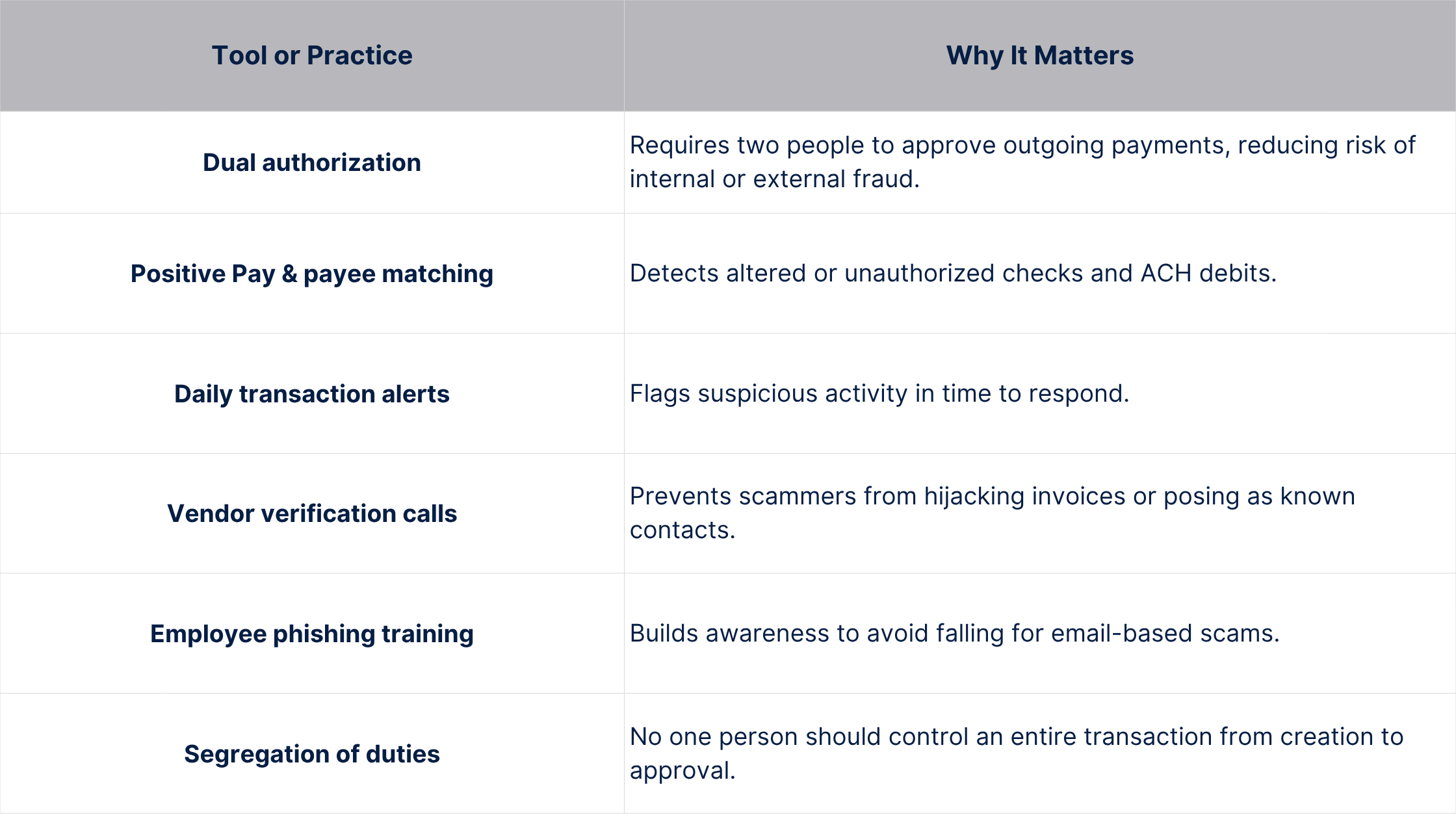
Surety Bank offers many of these solutions through our Treasury team, and we can help tailor them to your specific operations.
Even with great controls, no system is bulletproof. If fraud strikes, your response will determine how much damage your reputation takes—and how quickly you can recover.
In the first 72 hours:
In the weeks that follow:
This fictitious business was lucky—it survived. But the lesson is clear: fraud isn’t just a financial risk, it’s a reputational one. And once trust is broken, it takes time, strategy, and transparency to win it back.
At Surety Bank, we help businesses of all sizes protect their operations from fraud. Whether you need payment controls, alert systems, or a plan for what to do in a crisis, our Treasury & Fraud Prevention Team is here to help.

In the Summer 2025 issue of Building Central Florida Magazine, Surety Bank’s CEO Ryan James maps out a playbook for contractors battling the tariff-driven spikes in steel, aluminum, and other construction staples. James urges firms to replace one-job-at-a-time budgeting with rolling, company-wide cash-flow forecasts; to negotiate for delivery and payment flexibility; to lock in contingency capital before trouble hits; and to embed escalation clauses that keep margins intact—all while maintaining proactive, transparent communication with clients.
Read the full article on page 17:
Building Through the Turbulence – Building Central Florida Magazine

It’s easy to assume that in a digital world, check fraud is a thing of the past. But the reality is quite the opposite. In 2023 alone, check fraud losses in the Americas totaled a staggering $21 billion—representing 80% of all global check fraud cases. Despite a steady decline in the use of checks, fraudsters are doubling down on a still-vulnerable payment channel.
So what happens when a check your business issued ends up in the wrong hands?
Let’s say you wrote a vendor check back in February. Today, that check suddenly clears—but it’s been altered or stolen. What’s your next move? Do you catch it in time? Will your bank reimburse the loss? If you’re like many business owners, you’d expect your bank to take care of it. But depending on the terms in your bank’s Deposit Agreement, you may only have 30 days from the date of your statement to report the fraud and recover those funds. And once that window closes, so may your chances of getting that money back.
At Surety Bank, we want our business clients to know that help exists—and it's called Positive Pay.
Positive Pay is a fraud prevention tool that verifies checks presented for payment against a list of checks you’ve actually issued. If the details don’t match, the bank flags the check and reaches out before funds are released.
It’s like having a security checkpoint for every check your business issues.
Here’s what fraud can really cost your business:
Surety Bank’s Positive Pay solution is designed to reduce those risks before they become losses. Instead of waiting for fraud to strike, it gives business owners a chance to act first.
Most business owners don’t have the luxury of watching every check line item on their bank statement. Positive Pay works in the background—quietly checking, flagging, and helping you intercept fraud before it’s too late.
By offering this service, we’re not just protecting your account—we’re protecting your time, your reputation, and your peace of mind.
Check fraud isn’t going away. But your exposure to it can.
If you’re still issuing paper checks, it’s time to ask yourself: How am I protecting my business from check fraud? At Surety Bank, we’re ready to help you find the answer.
Reach out to our Treasury Management team to learn how Positive Pay can fit into your fraud prevention strategy.

Paper checks may feel old-school, yet they remain the easiest gateway for thieves. The U.S. Treasury reports that check-fraud suspicious-activity filings have climbed 385 percent since the pandemic, while 63 percent of companies faced attempted or actual check fraud in 2024, according to the Association for Financial Professionals’ 2025 survey.occ.govafponline.org Those numbers tell a blunt story: even as businesses adopt ACH and virtual cards, the humble check still opens a back door to five- and six-figure losses.
The phone lit up in the back office of Sunshine Custom Cabinets on a Thursday afternoon.
Co-owner Angela Moreno glanced at the caller ID from her bank and expected a routine wire inquiry. Instead she heard:
“Ms. Moreno, six checks just cleared your account for almost ten thousand dollars each. Can you confirm them?”
Angela had mailed only three checks that week, none over $4,500. Somewhere between the post-office drop box and her suppliers’ lockboxes, thieves had “washed” the envelopes, bleached the ink, and rewritten the checks for a cool $59,821.32—wiping out two payroll cycles in minutes.
The next 48 hours blurred into police reports, fraud affidavits, and tense conversations with employees wondering if Friday’s pay would arrive. The bank eventually credited most of the money, but cash flow froze for nearly a month, and the team sank forty billable hours into cleaning up—a cost no insurance policy reimbursed.
Check fraud has morphed from fax-era nuisance to organized, AI-enhanced side hustle. The good news: consistent, unglamorous discipline—secure mailing, rapid reconciliation, and an automated pre-clearance layer—sends fraudsters looking for softer targets. Angela calls that Thursday “the most expensive lesson I never budgeted for.” Tighten your routine today, and you won’t need the same wake-up call.
Need a practical walkthrough of daily controls—minus the jargon? Talk with our Treasury Management team about fitting these layers to your workflow before your next envelope hits the mail.

As more banking moves online, security has become just as important as convenience. Whether you’re checking a personal account or managing company finances, your computer habits play a critical role in keeping your information safe. A few consistent practices can greatly reduce your risk of fraud and protect sensitive data.
Malware can capture keystrokes, steal login credentials, and access personal files without you realizing it. To stay protected:
Make full use of the security tools your devices and bank provide:
Closing your browser window isn’t enough to end your session.
Browsers can store sensitive information like login pages or cached credentials. To protect yourself:
Phishing emails and fraudulent pop-ups can trick you into giving away banking information. Watch for:
Best practice: Always access your bank by typing the official web address directly into your browser, never through email or ad links.
Businesses face higher risks, so proactive steps are essential:
Online banking can be safe and reliable when paired with good cybersecurity habits. By:
…you can protect both your finances and your peace of mind.
The key is consistency. Security isn’t a one-time task—it’s a set of habits built into your everyday banking routine. Taking these steps ensures your accounts remain secure, your sensitive information stays private, and you can manage your finances confidently, whether personally or for your business.

In the heart of downtown, amidst the vibrant pulse of local eateries and community events, there’s a name that keeps coming up: Chef Nora. If you’ve dined at De La Vega, you’ve likely experienced her artistry on a plate. But beyond the signature flavors and culinary finesse, there's a deeper, richer story — one of family, perseverance, and community love. And now, with her latest venture, Golden Meals, Chef Nora is cooking up something even more personal.
Chef Nora’s journey into the restaurant world began two decades ago when she and her family — her parents, brother, and sister — moved from New Mexico to Florida. They left behind everything familiar on the word of a family friend who saw promise in a vacant restaurant spot downtown.
With only a bit of restaurant experience between them, they leapt into entrepreneurship. “It wasn’t just a job,” Nora recalls. “I had already worked in restaurants. I realized what I really wanted was to have my own.” The family rallied around her dream — a move that not only shaped their livelihoods but also laid the groundwork for something bigger than any one of them could have imagined.
Their first venture was De La Vega — a name that not only carried their family heritage but symbolized their growing identity in the community. “We started with Tex-Mex,” Nora explained, “but quickly realized there were too many of those already. So we pivoted to something unique: Latin fusion with a tapas concept.”
It was a family effort from the start. Nora spearheaded the menu, crafting recipes with creativity and care, while her brother took on the general manager role. “It was our school,” she says. “Everything we’ve learned in the past 20 years, we learned by doing.”
Today, De La Vega is more than a restaurant — it’s a beloved local fixture. With loyal customers, an ever-evolving menu, and a consistent focus on flavor, it’s the kind of place that gets recommended again and again.
The concept for Golden Meals was born not in a commercial kitchen, but in Nora’s own home. “My dad was living in the senior apartments, and I used to make meals for him — healthy, ready to eat, so he didn’t have to cook.” After he passed away three years ago, Nora found herself talking to his neighbors — many of whom had similar needs. The idea began to take shape: a meal service designed to support seniors, promote wellness, and most importantly, taste amazing.
But what started as a personal project in memory of her father has grown into something with far wider impact.
While initially conceived as a service for seniors, Golden Meals quickly found a broader audience. “Everyone needs healthy food — busy moms, students, professionals,” Nora notes. “We realized this wasn’t just about one group. It’s for anyone who wants quick, affordable, and nutritious meals.”
When a deli inside a local natural market became available, the opportunity felt serendipitous. “Everything was ready — the kitchen, the space. We just had to bring the concept and the heart.”
Golden Meals officially opened its doors four months ago, operating weekdays from 11 a.m. to 3 p.m. It functions as both a grab-and-go cafe and a meal delivery service, offering flexible access for people with packed schedules or limited mobility. And yes — delivery is currently free.
Unlike De La Vega’s Latin fusion focus, Golden Meals is all about clean, fresh ingredients and variety. “We’re not tied to any one cuisine here. We can offer pasta, Asian dishes, vegan options — whatever inspires us and serves our community.”
Everything is made in-house, from scratch. Think: vibrant green beans sautéed with garlic and olive oil, sweet potatoes roasted to perfection, and macaroni salad that’s light but packed with flavor. Sodium and sugar are kept low; flavor is boosted with herbs and spices, not additives.
“We don’t want ‘healthy’ to mean boring,” Nora laughs. “You can eat well and still love every bite.”
Why the name Golden Meals? It’s a tribute to Nora’s father and the community he was part of. “It started with the idea of serving those in their golden years,” she says. “But now it means meals that are golden in quality, golden in purpose. Meals that make you feel good.”
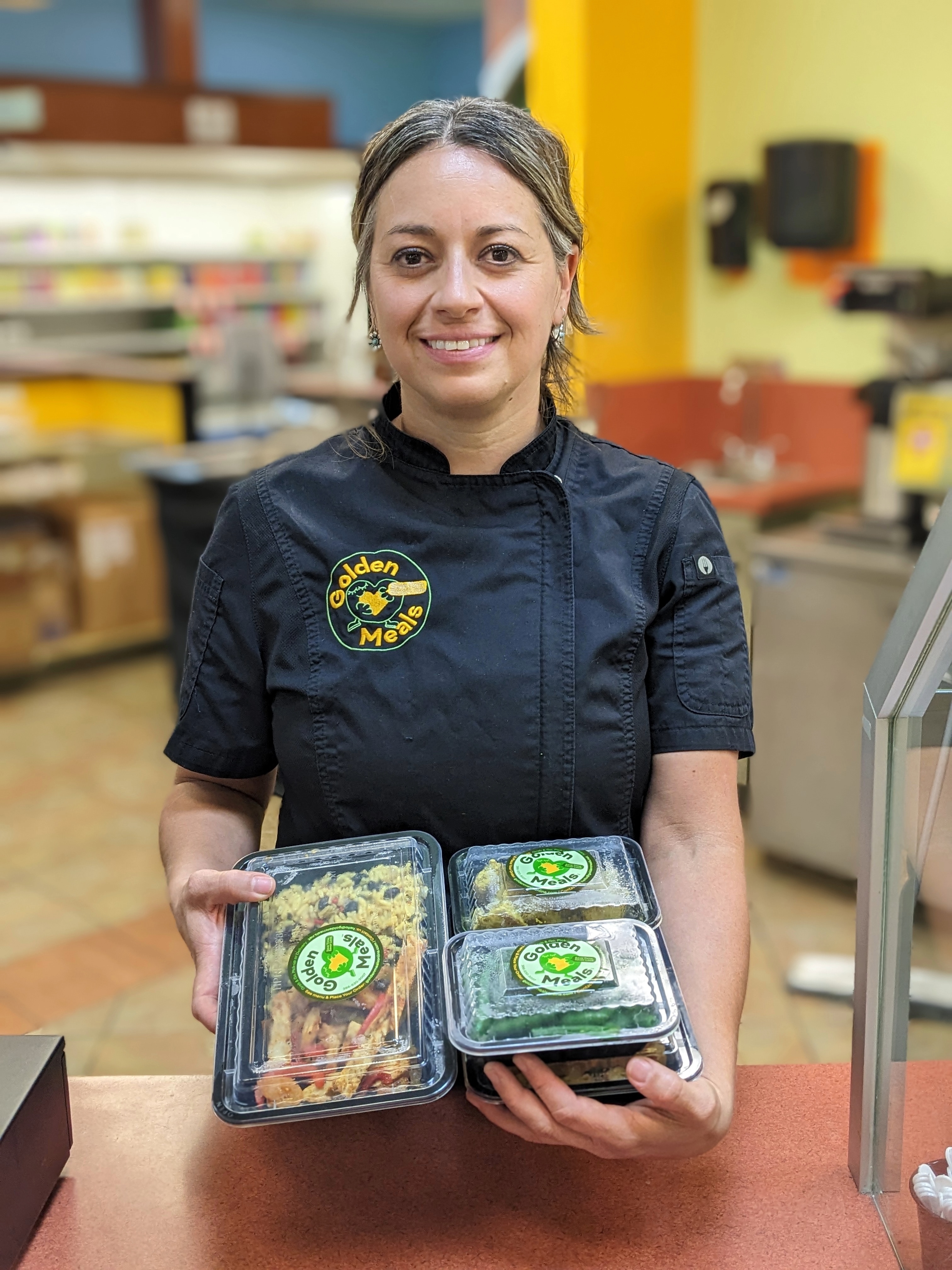
Nora doesn’t shy away from talking about the hurdles. “The recession in 2008 hit us hard,” she remembers. “We had to get creative - package deals, specials, anything to bring people in.” Then came the hurricanes, five in their first year in Florida. And of course, COVID lockdown.
“That was one of the toughest. We had no staff. It was just me, my brother, my nephew, my niece. We were cooking, cleaning, delivering — everything. But we made it. That’s what matters.”
For other small business owners, she offers a simple but powerful reminder: “You just keep going. You pivot, you adapt, you lean on your family and your community. And you never lose sight of why you started.”
📍 Located inside the Natural Market
🕚 Open Monday–Friday, 11 AM to 3 PM
📱 Order online or through the Golden Meals app
🚚 Free delivery available for local orders
Whether you're a parent looking for healthier alternatives, a student in need of quick fuel, or a senior seeking convenient meals that actually taste good — Golden Meals has something on the menu for you.
For Richard Taylor, Surety Bank has never simply been a place to bank. It has been part of his family and his community for generations.
His grandfather, Dr. Harold Taylor, served on Surety’s board and became president during a challenging period in the institution’s early history. His father later served as Surety’s attorney and on its Board of Directors. Richard’s own relationship with the bank began when he was a child.
“My earliest memory was at 110 North Florida,” Richard recalls. He believes that as soon as he was old enough to walk into Surety, he was bringing in a dime to start an account.
After leaving the Marine Corps in 1977, Richard eventually continued the family tradition by joining Surety’s Board of Directors himself.
His story provides a unique window into Surety Bank’s first 100 years and the principles that have allowed a local institution to continue serving its community through generations of change.
Surety was formed in 1926 as a mutual building and loan association, owned by its depositors and borrowers rather than traditional shareholders.
It wasn’t long before the young institution faced a major test.
Florida’s real estate boom collapsed before the Great Depression spread across the country. Richard grew up hearing stories about the banks around DeLand that failed during those difficult years. Surety, however, kept its doors open.
Richard believes the reason came down to the way Surety treated people.
“The reason it didn’t fold is because of two reasons. One, it was able to reason with the depositors and, two, because it acted reasonably with the borrowers.”
Instead of immediately turning to foreclosure when borrowers struggled, Richard says Surety did everything it could to work with them. At the same time, its leaders worked to maintain the confidence of depositors. That careful, personal approach helped Surety navigate one of the most difficult periods in American financial history without shutting down.
The story may be nearly a century old, but the philosophy behind it feels familiar: know the people you serve and be willing to work with them when it matters.
When Richard later joined the board, that personal knowledge of customers and the community was still an important part of how Surety operated.
He remembers sitting alongside directors who seemed to know the history behind nearly every property and family that came before them. When the bank considered making a loan, board members could personally visit the property, research comparable sales, and bring their own knowledge of the local market into the conversation.
For customers, it meant decisions were being made by people who understood the community.
“If you had a problem, you had somebody that you could go sit down across a desk and then talk to them about it.”
That ability to have a real conversation with the people behind your bank is something Richard remembers as an important part of Surety’s contribution to the community.
A lot has changed since those early days.
Richard remembers when customers carried physical books that recorded their payments and Surety used a large hand-operated calculating machine to figure interest. Today, technology has transformed nearly every part of the banking experience.
Surety has evolved with the industry. What began primarily as a building and loan association focused on residential homes has grown into a bank serving businesses and developing expertise in specialized areas of banking.
Richard describes that evolution as cautious, and that distinction is important.
Surety has continued to change without losing sight of what made it successful in the first place.
That perspective fits naturally with Surety Bank’s centennial message: “How we’ve always done it is how we’ll always do it.”
In many organizations, “how we’ve always done it” can imply a resistance to change. Surety’s history tells a different story. The tools have changed. The services have expanded. The way customers interact with their bank has evolved.
But the commitment to being thoughtful about how the bank grows and remaining connected to the people it serves has endured.
After all the changes Richard has witnessed, one characteristic stands out when he talks about what makes Surety different today.
“We are truly a local bank.”
For Richard, there is a difference between being called a community bank and actually being part of the community.
Surety’s roots are here. Its history is here. And generations of the people behind the bank have lived and worked alongside the customers they serve.
Richard describes Surety not only as a community bank, but as a community institution.
That connection has carried Surety through enormous changes in banking and in the community itself. Richard remembers a time when Surety did not need much advertising because local people already knew where to go when they needed a reliable place to borrow or deposit their money. Decades later, customers have more banking options than ever, but Surety continues to move steadily forward without chasing every passing trend.
Richard has seen Surety Bank move from passbooks and hand-operated calculators to modern banking. He has watched the institution expand beyond its original focus while continuing to take a careful approach to growth.
And when asked whether a bank that has already been here for 100 years can make it another 100, Richard sees no reason why it can’t.
That confidence comes from knowing where Surety has been.
For a century, the bank has adapted when necessary while holding onto the qualities that have carried it through generations: local roots, thoughtful decisions, and a commitment to the people it serves.
Richard Taylor’s family has been part of that story for generations, and his memories offer a rare look at just how much has changed since 1926.
They also show how much hasn’t.
That is the legacy of Surety Bank.
For Dan Glenn, Pastor of Stetson Baptist Church in DeLand, Surety Bank has become much more than the place where the church did its banking. Over the years, the initial banking relationship has grown into a partnership centered around a shared commitment to the community.
That partnership took on new meaning in 2018 when Stetson Baptist Church launched Night to Shine, an unforgettable prom experience for people with special needs held in partnership with the Tim Tebow Foundation.
Creating an experience like Night to Shine requires significant support, and Surety Bank was one of the event's earliest sponsors.
“Surety was one that came on very early saying, ‘Hey, we want to support that. We want to be a part of it.’”
For Dan, that moment marked a shift in the relationship. It became much more personal and community focused.
Surety continued supporting Night to Shine year after year, but one experience in particular showed Dan what that partnership truly meant.
After the first Night to Shine, Dan realized the church had never properly thanked Surety for its sponsorship. When it came time to plan the event again, he felt hesitant approaching Surety for another year of support.
The response surprised him.
There was no hesitation. Surety wanted to be involved again.
Years later, that commitment went even further when Surety reached out to the church without being asked and offered to increase its support.
“They have an intention to be generous, even when generosity may or may not be expected or requested.”
For Dan, that willingness to look for opportunities to make a greater impact is part of what distinguishes Surety Bank as a community organization.
Instead of simply waiting for someone to present a sponsorship request, Surety has been willing to ask a different question: How can we do more?
That philosophy extends beyond a single event.
Dan describes Surety not simply as a community bank, but as a “community-centered organization” that genuinely cares about DeLand and the relationships it has built throughout the city.
That personal connection is something Dan has experienced firsthand. His relationship with Surety isn't limited to the organization itself. It's also built through relationships with the people behind it.
As Surety Bank celebrates 100 years, Dan believes that commitment to people and community helps explain why the bank has remained part of DeLand for generations.
Over the past century, both the bank and the city have grown and changed. Yet Surety has continued to serve the community throughout that growth.
For Dan, that's exactly why Surety's 100th anniversary message, “How we've always done it is how we'll always do it,” resonates.
“The way they've always done things has been people centered, relationships centered, community centered.”
Those values create something that goes beyond banking. They create trust. They allow organizations like Stetson Baptist Church to know what to expect from a partner that has consistently shown up before and intends to continue showing up in the future.
After years of partnership, Dan hopes that part of Surety never changes.
This is how Surety Bank has always done it. It's how we will always do it.
For Austin Scott, starting a business wasn’t the result of a lifelong plan. It was something that grew over time, much like the lawns he now helps his customers care for.
Born and raised in DeLand, Austin is the owner of Coastal Green Pest Solutions, a new Volusia County business specializing in lawn treatments, pest management, fertilization, and the care of palms and shrubs.
The company may be new, but Austin is far from new to the work.
Before entering the lawn and pest control industry, Austin was selling auto parts at O’Reilly Auto Parts. Then a landscaper friend suggested he take a job with a local pest control company.
He gave it a shot and discovered an industry that fascinated him.
“I like that I could learn something new every day,” Austin says. “You get to see different problems, and you get to see the benefits of your own labor making a lawn beautiful. You get to see it go from nothing to something.”
Austin spent nearly six years in the industry, gradually developing an understanding of not only what products to use, but why lawns develop problems in the first place.
Interestingly, the work even gave him a new appreciation for a subject he once struggled with: chemistry.
In school, chemistry had never come naturally to Austin. But working with fertilizers, herbicides, insecticides, fungicides, and nutrients gave those concepts a real-world application.
“You get to learn something and then apply it directly,” he says.
And the more Austin learned, the more he realized there was an opportunity to do things differently.
Austin believes one of the biggest shortcomings in the lawn and pest control industry isn't necessarily the products or treatment programs companies use. It's the communication that happens, or doesn't happen, between the company, technician, and homeowner.
A lawn problem can be the result of insects, fungus, nutrient deficiencies, irrigation issues, environmental stress, or a combination of factors. Simply treating the symptom doesn't always solve the underlying problem.
Austin wants Coastal Green Pest Solutions to be different.
“I take pride in being the solution and the end to the revolving door when it comes to these lawn programs,” he says.
That means spending time with homeowners, explaining what is happening on their property, and helping them understand what needs to change.
Austin compares a lawn or landscape to the human body. One problem can affect the health of the entire system. Killing an insect, for example, may address the immediate issue, but it doesn't necessarily explain why the lawn became susceptible to the pest in the first place.
“If you can be the middleman between the problem, the chemicals, and the customer, and you can explain all that smoothly, that's normally the end,” Austin says. “A lot of people don't take the time to talk to their customers and make sure they understand.”
It's an approach built around education and relationships as much as treatment.
When the company Austin had worked for was sold, he saw an opportunity to take everything he'd learned and build something of his own.
Coastal Green Pest Solutions was born.
Today, Austin primarily works with residential customers throughout Volusia County who care about the long-term health and appearance of their properties.
His services include:
Austin's philosophy isn't about simply “spraying and praying,” as he puts it. Every property is different, so understanding what's actually happening comes before recommending a solution.
That philosophy also shapes how he plans to grow the business.
Starting a company requires more than expertise and ambition. There are trucks, equipment, products, operating expenses, and the reality that revenue doesn't necessarily arrive the moment the business opens its doors.
Austin knew he needed some financial breathing room as he got Coastal Green Pest Solutions off the ground.
That's where Surety Bank came in.
Austin first learned about Surety through his father, who had worked in real estate and developed a relationship with Surety Bank CEO Ryan James over the years.
When Austin was preparing to launch Coastal Green Pest Solutions, that local connection opened the door to a conversation.
“I was just looking for a good little loan—something to get me by, that way I had a little bit of breathing room,” Austin says. “I was very questionable on how I was going to make everything work, and honestly, I'm very grateful for Surety stepping in.”
Surety provided a business loan directly to Coastal Green Pest Solutions, giving Austin additional resources and flexibility during the critical early months of building the company.
For Austin, the experience demonstrated one of the advantages of working with a community bank: relationships matter.
Ryan knew Austin's family. He'd seen Austin working around town. And instead of Austin simply being another application, there was an opportunity to understand the person and business behind it.
That trust helped a local entrepreneur take the next step.
Just a couple of months into the business when we spoke with him, Austin already had big ambitions for Coastal Green Pest Solutions.
Eventually, he'd like to have multiple trucks on the road, a dedicated irrigation team, a sales team, and expanded services including home pest and termite control.
But he's in no hurry to grow simply for the sake of getting bigger.
Austin wants to make sure the service and customer experience that distinguish Coastal Green today remain intact as the company expands.
“If I'm not taking the time to personalize your service and making sure that I'm putting down what I'm promising, then there's no point in me opening up the next step,” he says.
He describes his philosophy simply as “natural growth or no growth.”
It's an especially fitting philosophy for someone who spends his days helping things grow.
For now, Austin is focused on building relationships, earning the trust of homeowners and landscapers throughout Volusia County, and developing Coastal Green one customer at a time.
And he's doing it in the community he has always called home.
“I still enjoy the small-town aspect of DeLand,” Austin says. “Raising a family here, having good friends here, it's very nice. DeLand's a good home base.”
As DeLand and Volusia County continue to grow, Austin hopes Coastal Green Pest Solutions will grow right alongside them, without losing the personal relationships that helped get the business started in the first place.
Coastal Green Pest Solutions serves homeowners throughout Volusia County. For homeowners who care about the health and appearance of their lawn and landscaping, Austin and Coastal Green provide personalized lawn treatment, pest management, fertilization, and plant health solutions.
Personal fraud continues to evolve, and scammers are finding increasingly sophisticated ways to target consumers. From AI-powered messages that appear surprisingly convincing to attempts to gain access to entire financial accounts. Recognizing the warning signs is becoming more important than ever.
While you can't prevent every fraud attempt, knowing what to watch for and taking a few proactive steps can make it much harder for scammers to succeed.
Artificial intelligence is making fraudulent calls and text messages feel more personal and legitimate. Scammers can use AI to create convincing communications designed to make you believe you're interacting with a trusted person or organization.
Be cautious when you receive an unexpected call or message asking for personal information, money, or access to an account. Before responding or taking action, reach out to Surety Bank directly to verify they are the ones calling. This step could mean not being scammed out of your money.
Fraudsters are increasingly looking beyond individual credit card numbers and attempting to gain access to entire financial profiles, including personal bank and investment accounts.
Protect your accounts by regularly reviewing activity for transactions you don't recognize and using multifactor authentication whenever it's available. Never provide your password, login credentials, or verification codes to someone who contacts you unexpectedly.
If you notice something unusual in your Surety Bank account, contact us promptly.
Older adults continue to be frequent targets of financial scams, particularly those involving tech support and investment-related schemes.
These scams often rely on urgency or fear to convince someone to act before they have an opportunity to question what's happening. Talk with older family members about common scams and encourage them to check with someone they trust before sending money or providing sensitive information in response to an unexpected request.
Taking a few minutes to verify a situation can help prevent a significant financial loss.
Protecting yourself doesn't require becoming a fraud expert. Start by being skeptical of unexpected requests for money or information, especially when someone pressures you to act immediately.
Use strong, unique passwords and enable multifactor authentication when available. Avoid clicking links in unexpected emails or text messages, and regularly review your bank accounts and credit reports for activity you don't recognize.
Most importantly, trust your instincts. If something doesn't feel right, stop and verify before taking action.
If you'd like to take additional steps to protect yourself, here are three resources worth exploring:
FTC IdentityTheft.gov
Best for someone who thinks their identity has already been compromised. The FTC provides a personalized recovery plan and steps for addressing identity theft.
Visit IdentityTheft.gov
FTC Credit Freeze & Fraud Alert Guide
Customers can place a free credit freeze, which can prevent identity thieves from opening new credit accounts in their name, or add a fraud alert.
Learn About Credit Freezes & Fraud Alerts
Aura
For those interested in a paid protection service, Aura offers identity and financial monitoring tools and other fraud-protection features. I’d position this as an optional third-party tool, not something Surety is recommending over other services.
Explore Aura
These resources are provided for informational purposes. Surety Bank does not endorse or guarantee any third-party product or service.
Fraud tactics will continue to change, but one of your strongest defenses is also one of the simplest: slow down.
Scammers often depend on creating urgency so you act before thinking. If you're unsure about a request involving your Surety Bank account, don't rely on the phone number, link, or contact information provided in the message. Contact Surety Bank directly through a trusted channel.
We're here to help you protect your financial information and recognize potential fraud before it becomes a loss.
For Maria Bonfiglio, working at Surety Bank has always been about more than banking. It's about taking care of people.
Maria has been part of the Surety Bank family for nine years, but her journey began with a simple text message. A former boss she had stayed in touch with reached out years after they had worked together and told her, "I have the perfect job for you." Maria's response was simple: "Where should I sign?"
Nine years later, her enthusiasm hasn't changed.
"I love it. I love my job."
Over the years, Maria's role has evolved, giving her the opportunity to learn new skills and develop deeper relationships with customers. She has gotten to know some of them so well that she can recognize who is calling just by the sound of their voice. For Maria, those relationships are what make Surety feel less like a workplace and more like a family.
That personal connection also shapes the way Maria approaches protecting customers.
When something doesn't seem right, she isn't afraid to ask questions. Whether she's reviewing a check or helping someone resolve an issue with an account, Maria understands that taking a little extra time can make a significant difference.
"We really care about our customers," Maria explains. Even when customers may wonder why the bank is asking additional questions, she wants them to understand the reason behind it. "We don't want them to lose money."
For Maria, that care isn't limited to customers. She has experienced it personally as an employee.
During some of the most difficult moments of her life, including an extended hospital stay and the loss of her son, Maria remembers her Surety family checking on her, visiting her, and making sure she knew she wasn't alone. Those experiences showed her that the relationships Surety talks about aren't simply something customers experience. They're part of the culture inside the bank, too.
It's also why Maria believes Surety Bank has remained part of the community for 100 years. She has worked at other banks, but says Surety's involvement in the community feels different. The bank isn't trying to be the biggest. Instead, it has remained focused on the people and communities it serves.
That same philosophy comes through in Maria's relationships with her customers. Some have developed such a strong connection with her that when they call, they specifically ask for Maria. She takes pride in being someone they know they can turn to when they have a question or need assistance.
After nine years, Maria still says thank you for the opportunity that brought her to Surety Bank. Her story is a reminder that relationship banking begins with people who genuinely care about the people on the other side of the counter or phone.
This is how Surety Bank has always done it. It's how we will always do it.
For Lewis Long III, banking with Surety Bank is a relationship that has lasted more than five decades.
As one of Surety Bank's longest-standing customers, Lewis has watched the bank grow alongside the community since his connection to Surety began more than 50 years ago. He originally opened a savings account after hearing from neighbors that the bank consistently offered strong value and genuinely cared about its customers.
Over the years, Lewis has seen a lot of change. He remembers making deposits with a passbook while employees manually updated balances using a hand-cranked adding machine. What hasn't changed, however, is the way Surety Bank treats the people who walk through its doors.
For Lewis, that commitment extends beyond his own banking experience. When his sons were born, he opened accounts for each of them at Surety Bank, continuing a family tradition that has now spanned generations. One of his sons even participated in the ribbon-cutting ceremony when Surety Bank dedicated its current building in the early 1990s.
Throughout his life of military service, public service, and community involvement, Lewis has always returned to the same bank.
What has kept him loyal all these years?
The answer is simple: people.
"You couldn't ask for better service or better people," Lewis says. "I don't know how they remember everybody's name that walks in the door, but they do. They're just super folks. The people have always been a gift to us and to the community."
Lewis believes that the values Surety Bank was founded on continue to define the bank today. One story from the bank's early history has always stayed with him. During the Great Depression, he recalls hearing that Surety worked with customers rather than rushing to foreclose on them because they cared more about helping people than taking their property. That philosophy, he says, is still reflected in the way the bank serves its customers today.
It's one of the reasons Lewis has become an advocate for the bank wherever he goes.
Whether he's encouraging friends to open a money market account, sharing the bank's history, or even suggesting a new Surety branch for his hometown of Lake Helen, Lewis proudly recommends the bank he's trusted for more than half a century.
"I wouldn't champion the bank if I didn't believe in these folks and believe in this bank," he says. "Everybody is important. They see past whatever's bothering someone that day and still treat people with kindness and respect."
As Surety Bank celebrates 100 years of serving Central Florida, customers like Lewis remind us that while banking has evolved, some things should never change. Genuine relationships, exceptional service, and a commitment to the community remain at the heart of everything we do.
This is how Surety Bank has always done it. It's how we will always do it.
For Richard Taylor, Surety Bank has never simply been a place to bank. It has been part of his family and his community for generations.
His grandfather, Dr. Harold Taylor, served on Surety’s board and became president during a challenging period in the institution’s early history. His father later served as Surety’s attorney and on its Board of Directors. Richard’s own relationship with the bank began when he was a child.
“My earliest memory was at 110 North Florida,” Richard recalls. He believes that as soon as he was old enough to walk into Surety, he was bringing in a dime to start an account.
After leaving the Marine Corps in 1977, Richard eventually continued the family tradition by joining Surety’s Board of Directors himself.
His story provides a unique window into Surety Bank’s first 100 years and the principles that have allowed a local institution to continue serving its community through generations of change.
Surety was formed in 1926 as a mutual building and loan association, owned by its depositors and borrowers rather than traditional shareholders.
It wasn’t long before the young institution faced a major test.
Florida’s real estate boom collapsed before the Great Depression spread across the country. Richard grew up hearing stories about the banks around DeLand that failed during those difficult years. Surety, however, kept its doors open.
Richard believes the reason came down to the way Surety treated people.
“The reason it didn’t fold is because of two reasons. One, it was able to reason with the depositors and, two, because it acted reasonably with the borrowers.”
Instead of immediately turning to foreclosure when borrowers struggled, Richard says Surety did everything it could to work with them. At the same time, its leaders worked to maintain the confidence of depositors. That careful, personal approach helped Surety navigate one of the most difficult periods in American financial history without shutting down.
The story may be nearly a century old, but the philosophy behind it feels familiar: know the people you serve and be willing to work with them when it matters.
When Richard later joined the board, that personal knowledge of customers and the community was still an important part of how Surety operated.
He remembers sitting alongside directors who seemed to know the history behind nearly every property and family that came before them. When the bank considered making a loan, board members could personally visit the property, research comparable sales, and bring their own knowledge of the local market into the conversation.
For customers, it meant decisions were being made by people who understood the community.
“If you had a problem, you had somebody that you could go sit down across a desk and then talk to them about it.”
That ability to have a real conversation with the people behind your bank is something Richard remembers as an important part of Surety’s contribution to the community.
A lot has changed since those early days.
Richard remembers when customers carried physical books that recorded their payments and Surety used a large hand-operated calculating machine to figure interest. Today, technology has transformed nearly every part of the banking experience.
Surety has evolved with the industry. What began primarily as a building and loan association focused on residential homes has grown into a bank serving businesses and developing expertise in specialized areas of banking.
Richard describes that evolution as cautious, and that distinction is important.
Surety has continued to change without losing sight of what made it successful in the first place.
That perspective fits naturally with Surety Bank’s centennial message: “How we’ve always done it is how we’ll always do it.”
In many organizations, “how we’ve always done it” can imply a resistance to change. Surety’s history tells a different story. The tools have changed. The services have expanded. The way customers interact with their bank has evolved.
But the commitment to being thoughtful about how the bank grows and remaining connected to the people it serves has endured.
After all the changes Richard has witnessed, one characteristic stands out when he talks about what makes Surety different today.
“We are truly a local bank.”
For Richard, there is a difference between being called a community bank and actually being part of the community.
Surety’s roots are here. Its history is here. And generations of the people behind the bank have lived and worked alongside the customers they serve.
Richard describes Surety not only as a community bank, but as a community institution.
That connection has carried Surety through enormous changes in banking and in the community itself. Richard remembers a time when Surety did not need much advertising because local people already knew where to go when they needed a reliable place to borrow or deposit their money. Decades later, customers have more banking options than ever, but Surety continues to move steadily forward without chasing every passing trend.
Richard has seen Surety Bank move from passbooks and hand-operated calculators to modern banking. He has watched the institution expand beyond its original focus while continuing to take a careful approach to growth.
And when asked whether a bank that has already been here for 100 years can make it another 100, Richard sees no reason why it can’t.
That confidence comes from knowing where Surety has been.
For a century, the bank has adapted when necessary while holding onto the qualities that have carried it through generations: local roots, thoughtful decisions, and a commitment to the people it serves.
Richard Taylor’s family has been part of that story for generations, and his memories offer a rare look at just how much has changed since 1926.
They also show how much hasn’t.
That is the legacy of Surety Bank.
For Dan Glenn, Pastor of Stetson Baptist Church in DeLand, Surety Bank has become much more than the place where the church did its banking. Over the years, the initial banking relationship has grown into a partnership centered around a shared commitment to the community.
That partnership took on new meaning in 2018 when Stetson Baptist Church launched Night to Shine, an unforgettable prom experience for people with special needs held in partnership with the Tim Tebow Foundation.
Creating an experience like Night to Shine requires significant support, and Surety Bank was one of the event's earliest sponsors.
“Surety was one that came on very early saying, ‘Hey, we want to support that. We want to be a part of it.’”
For Dan, that moment marked a shift in the relationship. It became much more personal and community focused.
Surety continued supporting Night to Shine year after year, but one experience in particular showed Dan what that partnership truly meant.
After the first Night to Shine, Dan realized the church had never properly thanked Surety for its sponsorship. When it came time to plan the event again, he felt hesitant approaching Surety for another year of support.
The response surprised him.
There was no hesitation. Surety wanted to be involved again.
Years later, that commitment went even further when Surety reached out to the church without being asked and offered to increase its support.
“They have an intention to be generous, even when generosity may or may not be expected or requested.”
For Dan, that willingness to look for opportunities to make a greater impact is part of what distinguishes Surety Bank as a community organization.
Instead of simply waiting for someone to present a sponsorship request, Surety has been willing to ask a different question: How can we do more?
That philosophy extends beyond a single event.
Dan describes Surety not simply as a community bank, but as a “community-centered organization” that genuinely cares about DeLand and the relationships it has built throughout the city.
That personal connection is something Dan has experienced firsthand. His relationship with Surety isn't limited to the organization itself. It's also built through relationships with the people behind it.
As Surety Bank celebrates 100 years, Dan believes that commitment to people and community helps explain why the bank has remained part of DeLand for generations.
Over the past century, both the bank and the city have grown and changed. Yet Surety has continued to serve the community throughout that growth.
For Dan, that's exactly why Surety's 100th anniversary message, “How we've always done it is how we'll always do it,” resonates.
“The way they've always done things has been people centered, relationships centered, community centered.”
Those values create something that goes beyond banking. They create trust. They allow organizations like Stetson Baptist Church to know what to expect from a partner that has consistently shown up before and intends to continue showing up in the future.
After years of partnership, Dan hopes that part of Surety never changes.
This is how Surety Bank has always done it. It's how we will always do it.
For Austin Scott, starting a business wasn’t the result of a lifelong plan. It was something that grew over time, much like the lawns he now helps his customers care for.
Born and raised in DeLand, Austin is the owner of Coastal Green Pest Solutions, a new Volusia County business specializing in lawn treatments, pest management, fertilization, and the care of palms and shrubs.
The company may be new, but Austin is far from new to the work.
Before entering the lawn and pest control industry, Austin was selling auto parts at O’Reilly Auto Parts. Then a landscaper friend suggested he take a job with a local pest control company.
He gave it a shot and discovered an industry that fascinated him.
“I like that I could learn something new every day,” Austin says. “You get to see different problems, and you get to see the benefits of your own labor making a lawn beautiful. You get to see it go from nothing to something.”
Austin spent nearly six years in the industry, gradually developing an understanding of not only what products to use, but why lawns develop problems in the first place.
Interestingly, the work even gave him a new appreciation for a subject he once struggled with: chemistry.
In school, chemistry had never come naturally to Austin. But working with fertilizers, herbicides, insecticides, fungicides, and nutrients gave those concepts a real-world application.
“You get to learn something and then apply it directly,” he says.
And the more Austin learned, the more he realized there was an opportunity to do things differently.
Austin believes one of the biggest shortcomings in the lawn and pest control industry isn't necessarily the products or treatment programs companies use. It's the communication that happens, or doesn't happen, between the company, technician, and homeowner.
A lawn problem can be the result of insects, fungus, nutrient deficiencies, irrigation issues, environmental stress, or a combination of factors. Simply treating the symptom doesn't always solve the underlying problem.
Austin wants Coastal Green Pest Solutions to be different.
“I take pride in being the solution and the end to the revolving door when it comes to these lawn programs,” he says.
That means spending time with homeowners, explaining what is happening on their property, and helping them understand what needs to change.
Austin compares a lawn or landscape to the human body. One problem can affect the health of the entire system. Killing an insect, for example, may address the immediate issue, but it doesn't necessarily explain why the lawn became susceptible to the pest in the first place.
“If you can be the middleman between the problem, the chemicals, and the customer, and you can explain all that smoothly, that's normally the end,” Austin says. “A lot of people don't take the time to talk to their customers and make sure they understand.”
It's an approach built around education and relationships as much as treatment.
When the company Austin had worked for was sold, he saw an opportunity to take everything he'd learned and build something of his own.
Coastal Green Pest Solutions was born.
Today, Austin primarily works with residential customers throughout Volusia County who care about the long-term health and appearance of their properties.
His services include:
Austin's philosophy isn't about simply “spraying and praying,” as he puts it. Every property is different, so understanding what's actually happening comes before recommending a solution.
That philosophy also shapes how he plans to grow the business.
Starting a company requires more than expertise and ambition. There are trucks, equipment, products, operating expenses, and the reality that revenue doesn't necessarily arrive the moment the business opens its doors.
Austin knew he needed some financial breathing room as he got Coastal Green Pest Solutions off the ground.
That's where Surety Bank came in.
Austin first learned about Surety through his father, who had worked in real estate and developed a relationship with Surety Bank CEO Ryan James over the years.
When Austin was preparing to launch Coastal Green Pest Solutions, that local connection opened the door to a conversation.
“I was just looking for a good little loan—something to get me by, that way I had a little bit of breathing room,” Austin says. “I was very questionable on how I was going to make everything work, and honestly, I'm very grateful for Surety stepping in.”
Surety provided a business loan directly to Coastal Green Pest Solutions, giving Austin additional resources and flexibility during the critical early months of building the company.
For Austin, the experience demonstrated one of the advantages of working with a community bank: relationships matter.
Ryan knew Austin's family. He'd seen Austin working around town. And instead of Austin simply being another application, there was an opportunity to understand the person and business behind it.
That trust helped a local entrepreneur take the next step.
Just a couple of months into the business when we spoke with him, Austin already had big ambitions for Coastal Green Pest Solutions.
Eventually, he'd like to have multiple trucks on the road, a dedicated irrigation team, a sales team, and expanded services including home pest and termite control.
But he's in no hurry to grow simply for the sake of getting bigger.
Austin wants to make sure the service and customer experience that distinguish Coastal Green today remain intact as the company expands.
“If I'm not taking the time to personalize your service and making sure that I'm putting down what I'm promising, then there's no point in me opening up the next step,” he says.
He describes his philosophy simply as “natural growth or no growth.”
It's an especially fitting philosophy for someone who spends his days helping things grow.
For now, Austin is focused on building relationships, earning the trust of homeowners and landscapers throughout Volusia County, and developing Coastal Green one customer at a time.
And he's doing it in the community he has always called home.
“I still enjoy the small-town aspect of DeLand,” Austin says. “Raising a family here, having good friends here, it's very nice. DeLand's a good home base.”
As DeLand and Volusia County continue to grow, Austin hopes Coastal Green Pest Solutions will grow right alongside them, without losing the personal relationships that helped get the business started in the first place.
Coastal Green Pest Solutions serves homeowners throughout Volusia County. For homeowners who care about the health and appearance of their lawn and landscaping, Austin and Coastal Green provide personalized lawn treatment, pest management, fertilization, and plant health solutions.
Personal fraud continues to evolve, and scammers are finding increasingly sophisticated ways to target consumers. From AI-powered messages that appear surprisingly convincing to attempts to gain access to entire financial accounts. Recognizing the warning signs is becoming more important than ever.
While you can't prevent every fraud attempt, knowing what to watch for and taking a few proactive steps can make it much harder for scammers to succeed.
Artificial intelligence is making fraudulent calls and text messages feel more personal and legitimate. Scammers can use AI to create convincing communications designed to make you believe you're interacting with a trusted person or organization.
Be cautious when you receive an unexpected call or message asking for personal information, money, or access to an account. Before responding or taking action, reach out to Surety Bank directly to verify they are the ones calling. This step could mean not being scammed out of your money.
Fraudsters are increasingly looking beyond individual credit card numbers and attempting to gain access to entire financial profiles, including personal bank and investment accounts.
Protect your accounts by regularly reviewing activity for transactions you don't recognize and using multifactor authentication whenever it's available. Never provide your password, login credentials, or verification codes to someone who contacts you unexpectedly.
If you notice something unusual in your Surety Bank account, contact us promptly.
Older adults continue to be frequent targets of financial scams, particularly those involving tech support and investment-related schemes.
These scams often rely on urgency or fear to convince someone to act before they have an opportunity to question what's happening. Talk with older family members about common scams and encourage them to check with someone they trust before sending money or providing sensitive information in response to an unexpected request.
Taking a few minutes to verify a situation can help prevent a significant financial loss.
Protecting yourself doesn't require becoming a fraud expert. Start by being skeptical of unexpected requests for money or information, especially when someone pressures you to act immediately.
Use strong, unique passwords and enable multifactor authentication when available. Avoid clicking links in unexpected emails or text messages, and regularly review your bank accounts and credit reports for activity you don't recognize.
Most importantly, trust your instincts. If something doesn't feel right, stop and verify before taking action.
If you'd like to take additional steps to protect yourself, here are three resources worth exploring:
FTC IdentityTheft.gov
Best for someone who thinks their identity has already been compromised. The FTC provides a personalized recovery plan and steps for addressing identity theft.
Visit IdentityTheft.gov
FTC Credit Freeze & Fraud Alert Guide
Customers can place a free credit freeze, which can prevent identity thieves from opening new credit accounts in their name, or add a fraud alert.
Learn About Credit Freezes & Fraud Alerts
Aura
For those interested in a paid protection service, Aura offers identity and financial monitoring tools and other fraud-protection features. I’d position this as an optional third-party tool, not something Surety is recommending over other services.
Explore Aura
These resources are provided for informational purposes. Surety Bank does not endorse or guarantee any third-party product or service.
Fraud tactics will continue to change, but one of your strongest defenses is also one of the simplest: slow down.
Scammers often depend on creating urgency so you act before thinking. If you're unsure about a request involving your Surety Bank account, don't rely on the phone number, link, or contact information provided in the message. Contact Surety Bank directly through a trusted channel.
We're here to help you protect your financial information and recognize potential fraud before it becomes a loss.
For Maria Bonfiglio, working at Surety Bank has always been about more than banking. It's about taking care of people.
Maria has been part of the Surety Bank family for nine years, but her journey began with a simple text message. A former boss she had stayed in touch with reached out years after they had worked together and told her, "I have the perfect job for you." Maria's response was simple: "Where should I sign?"
Nine years later, her enthusiasm hasn't changed.
"I love it. I love my job."
Over the years, Maria's role has evolved, giving her the opportunity to learn new skills and develop deeper relationships with customers. She has gotten to know some of them so well that she can recognize who is calling just by the sound of their voice. For Maria, those relationships are what make Surety feel less like a workplace and more like a family.
That personal connection also shapes the way Maria approaches protecting customers.
When something doesn't seem right, she isn't afraid to ask questions. Whether she's reviewing a check or helping someone resolve an issue with an account, Maria understands that taking a little extra time can make a significant difference.
"We really care about our customers," Maria explains. Even when customers may wonder why the bank is asking additional questions, she wants them to understand the reason behind it. "We don't want them to lose money."
For Maria, that care isn't limited to customers. She has experienced it personally as an employee.
During some of the most difficult moments of her life, including an extended hospital stay and the loss of her son, Maria remembers her Surety family checking on her, visiting her, and making sure she knew she wasn't alone. Those experiences showed her that the relationships Surety talks about aren't simply something customers experience. They're part of the culture inside the bank, too.
It's also why Maria believes Surety Bank has remained part of the community for 100 years. She has worked at other banks, but says Surety's involvement in the community feels different. The bank isn't trying to be the biggest. Instead, it has remained focused on the people and communities it serves.
That same philosophy comes through in Maria's relationships with her customers. Some have developed such a strong connection with her that when they call, they specifically ask for Maria. She takes pride in being someone they know they can turn to when they have a question or need assistance.
After nine years, Maria still says thank you for the opportunity that brought her to Surety Bank. Her story is a reminder that relationship banking begins with people who genuinely care about the people on the other side of the counter or phone.
This is how Surety Bank has always done it. It's how we will always do it.
For Lewis Long III, banking with Surety Bank is a relationship that has lasted more than five decades.
As one of Surety Bank's longest-standing customers, Lewis has watched the bank grow alongside the community since his connection to Surety began more than 50 years ago. He originally opened a savings account after hearing from neighbors that the bank consistently offered strong value and genuinely cared about its customers.
Over the years, Lewis has seen a lot of change. He remembers making deposits with a passbook while employees manually updated balances using a hand-cranked adding machine. What hasn't changed, however, is the way Surety Bank treats the people who walk through its doors.
For Lewis, that commitment extends beyond his own banking experience. When his sons were born, he opened accounts for each of them at Surety Bank, continuing a family tradition that has now spanned generations. One of his sons even participated in the ribbon-cutting ceremony when Surety Bank dedicated its current building in the early 1990s.
Throughout his life of military service, public service, and community involvement, Lewis has always returned to the same bank.
What has kept him loyal all these years?
The answer is simple: people.
"You couldn't ask for better service or better people," Lewis says. "I don't know how they remember everybody's name that walks in the door, but they do. They're just super folks. The people have always been a gift to us and to the community."
Lewis believes that the values Surety Bank was founded on continue to define the bank today. One story from the bank's early history has always stayed with him. During the Great Depression, he recalls hearing that Surety worked with customers rather than rushing to foreclose on them because they cared more about helping people than taking their property. That philosophy, he says, is still reflected in the way the bank serves its customers today.
It's one of the reasons Lewis has become an advocate for the bank wherever he goes.
Whether he's encouraging friends to open a money market account, sharing the bank's history, or even suggesting a new Surety branch for his hometown of Lake Helen, Lewis proudly recommends the bank he's trusted for more than half a century.
"I wouldn't champion the bank if I didn't believe in these folks and believe in this bank," he says. "Everybody is important. They see past whatever's bothering someone that day and still treat people with kindness and respect."
As Surety Bank celebrates 100 years of serving Central Florida, customers like Lewis remind us that while banking has evolved, some things should never change. Genuine relationships, exceptional service, and a commitment to the community remain at the heart of everything we do.
This is how Surety Bank has always done it. It's how we will always do it.
For Richard Taylor, Surety Bank has never simply been a place to bank. It has been part of his family and his community for generations.
His grandfather, Dr. Harold Taylor, served on Surety’s board and became president during a challenging period in the institution’s early history. His father later served as Surety’s attorney and on its Board of Directors. Richard’s own relationship with the bank began when he was a child.
“My earliest memory was at 110 North Florida,” Richard recalls. He believes that as soon as he was old enough to walk into Surety, he was bringing in a dime to start an account.
After leaving the Marine Corps in 1977, Richard eventually continued the family tradition by joining Surety’s Board of Directors himself.
His story provides a unique window into Surety Bank’s first 100 years and the principles that have allowed a local institution to continue serving its community through generations of change.
Surety was formed in 1926 as a mutual building and loan association, owned by its depositors and borrowers rather than traditional shareholders.
It wasn’t long before the young institution faced a major test.
Florida’s real estate boom collapsed before the Great Depression spread across the country. Richard grew up hearing stories about the banks around DeLand that failed during those difficult years. Surety, however, kept its doors open.
Richard believes the reason came down to the way Surety treated people.
“The reason it didn’t fold is because of two reasons. One, it was able to reason with the depositors and, two, because it acted reasonably with the borrowers.”
Instead of immediately turning to foreclosure when borrowers struggled, Richard says Surety did everything it could to work with them. At the same time, its leaders worked to maintain the confidence of depositors. That careful, personal approach helped Surety navigate one of the most difficult periods in American financial history without shutting down.
The story may be nearly a century old, but the philosophy behind it feels familiar: know the people you serve and be willing to work with them when it matters.
When Richard later joined the board, that personal knowledge of customers and the community was still an important part of how Surety operated.
He remembers sitting alongside directors who seemed to know the history behind nearly every property and family that came before them. When the bank considered making a loan, board members could personally visit the property, research comparable sales, and bring their own knowledge of the local market into the conversation.
For customers, it meant decisions were being made by people who understood the community.
“If you had a problem, you had somebody that you could go sit down across a desk and then talk to them about it.”
That ability to have a real conversation with the people behind your bank is something Richard remembers as an important part of Surety’s contribution to the community.
A lot has changed since those early days.
Richard remembers when customers carried physical books that recorded their payments and Surety used a large hand-operated calculating machine to figure interest. Today, technology has transformed nearly every part of the banking experience.
Surety has evolved with the industry. What began primarily as a building and loan association focused on residential homes has grown into a bank serving businesses and developing expertise in specialized areas of banking.
Richard describes that evolution as cautious, and that distinction is important.
Surety has continued to change without losing sight of what made it successful in the first place.
That perspective fits naturally with Surety Bank’s centennial message: “How we’ve always done it is how we’ll always do it.”
In many organizations, “how we’ve always done it” can imply a resistance to change. Surety’s history tells a different story. The tools have changed. The services have expanded. The way customers interact with their bank has evolved.
But the commitment to being thoughtful about how the bank grows and remaining connected to the people it serves has endured.
After all the changes Richard has witnessed, one characteristic stands out when he talks about what makes Surety different today.
“We are truly a local bank.”
For Richard, there is a difference between being called a community bank and actually being part of the community.
Surety’s roots are here. Its history is here. And generations of the people behind the bank have lived and worked alongside the customers they serve.
Richard describes Surety not only as a community bank, but as a community institution.
That connection has carried Surety through enormous changes in banking and in the community itself. Richard remembers a time when Surety did not need much advertising because local people already knew where to go when they needed a reliable place to borrow or deposit their money. Decades later, customers have more banking options than ever, but Surety continues to move steadily forward without chasing every passing trend.
Richard has seen Surety Bank move from passbooks and hand-operated calculators to modern banking. He has watched the institution expand beyond its original focus while continuing to take a careful approach to growth.
And when asked whether a bank that has already been here for 100 years can make it another 100, Richard sees no reason why it can’t.
That confidence comes from knowing where Surety has been.
For a century, the bank has adapted when necessary while holding onto the qualities that have carried it through generations: local roots, thoughtful decisions, and a commitment to the people it serves.
Richard Taylor’s family has been part of that story for generations, and his memories offer a rare look at just how much has changed since 1926.
They also show how much hasn’t.
That is the legacy of Surety Bank.
For Dan Glenn, Pastor of Stetson Baptist Church in DeLand, Surety Bank has become much more than the place where the church did its banking. Over the years, the initial banking relationship has grown into a partnership centered around a shared commitment to the community.
That partnership took on new meaning in 2018 when Stetson Baptist Church launched Night to Shine, an unforgettable prom experience for people with special needs held in partnership with the Tim Tebow Foundation.
Creating an experience like Night to Shine requires significant support, and Surety Bank was one of the event's earliest sponsors.
“Surety was one that came on very early saying, ‘Hey, we want to support that. We want to be a part of it.’”
For Dan, that moment marked a shift in the relationship. It became much more personal and community focused.
Surety continued supporting Night to Shine year after year, but one experience in particular showed Dan what that partnership truly meant.
After the first Night to Shine, Dan realized the church had never properly thanked Surety for its sponsorship. When it came time to plan the event again, he felt hesitant approaching Surety for another year of support.
The response surprised him.
There was no hesitation. Surety wanted to be involved again.
Years later, that commitment went even further when Surety reached out to the church without being asked and offered to increase its support.
“They have an intention to be generous, even when generosity may or may not be expected or requested.”
For Dan, that willingness to look for opportunities to make a greater impact is part of what distinguishes Surety Bank as a community organization.
Instead of simply waiting for someone to present a sponsorship request, Surety has been willing to ask a different question: How can we do more?
That philosophy extends beyond a single event.
Dan describes Surety not simply as a community bank, but as a “community-centered organization” that genuinely cares about DeLand and the relationships it has built throughout the city.
That personal connection is something Dan has experienced firsthand. His relationship with Surety isn't limited to the organization itself. It's also built through relationships with the people behind it.
As Surety Bank celebrates 100 years, Dan believes that commitment to people and community helps explain why the bank has remained part of DeLand for generations.
Over the past century, both the bank and the city have grown and changed. Yet Surety has continued to serve the community throughout that growth.
For Dan, that's exactly why Surety's 100th anniversary message, “How we've always done it is how we'll always do it,” resonates.
“The way they've always done things has been people centered, relationships centered, community centered.”
Those values create something that goes beyond banking. They create trust. They allow organizations like Stetson Baptist Church to know what to expect from a partner that has consistently shown up before and intends to continue showing up in the future.
After years of partnership, Dan hopes that part of Surety never changes.
This is how Surety Bank has always done it. It's how we will always do it.
For Austin Scott, starting a business wasn’t the result of a lifelong plan. It was something that grew over time, much like the lawns he now helps his customers care for.
Born and raised in DeLand, Austin is the owner of Coastal Green Pest Solutions, a new Volusia County business specializing in lawn treatments, pest management, fertilization, and the care of palms and shrubs.
The company may be new, but Austin is far from new to the work.
Before entering the lawn and pest control industry, Austin was selling auto parts at O’Reilly Auto Parts. Then a landscaper friend suggested he take a job with a local pest control company.
He gave it a shot and discovered an industry that fascinated him.
“I like that I could learn something new every day,” Austin says. “You get to see different problems, and you get to see the benefits of your own labor making a lawn beautiful. You get to see it go from nothing to something.”
Austin spent nearly six years in the industry, gradually developing an understanding of not only what products to use, but why lawns develop problems in the first place.
Interestingly, the work even gave him a new appreciation for a subject he once struggled with: chemistry.
In school, chemistry had never come naturally to Austin. But working with fertilizers, herbicides, insecticides, fungicides, and nutrients gave those concepts a real-world application.
“You get to learn something and then apply it directly,” he says.
And the more Austin learned, the more he realized there was an opportunity to do things differently.
Austin believes one of the biggest shortcomings in the lawn and pest control industry isn't necessarily the products or treatment programs companies use. It's the communication that happens, or doesn't happen, between the company, technician, and homeowner.
A lawn problem can be the result of insects, fungus, nutrient deficiencies, irrigation issues, environmental stress, or a combination of factors. Simply treating the symptom doesn't always solve the underlying problem.
Austin wants Coastal Green Pest Solutions to be different.
“I take pride in being the solution and the end to the revolving door when it comes to these lawn programs,” he says.
That means spending time with homeowners, explaining what is happening on their property, and helping them understand what needs to change.
Austin compares a lawn or landscape to the human body. One problem can affect the health of the entire system. Killing an insect, for example, may address the immediate issue, but it doesn't necessarily explain why the lawn became susceptible to the pest in the first place.
“If you can be the middleman between the problem, the chemicals, and the customer, and you can explain all that smoothly, that's normally the end,” Austin says. “A lot of people don't take the time to talk to their customers and make sure they understand.”
It's an approach built around education and relationships as much as treatment.
When the company Austin had worked for was sold, he saw an opportunity to take everything he'd learned and build something of his own.
Coastal Green Pest Solutions was born.
Today, Austin primarily works with residential customers throughout Volusia County who care about the long-term health and appearance of their properties.
His services include:
Austin's philosophy isn't about simply “spraying and praying,” as he puts it. Every property is different, so understanding what's actually happening comes before recommending a solution.
That philosophy also shapes how he plans to grow the business.
Starting a company requires more than expertise and ambition. There are trucks, equipment, products, operating expenses, and the reality that revenue doesn't necessarily arrive the moment the business opens its doors.
Austin knew he needed some financial breathing room as he got Coastal Green Pest Solutions off the ground.
That's where Surety Bank came in.
Austin first learned about Surety through his father, who had worked in real estate and developed a relationship with Surety Bank CEO Ryan James over the years.
When Austin was preparing to launch Coastal Green Pest Solutions, that local connection opened the door to a conversation.
“I was just looking for a good little loan—something to get me by, that way I had a little bit of breathing room,” Austin says. “I was very questionable on how I was going to make everything work, and honestly, I'm very grateful for Surety stepping in.”
Surety provided a business loan directly to Coastal Green Pest Solutions, giving Austin additional resources and flexibility during the critical early months of building the company.
For Austin, the experience demonstrated one of the advantages of working with a community bank: relationships matter.
Ryan knew Austin's family. He'd seen Austin working around town. And instead of Austin simply being another application, there was an opportunity to understand the person and business behind it.
That trust helped a local entrepreneur take the next step.
Just a couple of months into the business when we spoke with him, Austin already had big ambitions for Coastal Green Pest Solutions.
Eventually, he'd like to have multiple trucks on the road, a dedicated irrigation team, a sales team, and expanded services including home pest and termite control.
But he's in no hurry to grow simply for the sake of getting bigger.
Austin wants to make sure the service and customer experience that distinguish Coastal Green today remain intact as the company expands.
“If I'm not taking the time to personalize your service and making sure that I'm putting down what I'm promising, then there's no point in me opening up the next step,” he says.
He describes his philosophy simply as “natural growth or no growth.”
It's an especially fitting philosophy for someone who spends his days helping things grow.
For now, Austin is focused on building relationships, earning the trust of homeowners and landscapers throughout Volusia County, and developing Coastal Green one customer at a time.
And he's doing it in the community he has always called home.
“I still enjoy the small-town aspect of DeLand,” Austin says. “Raising a family here, having good friends here, it's very nice. DeLand's a good home base.”
As DeLand and Volusia County continue to grow, Austin hopes Coastal Green Pest Solutions will grow right alongside them, without losing the personal relationships that helped get the business started in the first place.
Coastal Green Pest Solutions serves homeowners throughout Volusia County. For homeowners who care about the health and appearance of their lawn and landscaping, Austin and Coastal Green provide personalized lawn treatment, pest management, fertilization, and plant health solutions.
Personal fraud continues to evolve, and scammers are finding increasingly sophisticated ways to target consumers. From AI-powered messages that appear surprisingly convincing to attempts to gain access to entire financial accounts. Recognizing the warning signs is becoming more important than ever.
While you can't prevent every fraud attempt, knowing what to watch for and taking a few proactive steps can make it much harder for scammers to succeed.
Artificial intelligence is making fraudulent calls and text messages feel more personal and legitimate. Scammers can use AI to create convincing communications designed to make you believe you're interacting with a trusted person or organization.
Be cautious when you receive an unexpected call or message asking for personal information, money, or access to an account. Before responding or taking action, reach out to Surety Bank directly to verify they are the ones calling. This step could mean not being scammed out of your money.
Fraudsters are increasingly looking beyond individual credit card numbers and attempting to gain access to entire financial profiles, including personal bank and investment accounts.
Protect your accounts by regularly reviewing activity for transactions you don't recognize and using multifactor authentication whenever it's available. Never provide your password, login credentials, or verification codes to someone who contacts you unexpectedly.
If you notice something unusual in your Surety Bank account, contact us promptly.
Older adults continue to be frequent targets of financial scams, particularly those involving tech support and investment-related schemes.
These scams often rely on urgency or fear to convince someone to act before they have an opportunity to question what's happening. Talk with older family members about common scams and encourage them to check with someone they trust before sending money or providing sensitive information in response to an unexpected request.
Taking a few minutes to verify a situation can help prevent a significant financial loss.
Protecting yourself doesn't require becoming a fraud expert. Start by being skeptical of unexpected requests for money or information, especially when someone pressures you to act immediately.
Use strong, unique passwords and enable multifactor authentication when available. Avoid clicking links in unexpected emails or text messages, and regularly review your bank accounts and credit reports for activity you don't recognize.
Most importantly, trust your instincts. If something doesn't feel right, stop and verify before taking action.
If you'd like to take additional steps to protect yourself, here are three resources worth exploring:
FTC IdentityTheft.gov
Best for someone who thinks their identity has already been compromised. The FTC provides a personalized recovery plan and steps for addressing identity theft.
Visit IdentityTheft.gov
FTC Credit Freeze & Fraud Alert Guide
Customers can place a free credit freeze, which can prevent identity thieves from opening new credit accounts in their name, or add a fraud alert.
Learn About Credit Freezes & Fraud Alerts
Aura
For those interested in a paid protection service, Aura offers identity and financial monitoring tools and other fraud-protection features. I’d position this as an optional third-party tool, not something Surety is recommending over other services.
Explore Aura
These resources are provided for informational purposes. Surety Bank does not endorse or guarantee any third-party product or service.
Fraud tactics will continue to change, but one of your strongest defenses is also one of the simplest: slow down.
Scammers often depend on creating urgency so you act before thinking. If you're unsure about a request involving your Surety Bank account, don't rely on the phone number, link, or contact information provided in the message. Contact Surety Bank directly through a trusted channel.
We're here to help you protect your financial information and recognize potential fraud before it becomes a loss.
For Maria Bonfiglio, working at Surety Bank has always been about more than banking. It's about taking care of people.
Maria has been part of the Surety Bank family for nine years, but her journey began with a simple text message. A former boss she had stayed in touch with reached out years after they had worked together and told her, "I have the perfect job for you." Maria's response was simple: "Where should I sign?"
Nine years later, her enthusiasm hasn't changed.
"I love it. I love my job."
Over the years, Maria's role has evolved, giving her the opportunity to learn new skills and develop deeper relationships with customers. She has gotten to know some of them so well that she can recognize who is calling just by the sound of their voice. For Maria, those relationships are what make Surety feel less like a workplace and more like a family.
That personal connection also shapes the way Maria approaches protecting customers.
When something doesn't seem right, she isn't afraid to ask questions. Whether she's reviewing a check or helping someone resolve an issue with an account, Maria understands that taking a little extra time can make a significant difference.
"We really care about our customers," Maria explains. Even when customers may wonder why the bank is asking additional questions, she wants them to understand the reason behind it. "We don't want them to lose money."
For Maria, that care isn't limited to customers. She has experienced it personally as an employee.
During some of the most difficult moments of her life, including an extended hospital stay and the loss of her son, Maria remembers her Surety family checking on her, visiting her, and making sure she knew she wasn't alone. Those experiences showed her that the relationships Surety talks about aren't simply something customers experience. They're part of the culture inside the bank, too.
It's also why Maria believes Surety Bank has remained part of the community for 100 years. She has worked at other banks, but says Surety's involvement in the community feels different. The bank isn't trying to be the biggest. Instead, it has remained focused on the people and communities it serves.
That same philosophy comes through in Maria's relationships with her customers. Some have developed such a strong connection with her that when they call, they specifically ask for Maria. She takes pride in being someone they know they can turn to when they have a question or need assistance.
After nine years, Maria still says thank you for the opportunity that brought her to Surety Bank. Her story is a reminder that relationship banking begins with people who genuinely care about the people on the other side of the counter or phone.
This is how Surety Bank has always done it. It's how we will always do it.
For Lewis Long III, banking with Surety Bank is a relationship that has lasted more than five decades.
As one of Surety Bank's longest-standing customers, Lewis has watched the bank grow alongside the community since his connection to Surety began more than 50 years ago. He originally opened a savings account after hearing from neighbors that the bank consistently offered strong value and genuinely cared about its customers.
Over the years, Lewis has seen a lot of change. He remembers making deposits with a passbook while employees manually updated balances using a hand-cranked adding machine. What hasn't changed, however, is the way Surety Bank treats the people who walk through its doors.
For Lewis, that commitment extends beyond his own banking experience. When his sons were born, he opened accounts for each of them at Surety Bank, continuing a family tradition that has now spanned generations. One of his sons even participated in the ribbon-cutting ceremony when Surety Bank dedicated its current building in the early 1990s.
Throughout his life of military service, public service, and community involvement, Lewis has always returned to the same bank.
What has kept him loyal all these years?
The answer is simple: people.
"You couldn't ask for better service or better people," Lewis says. "I don't know how they remember everybody's name that walks in the door, but they do. They're just super folks. The people have always been a gift to us and to the community."
Lewis believes that the values Surety Bank was founded on continue to define the bank today. One story from the bank's early history has always stayed with him. During the Great Depression, he recalls hearing that Surety worked with customers rather than rushing to foreclose on them because they cared more about helping people than taking their property. That philosophy, he says, is still reflected in the way the bank serves its customers today.
It's one of the reasons Lewis has become an advocate for the bank wherever he goes.
Whether he's encouraging friends to open a money market account, sharing the bank's history, or even suggesting a new Surety branch for his hometown of Lake Helen, Lewis proudly recommends the bank he's trusted for more than half a century.
"I wouldn't champion the bank if I didn't believe in these folks and believe in this bank," he says. "Everybody is important. They see past whatever's bothering someone that day and still treat people with kindness and respect."
As Surety Bank celebrates 100 years of serving Central Florida, customers like Lewis remind us that while banking has evolved, some things should never change. Genuine relationships, exceptional service, and a commitment to the community remain at the heart of everything we do.
This is how Surety Bank has always done it. It's how we will always do it.
Community


Surety Bank continually works to provide greater accessibility to all of its products and services. If you have any questions about accessible banking, call us at 386-734-1647
© 2026 Surety Bank