


Other Resources
ALL ARTICLES



Community
Lorem ipsum dolor sit amet, consectetur adipiscing elit. Suspendisse varius enim in eros elementum tristique. Duis cursus, mi quis viverra ornare, eros dolor interdum nulla, ut commodo diam libero vitae erat. Aenean faucibus nibh et justo cursus id rutrum lorem imperdiet. Nunc ut sem vitae risus tristique posuere.
Stay informed with out regularly updated resources. Each post convers a unique aspect of banking or finance to enhance your understanding and enable better financial decisions.

At East Coast Precision, a mid-sized manufacturing company in Florida, business was booming. Their team of 75 employees worked hard producing high-quality aerospace components, and their reputation for precision and reliability was unmatched. But as the company grew, its leadership team—Mark, the founder, and Sarah, the operations manager—realized their employee benefits needed a rethink.
The question wasn’t just about what benefits to offer, but why.
East Coast Precision had a unique culture. Their employees valued stability, but they also needed flexibility. Many had families, some were nearing retirement, and a few had been with the company since its early days. Their competitor across town shut down for two weeks every December, giving employees a built-in break. But Mark and Sarah knew that wouldn’t work for them—their production schedule relied on steady output, and some employees preferred to spread their vacation days throughout the year.
Then came the tougher decisions: PTO policies, sick days, and financial benefits. Some employees wanted a 401(k), but others, like newer hires fresh out of trade school, were more concerned about weekly take-home pay than long-term savings. The leadership team had to balance what was best for employees with what kept the business strong.
In the end, they set clear, fair policies:
The result? Employees felt valued, turnover dropped, and the company’s production remained steady.
This lesson applies beyond manufacturing. Whether you run a law firm, a retail store, or a tech startup, the benefits you offer should reflect your company’s values and mission.
For a deeper dive into how company culture and leadership impact employee benefits, check out this episode of The Expandable video series:
▶️ watch here
This video highlights the importance of strong leadership in shaping workplace culture, ensuring that employees are supported while keeping the organization’s mission at the forefront. The same principles apply when designing benefits—leaders must make choices that align with their company’s values while balancing business needs.
Ultimately, employee benefits should be a reflection of your company’s identity. They should serve your employees while keeping the business strong and able to serve its customers. Whether that means closing for two weeks each year or offering flexible PTO, the key is to make intentional choices—ones that align with your mission and show employees that they matter.
At Surety Bank, we understand that businesses thrive when they build strong relationships—both with their customers and their teams. When you design benefits that truly fit your company culture, you create a workplace where employees feel valued, engaged, and ready to do their best work.


Forget Growth for Growth’s Sake. Scale Your Company With Purpose!
Every business owner dreams of growth—the big contracts, the expanding team, the larger facility. Growth is exciting, but what happens when it outpaces your ability to sustain it? For small to mid-sized business owners, the challenge isn’t just getting bigger—it’s growing profitably. Scale too quickly, and you could find yourself losing control of your business. Scale too cautiously, and you risk stagnation. So, how do you strike the right balance?
The Growth Trap: A Cautionary Tale
Imagine you own a manufacturing company, and a massive order comes in. It’s a dream deal—10,000 units instead of the usual 1,000. You scramble to increase production, hiring new employees, ordering more materials, even taking on debt to finance the expansion. But a few months later, you realize you’re barely breaking even. The new employees aren’t fully trained yet, production costs have skyrocketed, and cash flow is tight. Your profit margins, which seemed healthy before, are now razor-thin. Worse, your suppliers have increased their prices due to the larger volume, but you didn’t adjust your pricing in time. You’re now operating at a loss, despite the influx of new business.
This scenario is all too common. Growth, if not managed wisely, can erode profits instead of increasing them. The key? Strategic scaling.
Profitability First, Expansion Second
In the early days, you might not be profitable, and that’s okay. Many businesses start in the red, investing in marketing, product development, and hiring. However, you must ensure you’re not losing money per product. If each unit costs $12 to make and you sell it for $10, no amount of scaling will save you—you’re just multiplying losses.
Similarly, new employees take time to become profitable. Hiring is an investment in growth, but it often takes months before an employee generates more revenue than they cost. Business owners must anticipate this ramp-up period and avoid over-hiring too soon.
Where to Focus Your Growth
Not all growth is created equal. The most efficient areas of expansion are those where costs scale more slowly than revenue. Prioritize these strategies:
Controlled Growth vs. Losing Control
Growth is exhilarating, but it must be controlled. Many business owners get so caught up in expansion that they give up too much equity, bringing in investors who eventually take control. Others overextend, running out of cash when things don’t go as planned.
Instead, keep growth sustainable:
Avoid Growth for Growth’s Sake
It’s easy to get caught up in vanity metrics—chasing higher sales, expanding into new markets, or acquiring more customers—without asking whether that growth actually benefits the business. But growth is not a goal in itself; it should be a means to an end. Every expansion initiative should answer a fundamental question: Will this make my business stronger in the long run? If the answer isn’t clear, it may be a sign to reassess.
Strategic growth means planning ahead. Before you leap, have a roadmap. Set clear, measurable goals, such as: “We aim to increase production by 50% over the next 18 months, which should yield a 20% revenue increase while maintaining a 15% profit margin.” This approach ensures that growth aligns with financial health, rather than just inflating top-line revenue while squeezing profits.
Smart business owners don’t just chase expansion; they balance growth with profitability. They scale strategically, ensuring each step forward is sustainable, and never lose sight of their core business strengths. With a steady hand, you can grow your company without losing control of it—and that’s the real measure of success.

This is the first of a new series of fictional case study articles. The business principles are applicable to all industries, not just the industry mentioned below.
Mike had spent years building his commercial construction company from the ground up. He took pride in his work, bidding on high-profile projects and assembling what he thought was a solid team. But as his company grew, so did his hiring challenges—especially when it came to leadership positions.
One project in particular—a multi-million dollar office complex—pushed his business to the edge. Under pressure to meet deadlines, Mike rushed to hire a new project manager, Tom, who came with an impressive résumé and glowing recommendations. But within weeks, cracks began to show.
Tom cut corners, ordered cheaper materials to save costs (without approval), and ignored safety protocols. Worse, he treated crew members poorly, causing skilled workers to quit mid-project. By the time Mike caught on, the damage was done. The project was behind schedule, client trust had eroded, and fixing Tom’s mistakes cost the company thousands.
Determined not to repeat the mistake, Mike changed his hiring approach. He thoroughly vetted new hires, conducted trial periods for leadership roles, and built a workplace culture that rewarded integrity and reliability. Within a year, his company had a team of dedicated leaders who took pride in their work—and it showed in their projects.
For businesses like Mike’s, hiring the right leadership isn’t just about filling roles—it’s about protecting the company's reputation, profitability, and long-term success.
A business can only succeed if its leadership is competent, ethical, and aligned with company values. A poor leadership hire can derail entire teams, weaken morale, and ultimately cost the company in lost productivity and damaged relationships.
The problem isn’t just finding someone with the right credentials. Many executives, managers, and directors look great on paper but fail to lead effectively. Worse, some take advantage of their positions, making decisions that benefit themselves at the expense of the company.
Avoiding these pitfalls requires a thoughtful hiring strategy that goes beyond skills and experience to assess character, leadership style, and long-term commitment.
When hiring for leadership roles, businesses should focus on finding ethical, capable, and accountable individuals. Here’s how:
Even the best leadership hire won’t stick around if they feel undervalued or unsupported. To keep strong leaders, businesses should:
Hiring and retaining the right leaders is just as critical—if not more so—than hiring the right employees. Leaders set the tone for company culture, influence productivity, and ultimately determine business success.
If your company has struggled with hiring leadership roles, it’s time to refine your hiring process, emphasize integrity, and invest in leadership development. By learning from mistakes—like Mike did—and implementing better hiring and retention practices, businesses can build a team of strong, ethical leaders who drive long-term success.
For more pratical information on hiring for a leadership position, check out this recent episode of the Expandable Show. https://www.youtube.com/watch?v=NtRezs5v4oA

Cash flow is the lifeblood of any business. Whether you're managing a commercial construction firm or running a retail operation, understanding how money moves in and out of your business is key to long-term success. Poor cash flow management can leave businesses scrambling to cover expenses, even when profits look good on paper.
A recent episode of the Expandable Series discussed this in detail, but here are some fundamental cash flow principles, using commercial construction as an example, that apply to businesses across all industries.
1. Understand Your Cash Outflows
In commercial construction, significant cash outlays are required upfront for raw materials, permits, and labor. These costs must be covered well before payments from clients arrive. Similarly, in retail, manufacturers need to purchase inventory long before customers make a purchase.
A business must have enough cash on hand to cover these expenses. Without it, operations may stall, delaying projects and impacting profitability. Understanding your cash needs ahead of time ensures smoother financial management.
Example: Imagine a mid-sized construction firm, Apex Builders, takes on a new commercial office project. Before the first payment arrives, they must pay for steel beams, concrete, and skilled labor. Without proper cash reserves or a well-structured payment schedule, Apex Builders could struggle to cover these costs, potentially halting the project and damaging their reputation.
2. Time Your Cash Inflows Strategically
Revenue in commercial construction typically comes from milestone payments throughout a project or upon completion. However, these payments can be delayed due to contract terms, client approvals, or unexpected issues.
For any business, it’s essential to analyze how long it takes to convert expenses into revenue. Are you waiting 30, 60, or even 90 days to get paid? If so, your business must be structured to withstand these gaps. Ensuring that your contract terms align with your cash flow needs can prevent unnecessary financial strain.
Example: Apex Builders structures their contracts to ensure payments are received at key milestones—such as after the foundation is laid, after framing is completed, and upon final inspection. By planning these payment intervals, they reduce financial stress and ensure they always have working capital.
3. Build a Cash Buffer
One of the best strategies for managing cash flow is to build a buffer that accounts for timing discrepancies. In construction, this means having enough reserves to cover payroll and material costs while waiting for payments. The same principle applies to any business with delayed payments.
This buffer should be built into your pricing. Instead of operating on razor-thin margins, factor in potential delays and unexpected costs when setting your rates. This ensures financial stability even during slower payment periods.
Example: Apex Builders includes a 10% contingency in their project bids, ensuring that if a client delays payment or unexpected costs arise, they have the liquidity to keep operations running smoothly.
4. Plan for Payroll and Fixed Expenses
Payroll is a non-negotiable expense in any business. Employees expect timely paychecks, and failure to meet payroll obligations can lead to operational disruptions and even legal consequences.
Since payroll and other fixed expenses (like rent, utilities, and insurance) don’t change based on revenue fluctuations, they must be accounted for in advance. Forecasting these expenses over the next quarter will help ensure you always have the necessary funds available.
Example: Apex Builders schedules payments from previous projects to help cover payroll during slow months, ensuring that employees are always paid on time.
5. Look Ahead to the Next Quarter
Successful businesses don’t just think about today’s cash flow—they plan for the next quarter and beyond. What projects are in the pipeline? When will revenue from those projects be realized? What expenses need to be covered in the meantime?
By forecasting cash flow and preparing for potential shortfalls, businesses can make informed decisions about when to invest, when to hold back, and when to seek additional financing options to bridge any gaps.
Example: Apex Builders maintain a rolling cash flow projection, helping them anticipate slow periods and ensuring they never take on more projects than they can financially support at one time.
The Bottom Line
Cash flow management isn’t just about tracking numbers—it’s about planning ahead, building flexibility into your pricing, and ensuring your business can withstand the natural ebbs and flows of financial cycles. Whether you’re in commercial construction, retail, or any other industry, mastering cash flow is essential for long-term success. Surety Bank is here to help businesses navigate these challenges with financial solutions designed to keep operations running smoothly.
.png)
In the spring of 1994, Cindy walked into Surety Bank—not to apply for a job, but to apply for a mortgage. She and her family had recently moved from Michigan, and Surety was simply the place she trusted to help them settle into their new home. What she didn’t expect was that the bank would also offer her something even more life-changing—a career that would span more than three decades.
“I didn’t have to look very hard for a job,” Cindy recalls with a laugh. “They saw that I had banking experience and called me up because they needed a teller.”
It was the start of a journey that would see Cindy grow from a front-line teller to a key part of the bank’s payroll and HR team. Over the years, she became a steady presence in the bank’s evolving landscape, witnessing firsthand how technology transformed the industry. When she first started, many processes were still manual—checks were physically run through proof machines, reconciliations were done by hand, and not everyone even had a computer at their desk.
“I remember when we had to share computers,” she says. “That didn’t last too long, but things were a lot different back then.”
Cindy’s career path took her from teller to bookkeeping, then into accounting, and eventually into payroll and HR, where she found her niche. She describes her work as being part of a team that always pulled together to solve challenges—a culture of collaboration and adaptability that made Surety Bank feel like home.
“We always worked together to find solutions,” Cindy reflects. “Even though my role became more specialized over the years, it was always about teamwork.”
For Cindy, working at Surety Bank wasn’t just about the job—it was about the life it allowed her to build. Living just three miles from the bank, she was able to balance her career while staying closely involved in raising her children, supporting her husband, and nurturing her faith.
“I’ve been able to have my life at home and my life here at work,” she says. “It’s been a blessing to have a career that allowed me to be present for the things that mattered most—my family, my husband, and my faith.”
As much as she dedicated herself to her work, Cindy never lost sight of what was most important. She is deeply grateful that her time at Surety allowed her to grow professionally while still prioritizing the people she loved.
Looking back, Cindy remembers the many friendships, the changes that brought new ideas, and the way she adapted alongside the bank. Perhaps most of all, she values the relationships she built—with colleagues who became like family and customers who left a lasting impression.
Now, as she steps into retirement, Cindy is ready for a new chapter—one that revolves around her grandchildren, travel, and time with family in Michigan. It’s a bittersweet transition, but one that feels right.
“I never dreamed I’d be working someplace for 31 years,” she admits. “But as it turns out, it really went by fast.”
For those just starting their careers in banking, Cindy offers a simple but powerful piece of advice: “Be open to learning all aspects of the job. Take your time, think things through, and just go with the flow.”
After 31 years of steady dedication, Cindy leaves behind a legacy of resilience, kindness, and adaptability—a perfect reflection of the values that make Surety Bank so special. While she may be stepping away from her desk, the impact she’s made at Surety Bank will remain for years to come.
Thank you, Cindy, for 31 incredible years. Your Surety Bank family will miss you!

Durable Medical Equipment (DME) is defined as any medical equipment used in the home to aid in a better quality of living. The term includes wheelchairs, knee braces, hospital beds, nebulizers, walkers, etc. DME is a benefit included in most insurances including Medicare Part B which covers medically necessary DME that is prescribed by a physician for use in a patient’s home.
According to an AARP Bulletin titled “Medicare Under Assault From Fraudsters”, “roughly 10 cents of every dollar budgeted for the giant health insurance program is stolen or misdirected before it helps any enrollee. Malcom Sparrow, a Harvard University professor and leading expert on health care fraud, says the true amount lost to fraud, abuse or improper payments could be 20 percent, or even as high as 30 percent.” See below a graphic that puts the scale of Medicare fraud into perspective.

As you can see, DME fraud has become a huge business for criminals, and they are increasingly using MSBs to provide illegal kickbacks to physicians, launder their illegal proceeds, and take advantage of fraud victims. This behavior should disgust any American taxpayer, if not morally, think about how much of our hard-earned money over the years goes straight into these fraudsters’ pockets.
How it works:
See below an excerpt from a February 4, 2021, Department of Justice Press release titled “Florida Businesswoman Pleads Guilty to Criminal Health Care and Tax Fraud Charges and Agrees to $20.3 Million Civil False Claims Act Settlement”
[According to court documents, Wolfe and her conspirators used Regency to establish dozens of DME supply companies — or, rather, DME fronts — using trickery and deception. The scheme involved placing the DME fronts in the names of straw owners. By concealing the true ownership, Wolfe’s conspirators secretly gained control of multiple companies. With such control, they collectively submitted well over $400 million in illegal DME claims to Medicare and the Civilian Health and Medical Program of the VA. The conspirators claimed that the unusually high volume of claims reflected the use of telemedicine procedures, when, in fact, they had simply bribed doctors to approve them. Almost always, the doctors had no telehealth interaction with the beneficiaries.]
As you can see Wolfe established multiple shell companies and submitted over $400 million in illegal DME claims to Medicare and the Civilian Health and Medical Program of the VA. Another crucial element of the scheme is she bribed doctors to approve these fraudulent invoices stating they conducted telehealth services for the beneficiaries. The illegal kickbacks to doctors is what check cashing MSBs will encounter. A pattern we have picked up on is checks from companies with “Medical Equipment, DME, Braces, Devices, etc.” made payable to individuals that turn out to be physicians or money mules are likely illegal kickbacks to doctors for signing off on fraudulent DME claims.
Anti-Kickback Statute [42 U.S.C. § 1320a-7b(b)]
The AKS is a criminal law that prohibits the knowing and willful payment of “remuneration” to induce or reward patient referrals or the generation of business involving any item or service payable by the Federal health care programs (e.g., drugs, supplies, or health care services for Medicare or Medicaid patients). Remuneration includes anything of value and can take many forms besides cash, such as free rent, expensive hotel stays and meals, and excessive compensation for medical directorships or consultancies. In some industries, it is acceptable to reward those who refer business to you. However, in the Federal health care programs, paying for referrals is a crime. The statute covers the payers of kickbacks-those who offer or pay remuneration- as well as the recipients of kickbacks-those who solicit or receive remuneration. Each party’s intent is a key element of their liability under the AKS.
Criminal penalties and administrative sanctions for violating the AKS include fines, jail terms, and exclusion from participation in the Federal health care programs. Under the CMPL, physicians who pay or accept kickbacks also face penalties of up to $50,000 per kickback plus three times the amount of the remuneration.
Other Examples:
Red flags we have identified relating to DME fraud kickbacks are as follows:
• Maker names related to medical equipment writing checks out to individuals. The dollar amount can be random, but we see a lot in the $2,000 – $9,000 range. Less sophisticated actors will structure these payments to remain under the $10,000 CTR threshold.
• When you look up the registered agents of these DME companies on publicly available databases such as Sunbiz.org in Florida, they often control several other companies related to medical equipment that have been recently established. This is indicative of shell companies just like we saw in the above example from the DOJ press release.
• A payee that comes into the check cashing store and regularly cashes checks made payable from DME related companies. You may want to conduct and internet search of these individuals and determine if they are a physician.
What to do if you suspect DME fraudsters are taking advantage of your business to facilitate payments?
If you suspect a potential customer or customer is involved in DME fraud you should investigate to determine if any of the above red flags are involved. As always, you should ask yourself does this activity make sense given the nature of the alleged business? If you determine an existing customer is involved in DME fraud and has conducted transactions aggregating over the SAR dollar volume threshold, file a SAR. As always if you suspect a customer is involved in illegal activity you need to block them from doing business with you. No matter how profitable the relationship is, it’s not worth being fined, losing your license, or ending up in a Department of Justice press release.
Sources:
https://www.aarp.org/money/scams-fraud/info-2018/medicare-scams-fraud-identity-theft.html
https://oig.hhs.gov/compliance/physician-education/01laws.asp
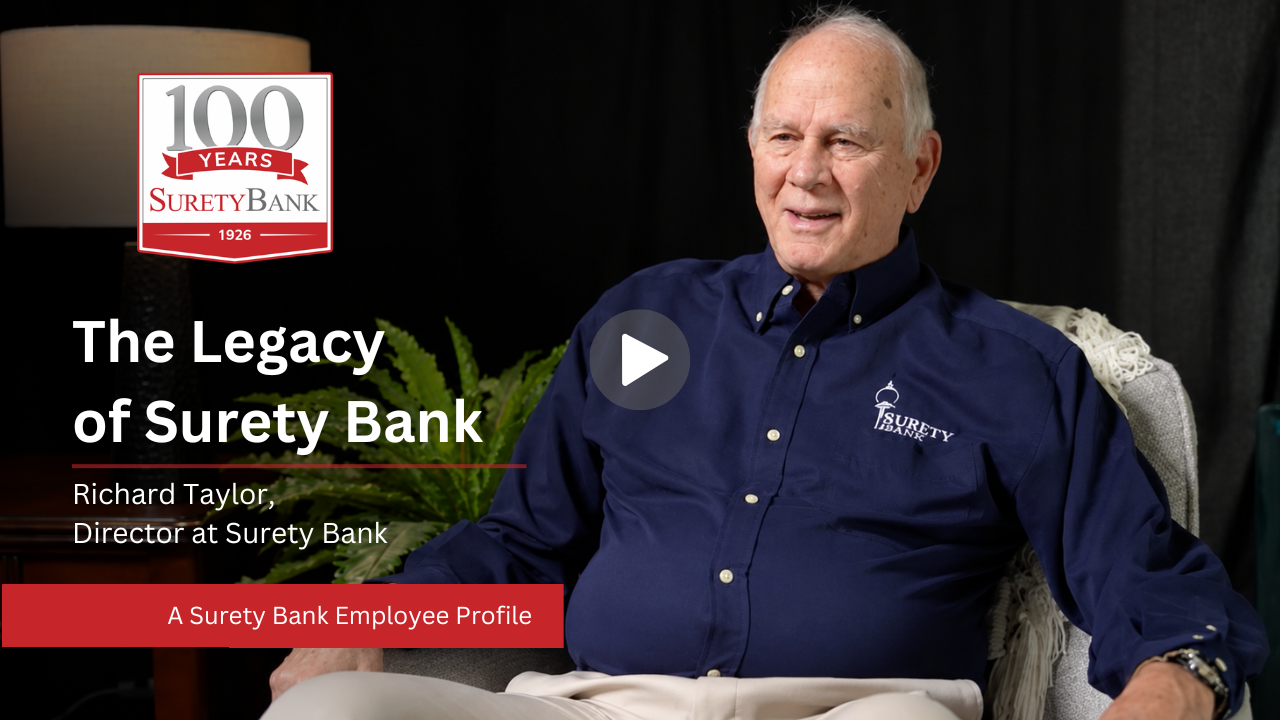
For Richard Taylor, Surety Bank has never simply been a place to bank. It has been part of his family and his community for generations.
His grandfather, Dr. Harold Taylor, served on Surety’s board and became president during a challenging period in the institution’s early history. His father later served as Surety’s attorney and on its Board of Directors. Richard’s own relationship with the bank began when he was a child.
“My earliest memory was at 110 North Florida,” Richard recalls. He believes that as soon as he was old enough to walk into Surety, he was bringing in a dime to start an account.
After leaving the Marine Corps in 1977, Richard eventually continued the family tradition by joining Surety’s Board of Directors himself.
His story provides a unique window into Surety Bank’s first 100 years and the principles that have allowed a local institution to continue serving its community through generations of change.
Surety was formed in 1926 as a mutual building and loan association, owned by its depositors and borrowers rather than traditional shareholders.
It wasn’t long before the young institution faced a major test.
Florida’s real estate boom collapsed before the Great Depression spread across the country. Richard grew up hearing stories about the banks around DeLand that failed during those difficult years. Surety, however, kept its doors open.
Richard believes the reason came down to the way Surety treated people.
“The reason it didn’t fold is because of two reasons. One, it was able to reason with the depositors and, two, because it acted reasonably with the borrowers.”
Instead of immediately turning to foreclosure when borrowers struggled, Richard says Surety did everything it could to work with them. At the same time, its leaders worked to maintain the confidence of depositors. That careful, personal approach helped Surety navigate one of the most difficult periods in American financial history without shutting down.
The story may be nearly a century old, but the philosophy behind it feels familiar: know the people you serve and be willing to work with them when it matters.
When Richard later joined the board, that personal knowledge of customers and the community was still an important part of how Surety operated.
He remembers sitting alongside directors who seemed to know the history behind nearly every property and family that came before them. When the bank considered making a loan, board members could personally visit the property, research comparable sales, and bring their own knowledge of the local market into the conversation.
For customers, it meant decisions were being made by people who understood the community.
“If you had a problem, you had somebody that you could go sit down across a desk and then talk to them about it.”
That ability to have a real conversation with the people behind your bank is something Richard remembers as an important part of Surety’s contribution to the community.
A lot has changed since those early days.
Richard remembers when customers carried physical books that recorded their payments and Surety used a large hand-operated calculating machine to figure interest. Today, technology has transformed nearly every part of the banking experience.
Surety has evolved with the industry. What began primarily as a building and loan association focused on residential homes has grown into a bank serving businesses and developing expertise in specialized areas of banking.
Richard describes that evolution as cautious, and that distinction is important.
Surety has continued to change without losing sight of what made it successful in the first place.
That perspective fits naturally with Surety Bank’s centennial message: “How we’ve always done it is how we’ll always do it.”
In many organizations, “how we’ve always done it” can imply a resistance to change. Surety’s history tells a different story. The tools have changed. The services have expanded. The way customers interact with their bank has evolved.
But the commitment to being thoughtful about how the bank grows and remaining connected to the people it serves has endured.
After all the changes Richard has witnessed, one characteristic stands out when he talks about what makes Surety different today.
“We are truly a local bank.”
For Richard, there is a difference between being called a community bank and actually being part of the community.
Surety’s roots are here. Its history is here. And generations of the people behind the bank have lived and worked alongside the customers they serve.
Richard describes Surety not only as a community bank, but as a community institution.
That connection has carried Surety through enormous changes in banking and in the community itself. Richard remembers a time when Surety did not need much advertising because local people already knew where to go when they needed a reliable place to borrow or deposit their money. Decades later, customers have more banking options than ever, but Surety continues to move steadily forward without chasing every passing trend.
Richard has seen Surety Bank move from passbooks and hand-operated calculators to modern banking. He has watched the institution expand beyond its original focus while continuing to take a careful approach to growth.
And when asked whether a bank that has already been here for 100 years can make it another 100, Richard sees no reason why it can’t.
That confidence comes from knowing where Surety has been.
For a century, the bank has adapted when necessary while holding onto the qualities that have carried it through generations: local roots, thoughtful decisions, and a commitment to the people it serves.
Richard Taylor’s family has been part of that story for generations, and his memories offer a rare look at just how much has changed since 1926.
They also show how much hasn’t.
That is the legacy of Surety Bank.
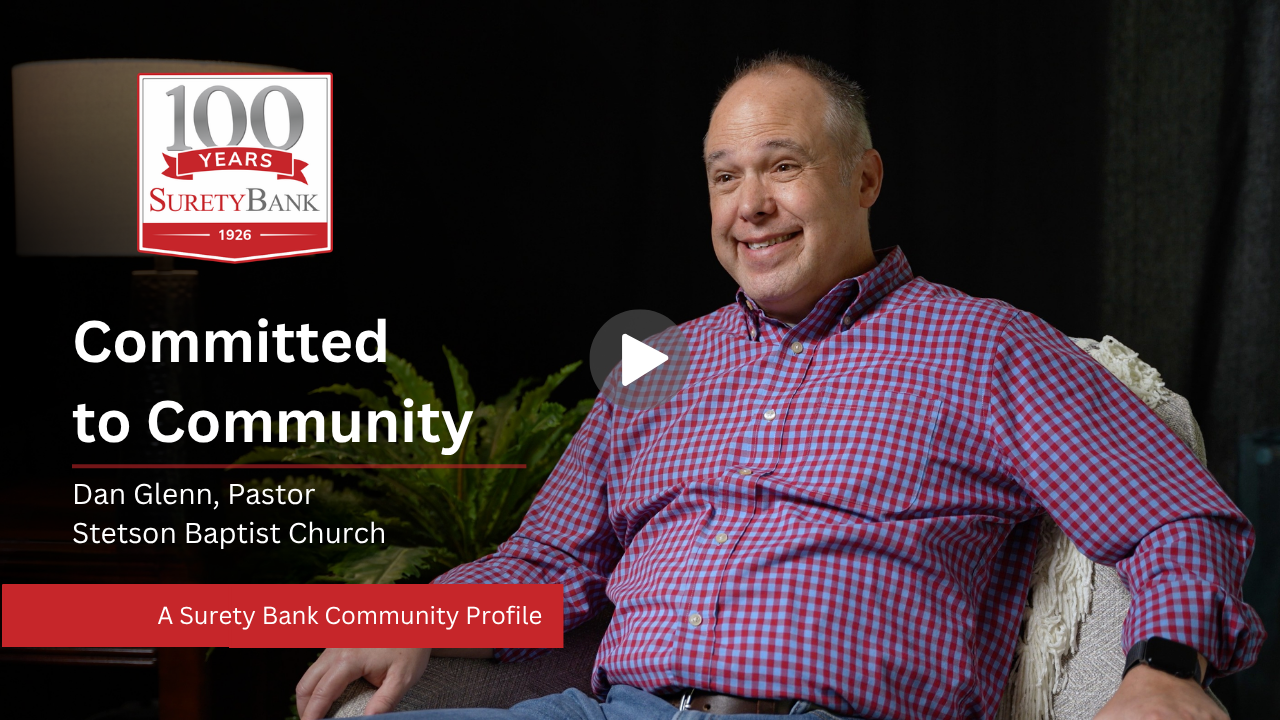
For Dan Glenn, Pastor of Stetson Baptist Church in DeLand, Surety Bank has become much more than the place where the church did its banking. Over the years, the initial banking relationship has grown into a partnership centered around a shared commitment to the community.
That partnership took on new meaning in 2018 when Stetson Baptist Church launched Night to Shine, an unforgettable prom experience for people with special needs held in partnership with the Tim Tebow Foundation.
Creating an experience like Night to Shine requires significant support, and Surety Bank was one of the event's earliest sponsors.
“Surety was one that came on very early saying, ‘Hey, we want to support that. We want to be a part of it.’”
For Dan, that moment marked a shift in the relationship. It became much more personal and community focused.
Surety continued supporting Night to Shine year after year, but one experience in particular showed Dan what that partnership truly meant.
After the first Night to Shine, Dan realized the church had never properly thanked Surety for its sponsorship. When it came time to plan the event again, he felt hesitant approaching Surety for another year of support.
The response surprised him.
There was no hesitation. Surety wanted to be involved again.
Years later, that commitment went even further when Surety reached out to the church without being asked and offered to increase its support.
“They have an intention to be generous, even when generosity may or may not be expected or requested.”
For Dan, that willingness to look for opportunities to make a greater impact is part of what distinguishes Surety Bank as a community organization.
Instead of simply waiting for someone to present a sponsorship request, Surety has been willing to ask a different question: How can we do more?
That philosophy extends beyond a single event.
Dan describes Surety not simply as a community bank, but as a “community-centered organization” that genuinely cares about DeLand and the relationships it has built throughout the city.
That personal connection is something Dan has experienced firsthand. His relationship with Surety isn't limited to the organization itself. It's also built through relationships with the people behind it.
As Surety Bank celebrates 100 years, Dan believes that commitment to people and community helps explain why the bank has remained part of DeLand for generations.
Over the past century, both the bank and the city have grown and changed. Yet Surety has continued to serve the community throughout that growth.
For Dan, that's exactly why Surety's 100th anniversary message, “How we've always done it is how we'll always do it,” resonates.
“The way they've always done things has been people centered, relationships centered, community centered.”
Those values create something that goes beyond banking. They create trust. They allow organizations like Stetson Baptist Church to know what to expect from a partner that has consistently shown up before and intends to continue showing up in the future.
After years of partnership, Dan hopes that part of Surety never changes.
This is how Surety Bank has always done it. It's how we will always do it.
For Austin Scott, starting a business wasn’t the result of a lifelong plan. It was something that grew over time, much like the lawns he now helps his customers care for.
Born and raised in DeLand, Austin is the owner of Coastal Green Pest Solutions, a new Volusia County business specializing in lawn treatments, pest management, fertilization, and the care of palms and shrubs.
The company may be new, but Austin is far from new to the work.
Before entering the lawn and pest control industry, Austin was selling auto parts at O’Reilly Auto Parts. Then a landscaper friend suggested he take a job with a local pest control company.
He gave it a shot and discovered an industry that fascinated him.
“I like that I could learn something new every day,” Austin says. “You get to see different problems, and you get to see the benefits of your own labor making a lawn beautiful. You get to see it go from nothing to something.”
Austin spent nearly six years in the industry, gradually developing an understanding of not only what products to use, but why lawns develop problems in the first place.
Interestingly, the work even gave him a new appreciation for a subject he once struggled with: chemistry.
In school, chemistry had never come naturally to Austin. But working with fertilizers, herbicides, insecticides, fungicides, and nutrients gave those concepts a real-world application.
“You get to learn something and then apply it directly,” he says.
And the more Austin learned, the more he realized there was an opportunity to do things differently.
Austin believes one of the biggest shortcomings in the lawn and pest control industry isn't necessarily the products or treatment programs companies use. It's the communication that happens, or doesn't happen, between the company, technician, and homeowner.
A lawn problem can be the result of insects, fungus, nutrient deficiencies, irrigation issues, environmental stress, or a combination of factors. Simply treating the symptom doesn't always solve the underlying problem.
Austin wants Coastal Green Pest Solutions to be different.
“I take pride in being the solution and the end to the revolving door when it comes to these lawn programs,” he says.
That means spending time with homeowners, explaining what is happening on their property, and helping them understand what needs to change.
Austin compares a lawn or landscape to the human body. One problem can affect the health of the entire system. Killing an insect, for example, may address the immediate issue, but it doesn't necessarily explain why the lawn became susceptible to the pest in the first place.
“If you can be the middleman between the problem, the chemicals, and the customer, and you can explain all that smoothly, that's normally the end,” Austin says. “A lot of people don't take the time to talk to their customers and make sure they understand.”
It's an approach built around education and relationships as much as treatment.
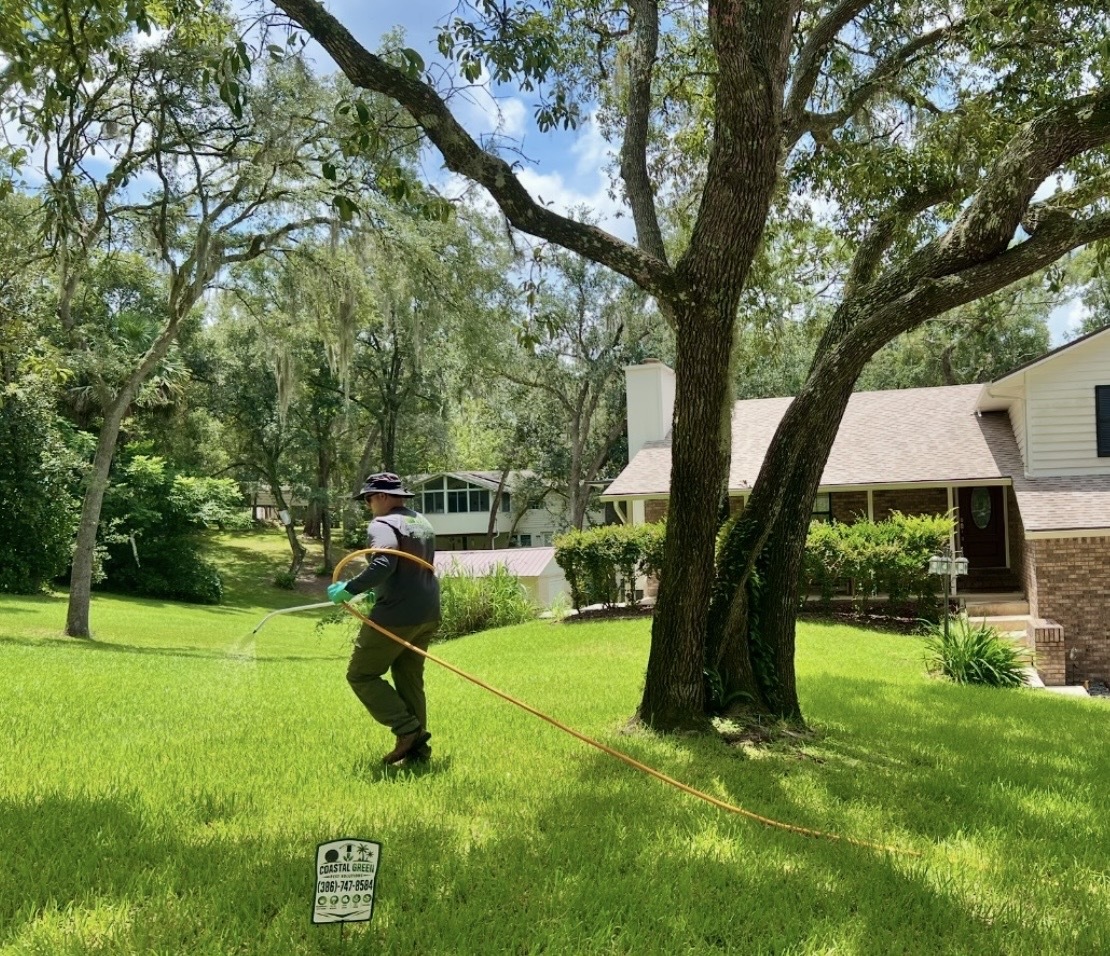
When the company Austin had worked for was sold, he saw an opportunity to take everything he'd learned and build something of his own.
Coastal Green Pest Solutions was born.
Today, Austin primarily works with residential customers throughout Volusia County who care about the long-term health and appearance of their properties.
His services include:
Austin's philosophy isn't about simply “spraying and praying,” as he puts it. Every property is different, so understanding what's actually happening comes before recommending a solution.
That philosophy also shapes how he plans to grow the business.
Starting a company requires more than expertise and ambition. There are trucks, equipment, products, operating expenses, and the reality that revenue doesn't necessarily arrive the moment the business opens its doors.
Austin knew he needed some financial breathing room as he got Coastal Green Pest Solutions off the ground.
That's where Surety Bank came in.
Austin first learned about Surety through his father, who had worked in real estate and developed a relationship with Surety Bank CEO Ryan James over the years.
When Austin was preparing to launch Coastal Green Pest Solutions, that local connection opened the door to a conversation.
“I was just looking for a good little loan—something to get me by, that way I had a little bit of breathing room,” Austin says. “I was very questionable on how I was going to make everything work, and honestly, I'm very grateful for Surety stepping in.”
Surety provided a business loan directly to Coastal Green Pest Solutions, giving Austin additional resources and flexibility during the critical early months of building the company.
For Austin, the experience demonstrated one of the advantages of working with a community bank: relationships matter.
Ryan knew Austin's family. He'd seen Austin working around town. And instead of Austin simply being another application, there was an opportunity to understand the person and business behind it.
That trust helped a local entrepreneur take the next step.
Just a couple of months into the business when we spoke with him, Austin already had big ambitions for Coastal Green Pest Solutions.
Eventually, he'd like to have multiple trucks on the road, a dedicated irrigation team, a sales team, and expanded services including home pest and termite control.
But he's in no hurry to grow simply for the sake of getting bigger.
Austin wants to make sure the service and customer experience that distinguish Coastal Green today remain intact as the company expands.
“If I'm not taking the time to personalize your service and making sure that I'm putting down what I'm promising, then there's no point in me opening up the next step,” he says.
He describes his philosophy simply as “natural growth or no growth.”
It's an especially fitting philosophy for someone who spends his days helping things grow.
For now, Austin is focused on building relationships, earning the trust of homeowners and landscapers throughout Volusia County, and developing Coastal Green one customer at a time.
And he's doing it in the community he has always called home.
“I still enjoy the small-town aspect of DeLand,” Austin says. “Raising a family here, having good friends here, it's very nice. DeLand's a good home base.”
As DeLand and Volusia County continue to grow, Austin hopes Coastal Green Pest Solutions will grow right alongside them, without losing the personal relationships that helped get the business started in the first place.
Coastal Green Pest Solutions serves homeowners throughout Volusia County. For homeowners who care about the health and appearance of their lawn and landscaping, Austin and Coastal Green provide personalized lawn treatment, pest management, fertilization, and plant health solutions.

Personal fraud continues to evolve, and scammers are finding increasingly sophisticated ways to target consumers. From AI-powered messages that appear surprisingly convincing to attempts to gain access to entire financial accounts. Recognizing the warning signs is becoming more important than ever.
While you can't prevent every fraud attempt, knowing what to watch for and taking a few proactive steps can make it much harder for scammers to succeed.
Artificial intelligence is making fraudulent calls and text messages feel more personal and legitimate. Scammers can use AI to create convincing communications designed to make you believe you're interacting with a trusted person or organization.
Be cautious when you receive an unexpected call or message asking for personal information, money, or access to an account. Before responding or taking action, reach out to Surety Bank directly to verify they are the ones calling. This step could mean not being scammed out of your money.
Fraudsters are increasingly looking beyond individual credit card numbers and attempting to gain access to entire financial profiles, including personal bank and investment accounts.
Protect your accounts by regularly reviewing activity for transactions you don't recognize and using multifactor authentication whenever it's available. Never provide your password, login credentials, or verification codes to someone who contacts you unexpectedly.
If you notice something unusual in your Surety Bank account, contact us promptly.
Older adults continue to be frequent targets of financial scams, particularly those involving tech support and investment-related schemes.
These scams often rely on urgency or fear to convince someone to act before they have an opportunity to question what's happening. Talk with older family members about common scams and encourage them to check with someone they trust before sending money or providing sensitive information in response to an unexpected request.
Taking a few minutes to verify a situation can help prevent a significant financial loss.
Protecting yourself doesn't require becoming a fraud expert. Start by being skeptical of unexpected requests for money or information, especially when someone pressures you to act immediately.
Use strong, unique passwords and enable multifactor authentication when available. Avoid clicking links in unexpected emails or text messages, and regularly review your bank accounts and credit reports for activity you don't recognize.
Most importantly, trust your instincts. If something doesn't feel right, stop and verify before taking action.
If you'd like to take additional steps to protect yourself, here are three resources worth exploring:
FTC IdentityTheft.gov
Best for someone who thinks their identity has already been compromised. The FTC provides a personalized recovery plan and steps for addressing identity theft.
Visit IdentityTheft.gov
FTC Credit Freeze & Fraud Alert Guide
Customers can place a free credit freeze, which can prevent identity thieves from opening new credit accounts in their name, or add a fraud alert.
Learn About Credit Freezes & Fraud Alerts
Aura
For those interested in a paid protection service, Aura offers identity and financial monitoring tools and other fraud-protection features. I’d position this as an optional third-party tool, not something Surety is recommending over other services.
Explore Aura
These resources are provided for informational purposes. Surety Bank does not endorse or guarantee any third-party product or service.
Fraud tactics will continue to change, but one of your strongest defenses is also one of the simplest: slow down.
Scammers often depend on creating urgency so you act before thinking. If you're unsure about a request involving your Surety Bank account, don't rely on the phone number, link, or contact information provided in the message. Contact Surety Bank directly through a trusted channel.
We're here to help you protect your financial information and recognize potential fraud before it becomes a loss.
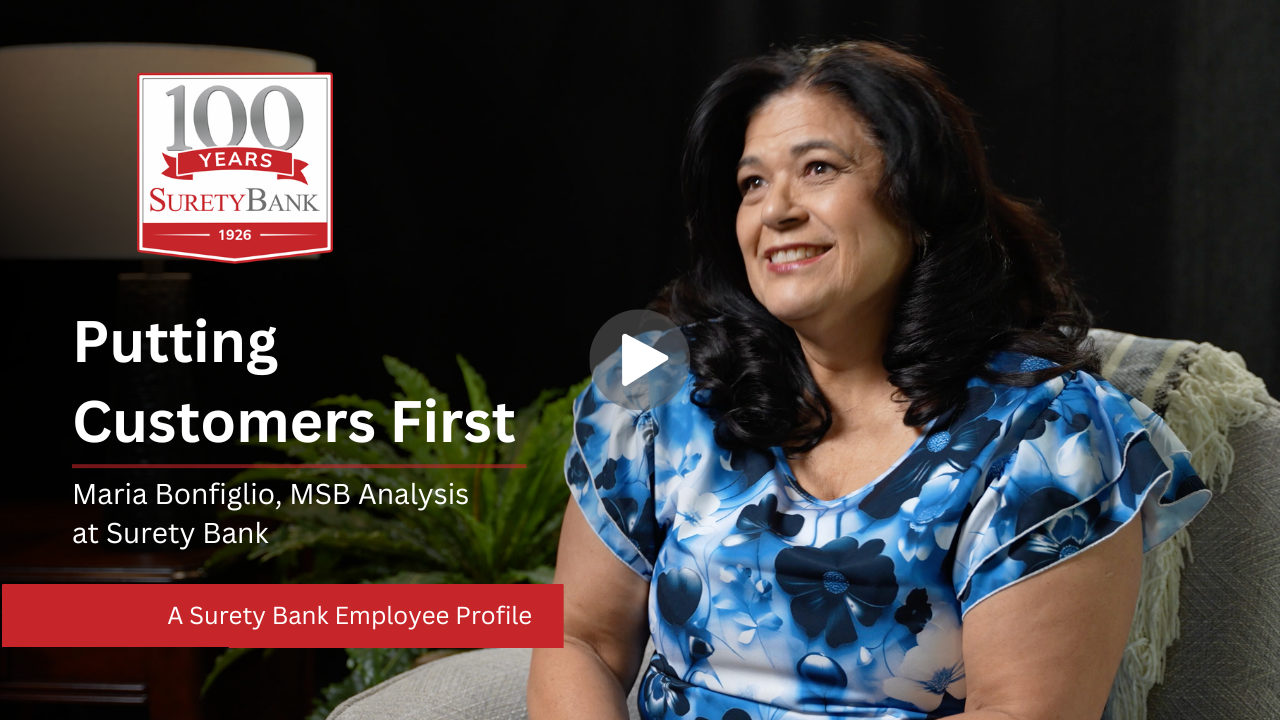
For Maria Bonfiglio, working at Surety Bank has always been about more than banking. It's about taking care of people.
Maria has been part of the Surety Bank family for nine years, but her journey began with a simple text message. A former boss she had stayed in touch with reached out years after they had worked together and told her, "I have the perfect job for you." Maria's response was simple: "Where should I sign?"
Nine years later, her enthusiasm hasn't changed.
"I love it. I love my job."
Over the years, Maria's role has evolved, giving her the opportunity to learn new skills and develop deeper relationships with customers. She has gotten to know some of them so well that she can recognize who is calling just by the sound of their voice. For Maria, those relationships are what make Surety feel less like a workplace and more like a family.
That personal connection also shapes the way Maria approaches protecting customers.
When something doesn't seem right, she isn't afraid to ask questions. Whether she's reviewing a check or helping someone resolve an issue with an account, Maria understands that taking a little extra time can make a significant difference.
"We really care about our customers," Maria explains. Even when customers may wonder why the bank is asking additional questions, she wants them to understand the reason behind it. "We don't want them to lose money."
For Maria, that care isn't limited to customers. She has experienced it personally as an employee.
During some of the most difficult moments of her life, including an extended hospital stay and the loss of her son, Maria remembers her Surety family checking on her, visiting her, and making sure she knew she wasn't alone. Those experiences showed her that the relationships Surety talks about aren't simply something customers experience. They're part of the culture inside the bank, too.
It's also why Maria believes Surety Bank has remained part of the community for 100 years. She has worked at other banks, but says Surety's involvement in the community feels different. The bank isn't trying to be the biggest. Instead, it has remained focused on the people and communities it serves.
That same philosophy comes through in Maria's relationships with her customers. Some have developed such a strong connection with her that when they call, they specifically ask for Maria. She takes pride in being someone they know they can turn to when they have a question or need assistance.
After nine years, Maria still says thank you for the opportunity that brought her to Surety Bank. Her story is a reminder that relationship banking begins with people who genuinely care about the people on the other side of the counter or phone.
This is how Surety Bank has always done it. It's how we will always do it.
.png)
For Lewis Long III, banking with Surety Bank is a relationship that has lasted more than five decades.
As one of Surety Bank's longest-standing customers, Lewis has watched the bank grow alongside the community since his connection to Surety began more than 50 years ago. He originally opened a savings account after hearing from neighbors that the bank consistently offered strong value and genuinely cared about its customers.
Over the years, Lewis has seen a lot of change. He remembers making deposits with a passbook while employees manually updated balances using a hand-cranked adding machine. What hasn't changed, however, is the way Surety Bank treats the people who walk through its doors.
For Lewis, that commitment extends beyond his own banking experience. When his sons were born, he opened accounts for each of them at Surety Bank, continuing a family tradition that has now spanned generations. One of his sons even participated in the ribbon-cutting ceremony when Surety Bank dedicated its current building in the early 1990s.
Throughout his life of military service, public service, and community involvement, Lewis has always returned to the same bank.
What has kept him loyal all these years?
The answer is simple: people.
"You couldn't ask for better service or better people," Lewis says. "I don't know how they remember everybody's name that walks in the door, but they do. They're just super folks. The people have always been a gift to us and to the community."
Lewis believes that the values Surety Bank was founded on continue to define the bank today. One story from the bank's early history has always stayed with him. During the Great Depression, he recalls hearing that Surety worked with customers rather than rushing to foreclose on them because they cared more about helping people than taking their property. That philosophy, he says, is still reflected in the way the bank serves its customers today.
It's one of the reasons Lewis has become an advocate for the bank wherever he goes.
Whether he's encouraging friends to open a money market account, sharing the bank's history, or even suggesting a new Surety branch for his hometown of Lake Helen, Lewis proudly recommends the bank he's trusted for more than half a century.
"I wouldn't champion the bank if I didn't believe in these folks and believe in this bank," he says. "Everybody is important. They see past whatever's bothering someone that day and still treat people with kindness and respect."
As Surety Bank celebrates 100 years of serving Central Florida, customers like Lewis remind us that while banking has evolved, some things should never change. Genuine relationships, exceptional service, and a commitment to the community remain at the heart of everything we do.
This is how Surety Bank has always done it. It's how we will always do it.
For Richard Taylor, Surety Bank has never simply been a place to bank. It has been part of his family and his community for generations.
His grandfather, Dr. Harold Taylor, served on Surety’s board and became president during a challenging period in the institution’s early history. His father later served as Surety’s attorney and on its Board of Directors. Richard’s own relationship with the bank began when he was a child.
“My earliest memory was at 110 North Florida,” Richard recalls. He believes that as soon as he was old enough to walk into Surety, he was bringing in a dime to start an account.
After leaving the Marine Corps in 1977, Richard eventually continued the family tradition by joining Surety’s Board of Directors himself.
His story provides a unique window into Surety Bank’s first 100 years and the principles that have allowed a local institution to continue serving its community through generations of change.
Surety was formed in 1926 as a mutual building and loan association, owned by its depositors and borrowers rather than traditional shareholders.
It wasn’t long before the young institution faced a major test.
Florida’s real estate boom collapsed before the Great Depression spread across the country. Richard grew up hearing stories about the banks around DeLand that failed during those difficult years. Surety, however, kept its doors open.
Richard believes the reason came down to the way Surety treated people.
“The reason it didn’t fold is because of two reasons. One, it was able to reason with the depositors and, two, because it acted reasonably with the borrowers.”
Instead of immediately turning to foreclosure when borrowers struggled, Richard says Surety did everything it could to work with them. At the same time, its leaders worked to maintain the confidence of depositors. That careful, personal approach helped Surety navigate one of the most difficult periods in American financial history without shutting down.
The story may be nearly a century old, but the philosophy behind it feels familiar: know the people you serve and be willing to work with them when it matters.
When Richard later joined the board, that personal knowledge of customers and the community was still an important part of how Surety operated.
He remembers sitting alongside directors who seemed to know the history behind nearly every property and family that came before them. When the bank considered making a loan, board members could personally visit the property, research comparable sales, and bring their own knowledge of the local market into the conversation.
For customers, it meant decisions were being made by people who understood the community.
“If you had a problem, you had somebody that you could go sit down across a desk and then talk to them about it.”
That ability to have a real conversation with the people behind your bank is something Richard remembers as an important part of Surety’s contribution to the community.
A lot has changed since those early days.
Richard remembers when customers carried physical books that recorded their payments and Surety used a large hand-operated calculating machine to figure interest. Today, technology has transformed nearly every part of the banking experience.
Surety has evolved with the industry. What began primarily as a building and loan association focused on residential homes has grown into a bank serving businesses and developing expertise in specialized areas of banking.
Richard describes that evolution as cautious, and that distinction is important.
Surety has continued to change without losing sight of what made it successful in the first place.
That perspective fits naturally with Surety Bank’s centennial message: “How we’ve always done it is how we’ll always do it.”
In many organizations, “how we’ve always done it” can imply a resistance to change. Surety’s history tells a different story. The tools have changed. The services have expanded. The way customers interact with their bank has evolved.
But the commitment to being thoughtful about how the bank grows and remaining connected to the people it serves has endured.
After all the changes Richard has witnessed, one characteristic stands out when he talks about what makes Surety different today.
“We are truly a local bank.”
For Richard, there is a difference between being called a community bank and actually being part of the community.
Surety’s roots are here. Its history is here. And generations of the people behind the bank have lived and worked alongside the customers they serve.
Richard describes Surety not only as a community bank, but as a community institution.
That connection has carried Surety through enormous changes in banking and in the community itself. Richard remembers a time when Surety did not need much advertising because local people already knew where to go when they needed a reliable place to borrow or deposit their money. Decades later, customers have more banking options than ever, but Surety continues to move steadily forward without chasing every passing trend.
Richard has seen Surety Bank move from passbooks and hand-operated calculators to modern banking. He has watched the institution expand beyond its original focus while continuing to take a careful approach to growth.
And when asked whether a bank that has already been here for 100 years can make it another 100, Richard sees no reason why it can’t.
That confidence comes from knowing where Surety has been.
For a century, the bank has adapted when necessary while holding onto the qualities that have carried it through generations: local roots, thoughtful decisions, and a commitment to the people it serves.
Richard Taylor’s family has been part of that story for generations, and his memories offer a rare look at just how much has changed since 1926.
They also show how much hasn’t.
That is the legacy of Surety Bank.
For Dan Glenn, Pastor of Stetson Baptist Church in DeLand, Surety Bank has become much more than the place where the church did its banking. Over the years, the initial banking relationship has grown into a partnership centered around a shared commitment to the community.
That partnership took on new meaning in 2018 when Stetson Baptist Church launched Night to Shine, an unforgettable prom experience for people with special needs held in partnership with the Tim Tebow Foundation.
Creating an experience like Night to Shine requires significant support, and Surety Bank was one of the event's earliest sponsors.
“Surety was one that came on very early saying, ‘Hey, we want to support that. We want to be a part of it.’”
For Dan, that moment marked a shift in the relationship. It became much more personal and community focused.
Surety continued supporting Night to Shine year after year, but one experience in particular showed Dan what that partnership truly meant.
After the first Night to Shine, Dan realized the church had never properly thanked Surety for its sponsorship. When it came time to plan the event again, he felt hesitant approaching Surety for another year of support.
The response surprised him.
There was no hesitation. Surety wanted to be involved again.
Years later, that commitment went even further when Surety reached out to the church without being asked and offered to increase its support.
“They have an intention to be generous, even when generosity may or may not be expected or requested.”
For Dan, that willingness to look for opportunities to make a greater impact is part of what distinguishes Surety Bank as a community organization.
Instead of simply waiting for someone to present a sponsorship request, Surety has been willing to ask a different question: How can we do more?
That philosophy extends beyond a single event.
Dan describes Surety not simply as a community bank, but as a “community-centered organization” that genuinely cares about DeLand and the relationships it has built throughout the city.
That personal connection is something Dan has experienced firsthand. His relationship with Surety isn't limited to the organization itself. It's also built through relationships with the people behind it.
As Surety Bank celebrates 100 years, Dan believes that commitment to people and community helps explain why the bank has remained part of DeLand for generations.
Over the past century, both the bank and the city have grown and changed. Yet Surety has continued to serve the community throughout that growth.
For Dan, that's exactly why Surety's 100th anniversary message, “How we've always done it is how we'll always do it,” resonates.
“The way they've always done things has been people centered, relationships centered, community centered.”
Those values create something that goes beyond banking. They create trust. They allow organizations like Stetson Baptist Church to know what to expect from a partner that has consistently shown up before and intends to continue showing up in the future.
After years of partnership, Dan hopes that part of Surety never changes.
This is how Surety Bank has always done it. It's how we will always do it.
For Austin Scott, starting a business wasn’t the result of a lifelong plan. It was something that grew over time, much like the lawns he now helps his customers care for.
Born and raised in DeLand, Austin is the owner of Coastal Green Pest Solutions, a new Volusia County business specializing in lawn treatments, pest management, fertilization, and the care of palms and shrubs.
The company may be new, but Austin is far from new to the work.
Before entering the lawn and pest control industry, Austin was selling auto parts at O’Reilly Auto Parts. Then a landscaper friend suggested he take a job with a local pest control company.
He gave it a shot and discovered an industry that fascinated him.
“I like that I could learn something new every day,” Austin says. “You get to see different problems, and you get to see the benefits of your own labor making a lawn beautiful. You get to see it go from nothing to something.”
Austin spent nearly six years in the industry, gradually developing an understanding of not only what products to use, but why lawns develop problems in the first place.
Interestingly, the work even gave him a new appreciation for a subject he once struggled with: chemistry.
In school, chemistry had never come naturally to Austin. But working with fertilizers, herbicides, insecticides, fungicides, and nutrients gave those concepts a real-world application.
“You get to learn something and then apply it directly,” he says.
And the more Austin learned, the more he realized there was an opportunity to do things differently.
Austin believes one of the biggest shortcomings in the lawn and pest control industry isn't necessarily the products or treatment programs companies use. It's the communication that happens, or doesn't happen, between the company, technician, and homeowner.
A lawn problem can be the result of insects, fungus, nutrient deficiencies, irrigation issues, environmental stress, or a combination of factors. Simply treating the symptom doesn't always solve the underlying problem.
Austin wants Coastal Green Pest Solutions to be different.
“I take pride in being the solution and the end to the revolving door when it comes to these lawn programs,” he says.
That means spending time with homeowners, explaining what is happening on their property, and helping them understand what needs to change.
Austin compares a lawn or landscape to the human body. One problem can affect the health of the entire system. Killing an insect, for example, may address the immediate issue, but it doesn't necessarily explain why the lawn became susceptible to the pest in the first place.
“If you can be the middleman between the problem, the chemicals, and the customer, and you can explain all that smoothly, that's normally the end,” Austin says. “A lot of people don't take the time to talk to their customers and make sure they understand.”
It's an approach built around education and relationships as much as treatment.
When the company Austin had worked for was sold, he saw an opportunity to take everything he'd learned and build something of his own.
Coastal Green Pest Solutions was born.
Today, Austin primarily works with residential customers throughout Volusia County who care about the long-term health and appearance of their properties.
His services include:
Austin's philosophy isn't about simply “spraying and praying,” as he puts it. Every property is different, so understanding what's actually happening comes before recommending a solution.
That philosophy also shapes how he plans to grow the business.
Starting a company requires more than expertise and ambition. There are trucks, equipment, products, operating expenses, and the reality that revenue doesn't necessarily arrive the moment the business opens its doors.
Austin knew he needed some financial breathing room as he got Coastal Green Pest Solutions off the ground.
That's where Surety Bank came in.
Austin first learned about Surety through his father, who had worked in real estate and developed a relationship with Surety Bank CEO Ryan James over the years.
When Austin was preparing to launch Coastal Green Pest Solutions, that local connection opened the door to a conversation.
“I was just looking for a good little loan—something to get me by, that way I had a little bit of breathing room,” Austin says. “I was very questionable on how I was going to make everything work, and honestly, I'm very grateful for Surety stepping in.”
Surety provided a business loan directly to Coastal Green Pest Solutions, giving Austin additional resources and flexibility during the critical early months of building the company.
For Austin, the experience demonstrated one of the advantages of working with a community bank: relationships matter.
Ryan knew Austin's family. He'd seen Austin working around town. And instead of Austin simply being another application, there was an opportunity to understand the person and business behind it.
That trust helped a local entrepreneur take the next step.
Just a couple of months into the business when we spoke with him, Austin already had big ambitions for Coastal Green Pest Solutions.
Eventually, he'd like to have multiple trucks on the road, a dedicated irrigation team, a sales team, and expanded services including home pest and termite control.
But he's in no hurry to grow simply for the sake of getting bigger.
Austin wants to make sure the service and customer experience that distinguish Coastal Green today remain intact as the company expands.
“If I'm not taking the time to personalize your service and making sure that I'm putting down what I'm promising, then there's no point in me opening up the next step,” he says.
He describes his philosophy simply as “natural growth or no growth.”
It's an especially fitting philosophy for someone who spends his days helping things grow.
For now, Austin is focused on building relationships, earning the trust of homeowners and landscapers throughout Volusia County, and developing Coastal Green one customer at a time.
And he's doing it in the community he has always called home.
“I still enjoy the small-town aspect of DeLand,” Austin says. “Raising a family here, having good friends here, it's very nice. DeLand's a good home base.”
As DeLand and Volusia County continue to grow, Austin hopes Coastal Green Pest Solutions will grow right alongside them, without losing the personal relationships that helped get the business started in the first place.
Coastal Green Pest Solutions serves homeowners throughout Volusia County. For homeowners who care about the health and appearance of their lawn and landscaping, Austin and Coastal Green provide personalized lawn treatment, pest management, fertilization, and plant health solutions.
Personal fraud continues to evolve, and scammers are finding increasingly sophisticated ways to target consumers. From AI-powered messages that appear surprisingly convincing to attempts to gain access to entire financial accounts. Recognizing the warning signs is becoming more important than ever.
While you can't prevent every fraud attempt, knowing what to watch for and taking a few proactive steps can make it much harder for scammers to succeed.
Artificial intelligence is making fraudulent calls and text messages feel more personal and legitimate. Scammers can use AI to create convincing communications designed to make you believe you're interacting with a trusted person or organization.
Be cautious when you receive an unexpected call or message asking for personal information, money, or access to an account. Before responding or taking action, reach out to Surety Bank directly to verify they are the ones calling. This step could mean not being scammed out of your money.
Fraudsters are increasingly looking beyond individual credit card numbers and attempting to gain access to entire financial profiles, including personal bank and investment accounts.
Protect your accounts by regularly reviewing activity for transactions you don't recognize and using multifactor authentication whenever it's available. Never provide your password, login credentials, or verification codes to someone who contacts you unexpectedly.
If you notice something unusual in your Surety Bank account, contact us promptly.
Older adults continue to be frequent targets of financial scams, particularly those involving tech support and investment-related schemes.
These scams often rely on urgency or fear to convince someone to act before they have an opportunity to question what's happening. Talk with older family members about common scams and encourage them to check with someone they trust before sending money or providing sensitive information in response to an unexpected request.
Taking a few minutes to verify a situation can help prevent a significant financial loss.
Protecting yourself doesn't require becoming a fraud expert. Start by being skeptical of unexpected requests for money or information, especially when someone pressures you to act immediately.
Use strong, unique passwords and enable multifactor authentication when available. Avoid clicking links in unexpected emails or text messages, and regularly review your bank accounts and credit reports for activity you don't recognize.
Most importantly, trust your instincts. If something doesn't feel right, stop and verify before taking action.
If you'd like to take additional steps to protect yourself, here are three resources worth exploring:
FTC IdentityTheft.gov
Best for someone who thinks their identity has already been compromised. The FTC provides a personalized recovery plan and steps for addressing identity theft.
Visit IdentityTheft.gov
FTC Credit Freeze & Fraud Alert Guide
Customers can place a free credit freeze, which can prevent identity thieves from opening new credit accounts in their name, or add a fraud alert.
Learn About Credit Freezes & Fraud Alerts
Aura
For those interested in a paid protection service, Aura offers identity and financial monitoring tools and other fraud-protection features. I’d position this as an optional third-party tool, not something Surety is recommending over other services.
Explore Aura
These resources are provided for informational purposes. Surety Bank does not endorse or guarantee any third-party product or service.
Fraud tactics will continue to change, but one of your strongest defenses is also one of the simplest: slow down.
Scammers often depend on creating urgency so you act before thinking. If you're unsure about a request involving your Surety Bank account, don't rely on the phone number, link, or contact information provided in the message. Contact Surety Bank directly through a trusted channel.
We're here to help you protect your financial information and recognize potential fraud before it becomes a loss.
For Maria Bonfiglio, working at Surety Bank has always been about more than banking. It's about taking care of people.
Maria has been part of the Surety Bank family for nine years, but her journey began with a simple text message. A former boss she had stayed in touch with reached out years after they had worked together and told her, "I have the perfect job for you." Maria's response was simple: "Where should I sign?"
Nine years later, her enthusiasm hasn't changed.
"I love it. I love my job."
Over the years, Maria's role has evolved, giving her the opportunity to learn new skills and develop deeper relationships with customers. She has gotten to know some of them so well that she can recognize who is calling just by the sound of their voice. For Maria, those relationships are what make Surety feel less like a workplace and more like a family.
That personal connection also shapes the way Maria approaches protecting customers.
When something doesn't seem right, she isn't afraid to ask questions. Whether she's reviewing a check or helping someone resolve an issue with an account, Maria understands that taking a little extra time can make a significant difference.
"We really care about our customers," Maria explains. Even when customers may wonder why the bank is asking additional questions, she wants them to understand the reason behind it. "We don't want them to lose money."
For Maria, that care isn't limited to customers. She has experienced it personally as an employee.
During some of the most difficult moments of her life, including an extended hospital stay and the loss of her son, Maria remembers her Surety family checking on her, visiting her, and making sure she knew she wasn't alone. Those experiences showed her that the relationships Surety talks about aren't simply something customers experience. They're part of the culture inside the bank, too.
It's also why Maria believes Surety Bank has remained part of the community for 100 years. She has worked at other banks, but says Surety's involvement in the community feels different. The bank isn't trying to be the biggest. Instead, it has remained focused on the people and communities it serves.
That same philosophy comes through in Maria's relationships with her customers. Some have developed such a strong connection with her that when they call, they specifically ask for Maria. She takes pride in being someone they know they can turn to when they have a question or need assistance.
After nine years, Maria still says thank you for the opportunity that brought her to Surety Bank. Her story is a reminder that relationship banking begins with people who genuinely care about the people on the other side of the counter or phone.
This is how Surety Bank has always done it. It's how we will always do it.
For Lewis Long III, banking with Surety Bank is a relationship that has lasted more than five decades.
As one of Surety Bank's longest-standing customers, Lewis has watched the bank grow alongside the community since his connection to Surety began more than 50 years ago. He originally opened a savings account after hearing from neighbors that the bank consistently offered strong value and genuinely cared about its customers.
Over the years, Lewis has seen a lot of change. He remembers making deposits with a passbook while employees manually updated balances using a hand-cranked adding machine. What hasn't changed, however, is the way Surety Bank treats the people who walk through its doors.
For Lewis, that commitment extends beyond his own banking experience. When his sons were born, he opened accounts for each of them at Surety Bank, continuing a family tradition that has now spanned generations. One of his sons even participated in the ribbon-cutting ceremony when Surety Bank dedicated its current building in the early 1990s.
Throughout his life of military service, public service, and community involvement, Lewis has always returned to the same bank.
What has kept him loyal all these years?
The answer is simple: people.
"You couldn't ask for better service or better people," Lewis says. "I don't know how they remember everybody's name that walks in the door, but they do. They're just super folks. The people have always been a gift to us and to the community."
Lewis believes that the values Surety Bank was founded on continue to define the bank today. One story from the bank's early history has always stayed with him. During the Great Depression, he recalls hearing that Surety worked with customers rather than rushing to foreclose on them because they cared more about helping people than taking their property. That philosophy, he says, is still reflected in the way the bank serves its customers today.
It's one of the reasons Lewis has become an advocate for the bank wherever he goes.
Whether he's encouraging friends to open a money market account, sharing the bank's history, or even suggesting a new Surety branch for his hometown of Lake Helen, Lewis proudly recommends the bank he's trusted for more than half a century.
"I wouldn't champion the bank if I didn't believe in these folks and believe in this bank," he says. "Everybody is important. They see past whatever's bothering someone that day and still treat people with kindness and respect."
As Surety Bank celebrates 100 years of serving Central Florida, customers like Lewis remind us that while banking has evolved, some things should never change. Genuine relationships, exceptional service, and a commitment to the community remain at the heart of everything we do.
This is how Surety Bank has always done it. It's how we will always do it.
For Richard Taylor, Surety Bank has never simply been a place to bank. It has been part of his family and his community for generations.
His grandfather, Dr. Harold Taylor, served on Surety’s board and became president during a challenging period in the institution’s early history. His father later served as Surety’s attorney and on its Board of Directors. Richard’s own relationship with the bank began when he was a child.
“My earliest memory was at 110 North Florida,” Richard recalls. He believes that as soon as he was old enough to walk into Surety, he was bringing in a dime to start an account.
After leaving the Marine Corps in 1977, Richard eventually continued the family tradition by joining Surety’s Board of Directors himself.
His story provides a unique window into Surety Bank’s first 100 years and the principles that have allowed a local institution to continue serving its community through generations of change.
Surety was formed in 1926 as a mutual building and loan association, owned by its depositors and borrowers rather than traditional shareholders.
It wasn’t long before the young institution faced a major test.
Florida’s real estate boom collapsed before the Great Depression spread across the country. Richard grew up hearing stories about the banks around DeLand that failed during those difficult years. Surety, however, kept its doors open.
Richard believes the reason came down to the way Surety treated people.
“The reason it didn’t fold is because of two reasons. One, it was able to reason with the depositors and, two, because it acted reasonably with the borrowers.”
Instead of immediately turning to foreclosure when borrowers struggled, Richard says Surety did everything it could to work with them. At the same time, its leaders worked to maintain the confidence of depositors. That careful, personal approach helped Surety navigate one of the most difficult periods in American financial history without shutting down.
The story may be nearly a century old, but the philosophy behind it feels familiar: know the people you serve and be willing to work with them when it matters.
When Richard later joined the board, that personal knowledge of customers and the community was still an important part of how Surety operated.
He remembers sitting alongside directors who seemed to know the history behind nearly every property and family that came before them. When the bank considered making a loan, board members could personally visit the property, research comparable sales, and bring their own knowledge of the local market into the conversation.
For customers, it meant decisions were being made by people who understood the community.
“If you had a problem, you had somebody that you could go sit down across a desk and then talk to them about it.”
That ability to have a real conversation with the people behind your bank is something Richard remembers as an important part of Surety’s contribution to the community.
A lot has changed since those early days.
Richard remembers when customers carried physical books that recorded their payments and Surety used a large hand-operated calculating machine to figure interest. Today, technology has transformed nearly every part of the banking experience.
Surety has evolved with the industry. What began primarily as a building and loan association focused on residential homes has grown into a bank serving businesses and developing expertise in specialized areas of banking.
Richard describes that evolution as cautious, and that distinction is important.
Surety has continued to change without losing sight of what made it successful in the first place.
That perspective fits naturally with Surety Bank’s centennial message: “How we’ve always done it is how we’ll always do it.”
In many organizations, “how we’ve always done it” can imply a resistance to change. Surety’s history tells a different story. The tools have changed. The services have expanded. The way customers interact with their bank has evolved.
But the commitment to being thoughtful about how the bank grows and remaining connected to the people it serves has endured.
After all the changes Richard has witnessed, one characteristic stands out when he talks about what makes Surety different today.
“We are truly a local bank.”
For Richard, there is a difference between being called a community bank and actually being part of the community.
Surety’s roots are here. Its history is here. And generations of the people behind the bank have lived and worked alongside the customers they serve.
Richard describes Surety not only as a community bank, but as a community institution.
That connection has carried Surety through enormous changes in banking and in the community itself. Richard remembers a time when Surety did not need much advertising because local people already knew where to go when they needed a reliable place to borrow or deposit their money. Decades later, customers have more banking options than ever, but Surety continues to move steadily forward without chasing every passing trend.
Richard has seen Surety Bank move from passbooks and hand-operated calculators to modern banking. He has watched the institution expand beyond its original focus while continuing to take a careful approach to growth.
And when asked whether a bank that has already been here for 100 years can make it another 100, Richard sees no reason why it can’t.
That confidence comes from knowing where Surety has been.
For a century, the bank has adapted when necessary while holding onto the qualities that have carried it through generations: local roots, thoughtful decisions, and a commitment to the people it serves.
Richard Taylor’s family has been part of that story for generations, and his memories offer a rare look at just how much has changed since 1926.
They also show how much hasn’t.
That is the legacy of Surety Bank.
For Dan Glenn, Pastor of Stetson Baptist Church in DeLand, Surety Bank has become much more than the place where the church did its banking. Over the years, the initial banking relationship has grown into a partnership centered around a shared commitment to the community.
That partnership took on new meaning in 2018 when Stetson Baptist Church launched Night to Shine, an unforgettable prom experience for people with special needs held in partnership with the Tim Tebow Foundation.
Creating an experience like Night to Shine requires significant support, and Surety Bank was one of the event's earliest sponsors.
“Surety was one that came on very early saying, ‘Hey, we want to support that. We want to be a part of it.’”
For Dan, that moment marked a shift in the relationship. It became much more personal and community focused.
Surety continued supporting Night to Shine year after year, but one experience in particular showed Dan what that partnership truly meant.
After the first Night to Shine, Dan realized the church had never properly thanked Surety for its sponsorship. When it came time to plan the event again, he felt hesitant approaching Surety for another year of support.
The response surprised him.
There was no hesitation. Surety wanted to be involved again.
Years later, that commitment went even further when Surety reached out to the church without being asked and offered to increase its support.
“They have an intention to be generous, even when generosity may or may not be expected or requested.”
For Dan, that willingness to look for opportunities to make a greater impact is part of what distinguishes Surety Bank as a community organization.
Instead of simply waiting for someone to present a sponsorship request, Surety has been willing to ask a different question: How can we do more?
That philosophy extends beyond a single event.
Dan describes Surety not simply as a community bank, but as a “community-centered organization” that genuinely cares about DeLand and the relationships it has built throughout the city.
That personal connection is something Dan has experienced firsthand. His relationship with Surety isn't limited to the organization itself. It's also built through relationships with the people behind it.
As Surety Bank celebrates 100 years, Dan believes that commitment to people and community helps explain why the bank has remained part of DeLand for generations.
Over the past century, both the bank and the city have grown and changed. Yet Surety has continued to serve the community throughout that growth.
For Dan, that's exactly why Surety's 100th anniversary message, “How we've always done it is how we'll always do it,” resonates.
“The way they've always done things has been people centered, relationships centered, community centered.”
Those values create something that goes beyond banking. They create trust. They allow organizations like Stetson Baptist Church to know what to expect from a partner that has consistently shown up before and intends to continue showing up in the future.
After years of partnership, Dan hopes that part of Surety never changes.
This is how Surety Bank has always done it. It's how we will always do it.
For Austin Scott, starting a business wasn’t the result of a lifelong plan. It was something that grew over time, much like the lawns he now helps his customers care for.
Born and raised in DeLand, Austin is the owner of Coastal Green Pest Solutions, a new Volusia County business specializing in lawn treatments, pest management, fertilization, and the care of palms and shrubs.
The company may be new, but Austin is far from new to the work.
Before entering the lawn and pest control industry, Austin was selling auto parts at O’Reilly Auto Parts. Then a landscaper friend suggested he take a job with a local pest control company.
He gave it a shot and discovered an industry that fascinated him.
“I like that I could learn something new every day,” Austin says. “You get to see different problems, and you get to see the benefits of your own labor making a lawn beautiful. You get to see it go from nothing to something.”
Austin spent nearly six years in the industry, gradually developing an understanding of not only what products to use, but why lawns develop problems in the first place.
Interestingly, the work even gave him a new appreciation for a subject he once struggled with: chemistry.
In school, chemistry had never come naturally to Austin. But working with fertilizers, herbicides, insecticides, fungicides, and nutrients gave those concepts a real-world application.
“You get to learn something and then apply it directly,” he says.
And the more Austin learned, the more he realized there was an opportunity to do things differently.
Austin believes one of the biggest shortcomings in the lawn and pest control industry isn't necessarily the products or treatment programs companies use. It's the communication that happens, or doesn't happen, between the company, technician, and homeowner.
A lawn problem can be the result of insects, fungus, nutrient deficiencies, irrigation issues, environmental stress, or a combination of factors. Simply treating the symptom doesn't always solve the underlying problem.
Austin wants Coastal Green Pest Solutions to be different.
“I take pride in being the solution and the end to the revolving door when it comes to these lawn programs,” he says.
That means spending time with homeowners, explaining what is happening on their property, and helping them understand what needs to change.
Austin compares a lawn or landscape to the human body. One problem can affect the health of the entire system. Killing an insect, for example, may address the immediate issue, but it doesn't necessarily explain why the lawn became susceptible to the pest in the first place.
“If you can be the middleman between the problem, the chemicals, and the customer, and you can explain all that smoothly, that's normally the end,” Austin says. “A lot of people don't take the time to talk to their customers and make sure they understand.”
It's an approach built around education and relationships as much as treatment.
When the company Austin had worked for was sold, he saw an opportunity to take everything he'd learned and build something of his own.
Coastal Green Pest Solutions was born.
Today, Austin primarily works with residential customers throughout Volusia County who care about the long-term health and appearance of their properties.
His services include:
Austin's philosophy isn't about simply “spraying and praying,” as he puts it. Every property is different, so understanding what's actually happening comes before recommending a solution.
That philosophy also shapes how he plans to grow the business.
Starting a company requires more than expertise and ambition. There are trucks, equipment, products, operating expenses, and the reality that revenue doesn't necessarily arrive the moment the business opens its doors.
Austin knew he needed some financial breathing room as he got Coastal Green Pest Solutions off the ground.
That's where Surety Bank came in.
Austin first learned about Surety through his father, who had worked in real estate and developed a relationship with Surety Bank CEO Ryan James over the years.
When Austin was preparing to launch Coastal Green Pest Solutions, that local connection opened the door to a conversation.
“I was just looking for a good little loan—something to get me by, that way I had a little bit of breathing room,” Austin says. “I was very questionable on how I was going to make everything work, and honestly, I'm very grateful for Surety stepping in.”
Surety provided a business loan directly to Coastal Green Pest Solutions, giving Austin additional resources and flexibility during the critical early months of building the company.
For Austin, the experience demonstrated one of the advantages of working with a community bank: relationships matter.
Ryan knew Austin's family. He'd seen Austin working around town. And instead of Austin simply being another application, there was an opportunity to understand the person and business behind it.
That trust helped a local entrepreneur take the next step.
Just a couple of months into the business when we spoke with him, Austin already had big ambitions for Coastal Green Pest Solutions.
Eventually, he'd like to have multiple trucks on the road, a dedicated irrigation team, a sales team, and expanded services including home pest and termite control.
But he's in no hurry to grow simply for the sake of getting bigger.
Austin wants to make sure the service and customer experience that distinguish Coastal Green today remain intact as the company expands.
“If I'm not taking the time to personalize your service and making sure that I'm putting down what I'm promising, then there's no point in me opening up the next step,” he says.
He describes his philosophy simply as “natural growth or no growth.”
It's an especially fitting philosophy for someone who spends his days helping things grow.
For now, Austin is focused on building relationships, earning the trust of homeowners and landscapers throughout Volusia County, and developing Coastal Green one customer at a time.
And he's doing it in the community he has always called home.
“I still enjoy the small-town aspect of DeLand,” Austin says. “Raising a family here, having good friends here, it's very nice. DeLand's a good home base.”
As DeLand and Volusia County continue to grow, Austin hopes Coastal Green Pest Solutions will grow right alongside them, without losing the personal relationships that helped get the business started in the first place.
Coastal Green Pest Solutions serves homeowners throughout Volusia County. For homeowners who care about the health and appearance of their lawn and landscaping, Austin and Coastal Green provide personalized lawn treatment, pest management, fertilization, and plant health solutions.
Personal fraud continues to evolve, and scammers are finding increasingly sophisticated ways to target consumers. From AI-powered messages that appear surprisingly convincing to attempts to gain access to entire financial accounts. Recognizing the warning signs is becoming more important than ever.
While you can't prevent every fraud attempt, knowing what to watch for and taking a few proactive steps can make it much harder for scammers to succeed.
Artificial intelligence is making fraudulent calls and text messages feel more personal and legitimate. Scammers can use AI to create convincing communications designed to make you believe you're interacting with a trusted person or organization.
Be cautious when you receive an unexpected call or message asking for personal information, money, or access to an account. Before responding or taking action, reach out to Surety Bank directly to verify they are the ones calling. This step could mean not being scammed out of your money.
Fraudsters are increasingly looking beyond individual credit card numbers and attempting to gain access to entire financial profiles, including personal bank and investment accounts.
Protect your accounts by regularly reviewing activity for transactions you don't recognize and using multifactor authentication whenever it's available. Never provide your password, login credentials, or verification codes to someone who contacts you unexpectedly.
If you notice something unusual in your Surety Bank account, contact us promptly.
Older adults continue to be frequent targets of financial scams, particularly those involving tech support and investment-related schemes.
These scams often rely on urgency or fear to convince someone to act before they have an opportunity to question what's happening. Talk with older family members about common scams and encourage them to check with someone they trust before sending money or providing sensitive information in response to an unexpected request.
Taking a few minutes to verify a situation can help prevent a significant financial loss.
Protecting yourself doesn't require becoming a fraud expert. Start by being skeptical of unexpected requests for money or information, especially when someone pressures you to act immediately.
Use strong, unique passwords and enable multifactor authentication when available. Avoid clicking links in unexpected emails or text messages, and regularly review your bank accounts and credit reports for activity you don't recognize.
Most importantly, trust your instincts. If something doesn't feel right, stop and verify before taking action.
If you'd like to take additional steps to protect yourself, here are three resources worth exploring:
FTC IdentityTheft.gov
Best for someone who thinks their identity has already been compromised. The FTC provides a personalized recovery plan and steps for addressing identity theft.
Visit IdentityTheft.gov
FTC Credit Freeze & Fraud Alert Guide
Customers can place a free credit freeze, which can prevent identity thieves from opening new credit accounts in their name, or add a fraud alert.
Learn About Credit Freezes & Fraud Alerts
Aura
For those interested in a paid protection service, Aura offers identity and financial monitoring tools and other fraud-protection features. I’d position this as an optional third-party tool, not something Surety is recommending over other services.
Explore Aura
These resources are provided for informational purposes. Surety Bank does not endorse or guarantee any third-party product or service.
Fraud tactics will continue to change, but one of your strongest defenses is also one of the simplest: slow down.
Scammers often depend on creating urgency so you act before thinking. If you're unsure about a request involving your Surety Bank account, don't rely on the phone number, link, or contact information provided in the message. Contact Surety Bank directly through a trusted channel.
We're here to help you protect your financial information and recognize potential fraud before it becomes a loss.
For Maria Bonfiglio, working at Surety Bank has always been about more than banking. It's about taking care of people.
Maria has been part of the Surety Bank family for nine years, but her journey began with a simple text message. A former boss she had stayed in touch with reached out years after they had worked together and told her, "I have the perfect job for you." Maria's response was simple: "Where should I sign?"
Nine years later, her enthusiasm hasn't changed.
"I love it. I love my job."
Over the years, Maria's role has evolved, giving her the opportunity to learn new skills and develop deeper relationships with customers. She has gotten to know some of them so well that she can recognize who is calling just by the sound of their voice. For Maria, those relationships are what make Surety feel less like a workplace and more like a family.
That personal connection also shapes the way Maria approaches protecting customers.
When something doesn't seem right, she isn't afraid to ask questions. Whether she's reviewing a check or helping someone resolve an issue with an account, Maria understands that taking a little extra time can make a significant difference.
"We really care about our customers," Maria explains. Even when customers may wonder why the bank is asking additional questions, she wants them to understand the reason behind it. "We don't want them to lose money."
For Maria, that care isn't limited to customers. She has experienced it personally as an employee.
During some of the most difficult moments of her life, including an extended hospital stay and the loss of her son, Maria remembers her Surety family checking on her, visiting her, and making sure she knew she wasn't alone. Those experiences showed her that the relationships Surety talks about aren't simply something customers experience. They're part of the culture inside the bank, too.
It's also why Maria believes Surety Bank has remained part of the community for 100 years. She has worked at other banks, but says Surety's involvement in the community feels different. The bank isn't trying to be the biggest. Instead, it has remained focused on the people and communities it serves.
That same philosophy comes through in Maria's relationships with her customers. Some have developed such a strong connection with her that when they call, they specifically ask for Maria. She takes pride in being someone they know they can turn to when they have a question or need assistance.
After nine years, Maria still says thank you for the opportunity that brought her to Surety Bank. Her story is a reminder that relationship banking begins with people who genuinely care about the people on the other side of the counter or phone.
This is how Surety Bank has always done it. It's how we will always do it.
For Lewis Long III, banking with Surety Bank is a relationship that has lasted more than five decades.
As one of Surety Bank's longest-standing customers, Lewis has watched the bank grow alongside the community since his connection to Surety began more than 50 years ago. He originally opened a savings account after hearing from neighbors that the bank consistently offered strong value and genuinely cared about its customers.
Over the years, Lewis has seen a lot of change. He remembers making deposits with a passbook while employees manually updated balances using a hand-cranked adding machine. What hasn't changed, however, is the way Surety Bank treats the people who walk through its doors.
For Lewis, that commitment extends beyond his own banking experience. When his sons were born, he opened accounts for each of them at Surety Bank, continuing a family tradition that has now spanned generations. One of his sons even participated in the ribbon-cutting ceremony when Surety Bank dedicated its current building in the early 1990s.
Throughout his life of military service, public service, and community involvement, Lewis has always returned to the same bank.
What has kept him loyal all these years?
The answer is simple: people.
"You couldn't ask for better service or better people," Lewis says. "I don't know how they remember everybody's name that walks in the door, but they do. They're just super folks. The people have always been a gift to us and to the community."
Lewis believes that the values Surety Bank was founded on continue to define the bank today. One story from the bank's early history has always stayed with him. During the Great Depression, he recalls hearing that Surety worked with customers rather than rushing to foreclose on them because they cared more about helping people than taking their property. That philosophy, he says, is still reflected in the way the bank serves its customers today.
It's one of the reasons Lewis has become an advocate for the bank wherever he goes.
Whether he's encouraging friends to open a money market account, sharing the bank's history, or even suggesting a new Surety branch for his hometown of Lake Helen, Lewis proudly recommends the bank he's trusted for more than half a century.
"I wouldn't champion the bank if I didn't believe in these folks and believe in this bank," he says. "Everybody is important. They see past whatever's bothering someone that day and still treat people with kindness and respect."
As Surety Bank celebrates 100 years of serving Central Florida, customers like Lewis remind us that while banking has evolved, some things should never change. Genuine relationships, exceptional service, and a commitment to the community remain at the heart of everything we do.
This is how Surety Bank has always done it. It's how we will always do it.
For Richard Taylor, Surety Bank has never simply been a place to bank. It has been part of his family and his community for generations.
His grandfather, Dr. Harold Taylor, served on Surety’s board and became president during a challenging period in the institution’s early history. His father later served as Surety’s attorney and on its Board of Directors. Richard’s own relationship with the bank began when he was a child.
“My earliest memory was at 110 North Florida,” Richard recalls. He believes that as soon as he was old enough to walk into Surety, he was bringing in a dime to start an account.
After leaving the Marine Corps in 1977, Richard eventually continued the family tradition by joining Surety’s Board of Directors himself.
His story provides a unique window into Surety Bank’s first 100 years and the principles that have allowed a local institution to continue serving its community through generations of change.
Surety was formed in 1926 as a mutual building and loan association, owned by its depositors and borrowers rather than traditional shareholders.
It wasn’t long before the young institution faced a major test.
Florida’s real estate boom collapsed before the Great Depression spread across the country. Richard grew up hearing stories about the banks around DeLand that failed during those difficult years. Surety, however, kept its doors open.
Richard believes the reason came down to the way Surety treated people.
“The reason it didn’t fold is because of two reasons. One, it was able to reason with the depositors and, two, because it acted reasonably with the borrowers.”
Instead of immediately turning to foreclosure when borrowers struggled, Richard says Surety did everything it could to work with them. At the same time, its leaders worked to maintain the confidence of depositors. That careful, personal approach helped Surety navigate one of the most difficult periods in American financial history without shutting down.
The story may be nearly a century old, but the philosophy behind it feels familiar: know the people you serve and be willing to work with them when it matters.
When Richard later joined the board, that personal knowledge of customers and the community was still an important part of how Surety operated.
He remembers sitting alongside directors who seemed to know the history behind nearly every property and family that came before them. When the bank considered making a loan, board members could personally visit the property, research comparable sales, and bring their own knowledge of the local market into the conversation.
For customers, it meant decisions were being made by people who understood the community.
“If you had a problem, you had somebody that you could go sit down across a desk and then talk to them about it.”
That ability to have a real conversation with the people behind your bank is something Richard remembers as an important part of Surety’s contribution to the community.
A lot has changed since those early days.
Richard remembers when customers carried physical books that recorded their payments and Surety used a large hand-operated calculating machine to figure interest. Today, technology has transformed nearly every part of the banking experience.
Surety has evolved with the industry. What began primarily as a building and loan association focused on residential homes has grown into a bank serving businesses and developing expertise in specialized areas of banking.
Richard describes that evolution as cautious, and that distinction is important.
Surety has continued to change without losing sight of what made it successful in the first place.
That perspective fits naturally with Surety Bank’s centennial message: “How we’ve always done it is how we’ll always do it.”
In many organizations, “how we’ve always done it” can imply a resistance to change. Surety’s history tells a different story. The tools have changed. The services have expanded. The way customers interact with their bank has evolved.
But the commitment to being thoughtful about how the bank grows and remaining connected to the people it serves has endured.
After all the changes Richard has witnessed, one characteristic stands out when he talks about what makes Surety different today.
“We are truly a local bank.”
For Richard, there is a difference between being called a community bank and actually being part of the community.
Surety’s roots are here. Its history is here. And generations of the people behind the bank have lived and worked alongside the customers they serve.
Richard describes Surety not only as a community bank, but as a community institution.
That connection has carried Surety through enormous changes in banking and in the community itself. Richard remembers a time when Surety did not need much advertising because local people already knew where to go when they needed a reliable place to borrow or deposit their money. Decades later, customers have more banking options than ever, but Surety continues to move steadily forward without chasing every passing trend.
Richard has seen Surety Bank move from passbooks and hand-operated calculators to modern banking. He has watched the institution expand beyond its original focus while continuing to take a careful approach to growth.
And when asked whether a bank that has already been here for 100 years can make it another 100, Richard sees no reason why it can’t.
That confidence comes from knowing where Surety has been.
For a century, the bank has adapted when necessary while holding onto the qualities that have carried it through generations: local roots, thoughtful decisions, and a commitment to the people it serves.
Richard Taylor’s family has been part of that story for generations, and his memories offer a rare look at just how much has changed since 1926.
They also show how much hasn’t.
That is the legacy of Surety Bank.
For Dan Glenn, Pastor of Stetson Baptist Church in DeLand, Surety Bank has become much more than the place where the church did its banking. Over the years, the initial banking relationship has grown into a partnership centered around a shared commitment to the community.
That partnership took on new meaning in 2018 when Stetson Baptist Church launched Night to Shine, an unforgettable prom experience for people with special needs held in partnership with the Tim Tebow Foundation.
Creating an experience like Night to Shine requires significant support, and Surety Bank was one of the event's earliest sponsors.
“Surety was one that came on very early saying, ‘Hey, we want to support that. We want to be a part of it.’”
For Dan, that moment marked a shift in the relationship. It became much more personal and community focused.
Surety continued supporting Night to Shine year after year, but one experience in particular showed Dan what that partnership truly meant.
After the first Night to Shine, Dan realized the church had never properly thanked Surety for its sponsorship. When it came time to plan the event again, he felt hesitant approaching Surety for another year of support.
The response surprised him.
There was no hesitation. Surety wanted to be involved again.
Years later, that commitment went even further when Surety reached out to the church without being asked and offered to increase its support.
“They have an intention to be generous, even when generosity may or may not be expected or requested.”
For Dan, that willingness to look for opportunities to make a greater impact is part of what distinguishes Surety Bank as a community organization.
Instead of simply waiting for someone to present a sponsorship request, Surety has been willing to ask a different question: How can we do more?
That philosophy extends beyond a single event.
Dan describes Surety not simply as a community bank, but as a “community-centered organization” that genuinely cares about DeLand and the relationships it has built throughout the city.
That personal connection is something Dan has experienced firsthand. His relationship with Surety isn't limited to the organization itself. It's also built through relationships with the people behind it.
As Surety Bank celebrates 100 years, Dan believes that commitment to people and community helps explain why the bank has remained part of DeLand for generations.
Over the past century, both the bank and the city have grown and changed. Yet Surety has continued to serve the community throughout that growth.
For Dan, that's exactly why Surety's 100th anniversary message, “How we've always done it is how we'll always do it,” resonates.
“The way they've always done things has been people centered, relationships centered, community centered.”
Those values create something that goes beyond banking. They create trust. They allow organizations like Stetson Baptist Church to know what to expect from a partner that has consistently shown up before and intends to continue showing up in the future.
After years of partnership, Dan hopes that part of Surety never changes.
This is how Surety Bank has always done it. It's how we will always do it.
For Austin Scott, starting a business wasn’t the result of a lifelong plan. It was something that grew over time, much like the lawns he now helps his customers care for.
Born and raised in DeLand, Austin is the owner of Coastal Green Pest Solutions, a new Volusia County business specializing in lawn treatments, pest management, fertilization, and the care of palms and shrubs.
The company may be new, but Austin is far from new to the work.
Before entering the lawn and pest control industry, Austin was selling auto parts at O’Reilly Auto Parts. Then a landscaper friend suggested he take a job with a local pest control company.
He gave it a shot and discovered an industry that fascinated him.
“I like that I could learn something new every day,” Austin says. “You get to see different problems, and you get to see the benefits of your own labor making a lawn beautiful. You get to see it go from nothing to something.”
Austin spent nearly six years in the industry, gradually developing an understanding of not only what products to use, but why lawns develop problems in the first place.
Interestingly, the work even gave him a new appreciation for a subject he once struggled with: chemistry.
In school, chemistry had never come naturally to Austin. But working with fertilizers, herbicides, insecticides, fungicides, and nutrients gave those concepts a real-world application.
“You get to learn something and then apply it directly,” he says.
And the more Austin learned, the more he realized there was an opportunity to do things differently.
Austin believes one of the biggest shortcomings in the lawn and pest control industry isn't necessarily the products or treatment programs companies use. It's the communication that happens, or doesn't happen, between the company, technician, and homeowner.
A lawn problem can be the result of insects, fungus, nutrient deficiencies, irrigation issues, environmental stress, or a combination of factors. Simply treating the symptom doesn't always solve the underlying problem.
Austin wants Coastal Green Pest Solutions to be different.
“I take pride in being the solution and the end to the revolving door when it comes to these lawn programs,” he says.
That means spending time with homeowners, explaining what is happening on their property, and helping them understand what needs to change.
Austin compares a lawn or landscape to the human body. One problem can affect the health of the entire system. Killing an insect, for example, may address the immediate issue, but it doesn't necessarily explain why the lawn became susceptible to the pest in the first place.
“If you can be the middleman between the problem, the chemicals, and the customer, and you can explain all that smoothly, that's normally the end,” Austin says. “A lot of people don't take the time to talk to their customers and make sure they understand.”
It's an approach built around education and relationships as much as treatment.
When the company Austin had worked for was sold, he saw an opportunity to take everything he'd learned and build something of his own.
Coastal Green Pest Solutions was born.
Today, Austin primarily works with residential customers throughout Volusia County who care about the long-term health and appearance of their properties.
His services include:
Austin's philosophy isn't about simply “spraying and praying,” as he puts it. Every property is different, so understanding what's actually happening comes before recommending a solution.
That philosophy also shapes how he plans to grow the business.
Starting a company requires more than expertise and ambition. There are trucks, equipment, products, operating expenses, and the reality that revenue doesn't necessarily arrive the moment the business opens its doors.
Austin knew he needed some financial breathing room as he got Coastal Green Pest Solutions off the ground.
That's where Surety Bank came in.
Austin first learned about Surety through his father, who had worked in real estate and developed a relationship with Surety Bank CEO Ryan James over the years.
When Austin was preparing to launch Coastal Green Pest Solutions, that local connection opened the door to a conversation.
“I was just looking for a good little loan—something to get me by, that way I had a little bit of breathing room,” Austin says. “I was very questionable on how I was going to make everything work, and honestly, I'm very grateful for Surety stepping in.”
Surety provided a business loan directly to Coastal Green Pest Solutions, giving Austin additional resources and flexibility during the critical early months of building the company.
For Austin, the experience demonstrated one of the advantages of working with a community bank: relationships matter.
Ryan knew Austin's family. He'd seen Austin working around town. And instead of Austin simply being another application, there was an opportunity to understand the person and business behind it.
That trust helped a local entrepreneur take the next step.
Just a couple of months into the business when we spoke with him, Austin already had big ambitions for Coastal Green Pest Solutions.
Eventually, he'd like to have multiple trucks on the road, a dedicated irrigation team, a sales team, and expanded services including home pest and termite control.
But he's in no hurry to grow simply for the sake of getting bigger.
Austin wants to make sure the service and customer experience that distinguish Coastal Green today remain intact as the company expands.
“If I'm not taking the time to personalize your service and making sure that I'm putting down what I'm promising, then there's no point in me opening up the next step,” he says.
He describes his philosophy simply as “natural growth or no growth.”
It's an especially fitting philosophy for someone who spends his days helping things grow.
For now, Austin is focused on building relationships, earning the trust of homeowners and landscapers throughout Volusia County, and developing Coastal Green one customer at a time.
And he's doing it in the community he has always called home.
“I still enjoy the small-town aspect of DeLand,” Austin says. “Raising a family here, having good friends here, it's very nice. DeLand's a good home base.”
As DeLand and Volusia County continue to grow, Austin hopes Coastal Green Pest Solutions will grow right alongside them, without losing the personal relationships that helped get the business started in the first place.
Coastal Green Pest Solutions serves homeowners throughout Volusia County. For homeowners who care about the health and appearance of their lawn and landscaping, Austin and Coastal Green provide personalized lawn treatment, pest management, fertilization, and plant health solutions.
Personal fraud continues to evolve, and scammers are finding increasingly sophisticated ways to target consumers. From AI-powered messages that appear surprisingly convincing to attempts to gain access to entire financial accounts. Recognizing the warning signs is becoming more important than ever.
While you can't prevent every fraud attempt, knowing what to watch for and taking a few proactive steps can make it much harder for scammers to succeed.
Artificial intelligence is making fraudulent calls and text messages feel more personal and legitimate. Scammers can use AI to create convincing communications designed to make you believe you're interacting with a trusted person or organization.
Be cautious when you receive an unexpected call or message asking for personal information, money, or access to an account. Before responding or taking action, reach out to Surety Bank directly to verify they are the ones calling. This step could mean not being scammed out of your money.
Fraudsters are increasingly looking beyond individual credit card numbers and attempting to gain access to entire financial profiles, including personal bank and investment accounts.
Protect your accounts by regularly reviewing activity for transactions you don't recognize and using multifactor authentication whenever it's available. Never provide your password, login credentials, or verification codes to someone who contacts you unexpectedly.
If you notice something unusual in your Surety Bank account, contact us promptly.
Older adults continue to be frequent targets of financial scams, particularly those involving tech support and investment-related schemes.
These scams often rely on urgency or fear to convince someone to act before they have an opportunity to question what's happening. Talk with older family members about common scams and encourage them to check with someone they trust before sending money or providing sensitive information in response to an unexpected request.
Taking a few minutes to verify a situation can help prevent a significant financial loss.
Protecting yourself doesn't require becoming a fraud expert. Start by being skeptical of unexpected requests for money or information, especially when someone pressures you to act immediately.
Use strong, unique passwords and enable multifactor authentication when available. Avoid clicking links in unexpected emails or text messages, and regularly review your bank accounts and credit reports for activity you don't recognize.
Most importantly, trust your instincts. If something doesn't feel right, stop and verify before taking action.
If you'd like to take additional steps to protect yourself, here are three resources worth exploring:
FTC IdentityTheft.gov
Best for someone who thinks their identity has already been compromised. The FTC provides a personalized recovery plan and steps for addressing identity theft.
Visit IdentityTheft.gov
FTC Credit Freeze & Fraud Alert Guide
Customers can place a free credit freeze, which can prevent identity thieves from opening new credit accounts in their name, or add a fraud alert.
Learn About Credit Freezes & Fraud Alerts
Aura
For those interested in a paid protection service, Aura offers identity and financial monitoring tools and other fraud-protection features. I’d position this as an optional third-party tool, not something Surety is recommending over other services.
Explore Aura
These resources are provided for informational purposes. Surety Bank does not endorse or guarantee any third-party product or service.
Fraud tactics will continue to change, but one of your strongest defenses is also one of the simplest: slow down.
Scammers often depend on creating urgency so you act before thinking. If you're unsure about a request involving your Surety Bank account, don't rely on the phone number, link, or contact information provided in the message. Contact Surety Bank directly through a trusted channel.
We're here to help you protect your financial information and recognize potential fraud before it becomes a loss.
For Maria Bonfiglio, working at Surety Bank has always been about more than banking. It's about taking care of people.
Maria has been part of the Surety Bank family for nine years, but her journey began with a simple text message. A former boss she had stayed in touch with reached out years after they had worked together and told her, "I have the perfect job for you." Maria's response was simple: "Where should I sign?"
Nine years later, her enthusiasm hasn't changed.
"I love it. I love my job."
Over the years, Maria's role has evolved, giving her the opportunity to learn new skills and develop deeper relationships with customers. She has gotten to know some of them so well that she can recognize who is calling just by the sound of their voice. For Maria, those relationships are what make Surety feel less like a workplace and more like a family.
That personal connection also shapes the way Maria approaches protecting customers.
When something doesn't seem right, she isn't afraid to ask questions. Whether she's reviewing a check or helping someone resolve an issue with an account, Maria understands that taking a little extra time can make a significant difference.
"We really care about our customers," Maria explains. Even when customers may wonder why the bank is asking additional questions, she wants them to understand the reason behind it. "We don't want them to lose money."
For Maria, that care isn't limited to customers. She has experienced it personally as an employee.
During some of the most difficult moments of her life, including an extended hospital stay and the loss of her son, Maria remembers her Surety family checking on her, visiting her, and making sure she knew she wasn't alone. Those experiences showed her that the relationships Surety talks about aren't simply something customers experience. They're part of the culture inside the bank, too.
It's also why Maria believes Surety Bank has remained part of the community for 100 years. She has worked at other banks, but says Surety's involvement in the community feels different. The bank isn't trying to be the biggest. Instead, it has remained focused on the people and communities it serves.
That same philosophy comes through in Maria's relationships with her customers. Some have developed such a strong connection with her that when they call, they specifically ask for Maria. She takes pride in being someone they know they can turn to when they have a question or need assistance.
After nine years, Maria still says thank you for the opportunity that brought her to Surety Bank. Her story is a reminder that relationship banking begins with people who genuinely care about the people on the other side of the counter or phone.
This is how Surety Bank has always done it. It's how we will always do it.
For Lewis Long III, banking with Surety Bank is a relationship that has lasted more than five decades.
As one of Surety Bank's longest-standing customers, Lewis has watched the bank grow alongside the community since his connection to Surety began more than 50 years ago. He originally opened a savings account after hearing from neighbors that the bank consistently offered strong value and genuinely cared about its customers.
Over the years, Lewis has seen a lot of change. He remembers making deposits with a passbook while employees manually updated balances using a hand-cranked adding machine. What hasn't changed, however, is the way Surety Bank treats the people who walk through its doors.
For Lewis, that commitment extends beyond his own banking experience. When his sons were born, he opened accounts for each of them at Surety Bank, continuing a family tradition that has now spanned generations. One of his sons even participated in the ribbon-cutting ceremony when Surety Bank dedicated its current building in the early 1990s.
Throughout his life of military service, public service, and community involvement, Lewis has always returned to the same bank.
What has kept him loyal all these years?
The answer is simple: people.
"You couldn't ask for better service or better people," Lewis says. "I don't know how they remember everybody's name that walks in the door, but they do. They're just super folks. The people have always been a gift to us and to the community."
Lewis believes that the values Surety Bank was founded on continue to define the bank today. One story from the bank's early history has always stayed with him. During the Great Depression, he recalls hearing that Surety worked with customers rather than rushing to foreclose on them because they cared more about helping people than taking their property. That philosophy, he says, is still reflected in the way the bank serves its customers today.
It's one of the reasons Lewis has become an advocate for the bank wherever he goes.
Whether he's encouraging friends to open a money market account, sharing the bank's history, or even suggesting a new Surety branch for his hometown of Lake Helen, Lewis proudly recommends the bank he's trusted for more than half a century.
"I wouldn't champion the bank if I didn't believe in these folks and believe in this bank," he says. "Everybody is important. They see past whatever's bothering someone that day and still treat people with kindness and respect."
As Surety Bank celebrates 100 years of serving Central Florida, customers like Lewis remind us that while banking has evolved, some things should never change. Genuine relationships, exceptional service, and a commitment to the community remain at the heart of everything we do.
This is how Surety Bank has always done it. It's how we will always do it.
For Richard Taylor, Surety Bank has never simply been a place to bank. It has been part of his family and his community for generations.
His grandfather, Dr. Harold Taylor, served on Surety’s board and became president during a challenging period in the institution’s early history. His father later served as Surety’s attorney and on its Board of Directors. Richard’s own relationship with the bank began when he was a child.
“My earliest memory was at 110 North Florida,” Richard recalls. He believes that as soon as he was old enough to walk into Surety, he was bringing in a dime to start an account.
After leaving the Marine Corps in 1977, Richard eventually continued the family tradition by joining Surety’s Board of Directors himself.
His story provides a unique window into Surety Bank’s first 100 years and the principles that have allowed a local institution to continue serving its community through generations of change.
Surety was formed in 1926 as a mutual building and loan association, owned by its depositors and borrowers rather than traditional shareholders.
It wasn’t long before the young institution faced a major test.
Florida’s real estate boom collapsed before the Great Depression spread across the country. Richard grew up hearing stories about the banks around DeLand that failed during those difficult years. Surety, however, kept its doors open.
Richard believes the reason came down to the way Surety treated people.
“The reason it didn’t fold is because of two reasons. One, it was able to reason with the depositors and, two, because it acted reasonably with the borrowers.”
Instead of immediately turning to foreclosure when borrowers struggled, Richard says Surety did everything it could to work with them. At the same time, its leaders worked to maintain the confidence of depositors. That careful, personal approach helped Surety navigate one of the most difficult periods in American financial history without shutting down.
The story may be nearly a century old, but the philosophy behind it feels familiar: know the people you serve and be willing to work with them when it matters.
When Richard later joined the board, that personal knowledge of customers and the community was still an important part of how Surety operated.
He remembers sitting alongside directors who seemed to know the history behind nearly every property and family that came before them. When the bank considered making a loan, board members could personally visit the property, research comparable sales, and bring their own knowledge of the local market into the conversation.
For customers, it meant decisions were being made by people who understood the community.
“If you had a problem, you had somebody that you could go sit down across a desk and then talk to them about it.”
That ability to have a real conversation with the people behind your bank is something Richard remembers as an important part of Surety’s contribution to the community.
A lot has changed since those early days.
Richard remembers when customers carried physical books that recorded their payments and Surety used a large hand-operated calculating machine to figure interest. Today, technology has transformed nearly every part of the banking experience.
Surety has evolved with the industry. What began primarily as a building and loan association focused on residential homes has grown into a bank serving businesses and developing expertise in specialized areas of banking.
Richard describes that evolution as cautious, and that distinction is important.
Surety has continued to change without losing sight of what made it successful in the first place.
That perspective fits naturally with Surety Bank’s centennial message: “How we’ve always done it is how we’ll always do it.”
In many organizations, “how we’ve always done it” can imply a resistance to change. Surety’s history tells a different story. The tools have changed. The services have expanded. The way customers interact with their bank has evolved.
But the commitment to being thoughtful about how the bank grows and remaining connected to the people it serves has endured.
After all the changes Richard has witnessed, one characteristic stands out when he talks about what makes Surety different today.
“We are truly a local bank.”
For Richard, there is a difference between being called a community bank and actually being part of the community.
Surety’s roots are here. Its history is here. And generations of the people behind the bank have lived and worked alongside the customers they serve.
Richard describes Surety not only as a community bank, but as a community institution.
That connection has carried Surety through enormous changes in banking and in the community itself. Richard remembers a time when Surety did not need much advertising because local people already knew where to go when they needed a reliable place to borrow or deposit their money. Decades later, customers have more banking options than ever, but Surety continues to move steadily forward without chasing every passing trend.
Richard has seen Surety Bank move from passbooks and hand-operated calculators to modern banking. He has watched the institution expand beyond its original focus while continuing to take a careful approach to growth.
And when asked whether a bank that has already been here for 100 years can make it another 100, Richard sees no reason why it can’t.
That confidence comes from knowing where Surety has been.
For a century, the bank has adapted when necessary while holding onto the qualities that have carried it through generations: local roots, thoughtful decisions, and a commitment to the people it serves.
Richard Taylor’s family has been part of that story for generations, and his memories offer a rare look at just how much has changed since 1926.
They also show how much hasn’t.
That is the legacy of Surety Bank.
For Dan Glenn, Pastor of Stetson Baptist Church in DeLand, Surety Bank has become much more than the place where the church did its banking. Over the years, the initial banking relationship has grown into a partnership centered around a shared commitment to the community.
That partnership took on new meaning in 2018 when Stetson Baptist Church launched Night to Shine, an unforgettable prom experience for people with special needs held in partnership with the Tim Tebow Foundation.
Creating an experience like Night to Shine requires significant support, and Surety Bank was one of the event's earliest sponsors.
“Surety was one that came on very early saying, ‘Hey, we want to support that. We want to be a part of it.’”
For Dan, that moment marked a shift in the relationship. It became much more personal and community focused.
Surety continued supporting Night to Shine year after year, but one experience in particular showed Dan what that partnership truly meant.
After the first Night to Shine, Dan realized the church had never properly thanked Surety for its sponsorship. When it came time to plan the event again, he felt hesitant approaching Surety for another year of support.
The response surprised him.
There was no hesitation. Surety wanted to be involved again.
Years later, that commitment went even further when Surety reached out to the church without being asked and offered to increase its support.
“They have an intention to be generous, even when generosity may or may not be expected or requested.”
For Dan, that willingness to look for opportunities to make a greater impact is part of what distinguishes Surety Bank as a community organization.
Instead of simply waiting for someone to present a sponsorship request, Surety has been willing to ask a different question: How can we do more?
That philosophy extends beyond a single event.
Dan describes Surety not simply as a community bank, but as a “community-centered organization” that genuinely cares about DeLand and the relationships it has built throughout the city.
That personal connection is something Dan has experienced firsthand. His relationship with Surety isn't limited to the organization itself. It's also built through relationships with the people behind it.
As Surety Bank celebrates 100 years, Dan believes that commitment to people and community helps explain why the bank has remained part of DeLand for generations.
Over the past century, both the bank and the city have grown and changed. Yet Surety has continued to serve the community throughout that growth.
For Dan, that's exactly why Surety's 100th anniversary message, “How we've always done it is how we'll always do it,” resonates.
“The way they've always done things has been people centered, relationships centered, community centered.”
Those values create something that goes beyond banking. They create trust. They allow organizations like Stetson Baptist Church to know what to expect from a partner that has consistently shown up before and intends to continue showing up in the future.
After years of partnership, Dan hopes that part of Surety never changes.
This is how Surety Bank has always done it. It's how we will always do it.
For Austin Scott, starting a business wasn’t the result of a lifelong plan. It was something that grew over time, much like the lawns he now helps his customers care for.
Born and raised in DeLand, Austin is the owner of Coastal Green Pest Solutions, a new Volusia County business specializing in lawn treatments, pest management, fertilization, and the care of palms and shrubs.
The company may be new, but Austin is far from new to the work.
Before entering the lawn and pest control industry, Austin was selling auto parts at O’Reilly Auto Parts. Then a landscaper friend suggested he take a job with a local pest control company.
He gave it a shot and discovered an industry that fascinated him.
“I like that I could learn something new every day,” Austin says. “You get to see different problems, and you get to see the benefits of your own labor making a lawn beautiful. You get to see it go from nothing to something.”
Austin spent nearly six years in the industry, gradually developing an understanding of not only what products to use, but why lawns develop problems in the first place.
Interestingly, the work even gave him a new appreciation for a subject he once struggled with: chemistry.
In school, chemistry had never come naturally to Austin. But working with fertilizers, herbicides, insecticides, fungicides, and nutrients gave those concepts a real-world application.
“You get to learn something and then apply it directly,” he says.
And the more Austin learned, the more he realized there was an opportunity to do things differently.
Austin believes one of the biggest shortcomings in the lawn and pest control industry isn't necessarily the products or treatment programs companies use. It's the communication that happens, or doesn't happen, between the company, technician, and homeowner.
A lawn problem can be the result of insects, fungus, nutrient deficiencies, irrigation issues, environmental stress, or a combination of factors. Simply treating the symptom doesn't always solve the underlying problem.
Austin wants Coastal Green Pest Solutions to be different.
“I take pride in being the solution and the end to the revolving door when it comes to these lawn programs,” he says.
That means spending time with homeowners, explaining what is happening on their property, and helping them understand what needs to change.
Austin compares a lawn or landscape to the human body. One problem can affect the health of the entire system. Killing an insect, for example, may address the immediate issue, but it doesn't necessarily explain why the lawn became susceptible to the pest in the first place.
“If you can be the middleman between the problem, the chemicals, and the customer, and you can explain all that smoothly, that's normally the end,” Austin says. “A lot of people don't take the time to talk to their customers and make sure they understand.”
It's an approach built around education and relationships as much as treatment.
When the company Austin had worked for was sold, he saw an opportunity to take everything he'd learned and build something of his own.
Coastal Green Pest Solutions was born.
Today, Austin primarily works with residential customers throughout Volusia County who care about the long-term health and appearance of their properties.
His services include:
Austin's philosophy isn't about simply “spraying and praying,” as he puts it. Every property is different, so understanding what's actually happening comes before recommending a solution.
That philosophy also shapes how he plans to grow the business.
Starting a company requires more than expertise and ambition. There are trucks, equipment, products, operating expenses, and the reality that revenue doesn't necessarily arrive the moment the business opens its doors.
Austin knew he needed some financial breathing room as he got Coastal Green Pest Solutions off the ground.
That's where Surety Bank came in.
Austin first learned about Surety through his father, who had worked in real estate and developed a relationship with Surety Bank CEO Ryan James over the years.
When Austin was preparing to launch Coastal Green Pest Solutions, that local connection opened the door to a conversation.
“I was just looking for a good little loan—something to get me by, that way I had a little bit of breathing room,” Austin says. “I was very questionable on how I was going to make everything work, and honestly, I'm very grateful for Surety stepping in.”
Surety provided a business loan directly to Coastal Green Pest Solutions, giving Austin additional resources and flexibility during the critical early months of building the company.
For Austin, the experience demonstrated one of the advantages of working with a community bank: relationships matter.
Ryan knew Austin's family. He'd seen Austin working around town. And instead of Austin simply being another application, there was an opportunity to understand the person and business behind it.
That trust helped a local entrepreneur take the next step.
Just a couple of months into the business when we spoke with him, Austin already had big ambitions for Coastal Green Pest Solutions.
Eventually, he'd like to have multiple trucks on the road, a dedicated irrigation team, a sales team, and expanded services including home pest and termite control.
But he's in no hurry to grow simply for the sake of getting bigger.
Austin wants to make sure the service and customer experience that distinguish Coastal Green today remain intact as the company expands.
“If I'm not taking the time to personalize your service and making sure that I'm putting down what I'm promising, then there's no point in me opening up the next step,” he says.
He describes his philosophy simply as “natural growth or no growth.”
It's an especially fitting philosophy for someone who spends his days helping things grow.
For now, Austin is focused on building relationships, earning the trust of homeowners and landscapers throughout Volusia County, and developing Coastal Green one customer at a time.
And he's doing it in the community he has always called home.
“I still enjoy the small-town aspect of DeLand,” Austin says. “Raising a family here, having good friends here, it's very nice. DeLand's a good home base.”
As DeLand and Volusia County continue to grow, Austin hopes Coastal Green Pest Solutions will grow right alongside them, without losing the personal relationships that helped get the business started in the first place.
Coastal Green Pest Solutions serves homeowners throughout Volusia County. For homeowners who care about the health and appearance of their lawn and landscaping, Austin and Coastal Green provide personalized lawn treatment, pest management, fertilization, and plant health solutions.
Personal fraud continues to evolve, and scammers are finding increasingly sophisticated ways to target consumers. From AI-powered messages that appear surprisingly convincing to attempts to gain access to entire financial accounts. Recognizing the warning signs is becoming more important than ever.
While you can't prevent every fraud attempt, knowing what to watch for and taking a few proactive steps can make it much harder for scammers to succeed.
Artificial intelligence is making fraudulent calls and text messages feel more personal and legitimate. Scammers can use AI to create convincing communications designed to make you believe you're interacting with a trusted person or organization.
Be cautious when you receive an unexpected call or message asking for personal information, money, or access to an account. Before responding or taking action, reach out to Surety Bank directly to verify they are the ones calling. This step could mean not being scammed out of your money.
Fraudsters are increasingly looking beyond individual credit card numbers and attempting to gain access to entire financial profiles, including personal bank and investment accounts.
Protect your accounts by regularly reviewing activity for transactions you don't recognize and using multifactor authentication whenever it's available. Never provide your password, login credentials, or verification codes to someone who contacts you unexpectedly.
If you notice something unusual in your Surety Bank account, contact us promptly.
Older adults continue to be frequent targets of financial scams, particularly those involving tech support and investment-related schemes.
These scams often rely on urgency or fear to convince someone to act before they have an opportunity to question what's happening. Talk with older family members about common scams and encourage them to check with someone they trust before sending money or providing sensitive information in response to an unexpected request.
Taking a few minutes to verify a situation can help prevent a significant financial loss.
Protecting yourself doesn't require becoming a fraud expert. Start by being skeptical of unexpected requests for money or information, especially when someone pressures you to act immediately.
Use strong, unique passwords and enable multifactor authentication when available. Avoid clicking links in unexpected emails or text messages, and regularly review your bank accounts and credit reports for activity you don't recognize.
Most importantly, trust your instincts. If something doesn't feel right, stop and verify before taking action.
If you'd like to take additional steps to protect yourself, here are three resources worth exploring:
FTC IdentityTheft.gov
Best for someone who thinks their identity has already been compromised. The FTC provides a personalized recovery plan and steps for addressing identity theft.
Visit IdentityTheft.gov
FTC Credit Freeze & Fraud Alert Guide
Customers can place a free credit freeze, which can prevent identity thieves from opening new credit accounts in their name, or add a fraud alert.
Learn About Credit Freezes & Fraud Alerts
Aura
For those interested in a paid protection service, Aura offers identity and financial monitoring tools and other fraud-protection features. I’d position this as an optional third-party tool, not something Surety is recommending over other services.
Explore Aura
These resources are provided for informational purposes. Surety Bank does not endorse or guarantee any third-party product or service.
Fraud tactics will continue to change, but one of your strongest defenses is also one of the simplest: slow down.
Scammers often depend on creating urgency so you act before thinking. If you're unsure about a request involving your Surety Bank account, don't rely on the phone number, link, or contact information provided in the message. Contact Surety Bank directly through a trusted channel.
We're here to help you protect your financial information and recognize potential fraud before it becomes a loss.
For Maria Bonfiglio, working at Surety Bank has always been about more than banking. It's about taking care of people.
Maria has been part of the Surety Bank family for nine years, but her journey began with a simple text message. A former boss she had stayed in touch with reached out years after they had worked together and told her, "I have the perfect job for you." Maria's response was simple: "Where should I sign?"
Nine years later, her enthusiasm hasn't changed.
"I love it. I love my job."
Over the years, Maria's role has evolved, giving her the opportunity to learn new skills and develop deeper relationships with customers. She has gotten to know some of them so well that she can recognize who is calling just by the sound of their voice. For Maria, those relationships are what make Surety feel less like a workplace and more like a family.
That personal connection also shapes the way Maria approaches protecting customers.
When something doesn't seem right, she isn't afraid to ask questions. Whether she's reviewing a check or helping someone resolve an issue with an account, Maria understands that taking a little extra time can make a significant difference.
"We really care about our customers," Maria explains. Even when customers may wonder why the bank is asking additional questions, she wants them to understand the reason behind it. "We don't want them to lose money."
For Maria, that care isn't limited to customers. She has experienced it personally as an employee.
During some of the most difficult moments of her life, including an extended hospital stay and the loss of her son, Maria remembers her Surety family checking on her, visiting her, and making sure she knew she wasn't alone. Those experiences showed her that the relationships Surety talks about aren't simply something customers experience. They're part of the culture inside the bank, too.
It's also why Maria believes Surety Bank has remained part of the community for 100 years. She has worked at other banks, but says Surety's involvement in the community feels different. The bank isn't trying to be the biggest. Instead, it has remained focused on the people and communities it serves.
That same philosophy comes through in Maria's relationships with her customers. Some have developed such a strong connection with her that when they call, they specifically ask for Maria. She takes pride in being someone they know they can turn to when they have a question or need assistance.
After nine years, Maria still says thank you for the opportunity that brought her to Surety Bank. Her story is a reminder that relationship banking begins with people who genuinely care about the people on the other side of the counter or phone.
This is how Surety Bank has always done it. It's how we will always do it.
For Lewis Long III, banking with Surety Bank is a relationship that has lasted more than five decades.
As one of Surety Bank's longest-standing customers, Lewis has watched the bank grow alongside the community since his connection to Surety began more than 50 years ago. He originally opened a savings account after hearing from neighbors that the bank consistently offered strong value and genuinely cared about its customers.
Over the years, Lewis has seen a lot of change. He remembers making deposits with a passbook while employees manually updated balances using a hand-cranked adding machine. What hasn't changed, however, is the way Surety Bank treats the people who walk through its doors.
For Lewis, that commitment extends beyond his own banking experience. When his sons were born, he opened accounts for each of them at Surety Bank, continuing a family tradition that has now spanned generations. One of his sons even participated in the ribbon-cutting ceremony when Surety Bank dedicated its current building in the early 1990s.
Throughout his life of military service, public service, and community involvement, Lewis has always returned to the same bank.
What has kept him loyal all these years?
The answer is simple: people.
"You couldn't ask for better service or better people," Lewis says. "I don't know how they remember everybody's name that walks in the door, but they do. They're just super folks. The people have always been a gift to us and to the community."
Lewis believes that the values Surety Bank was founded on continue to define the bank today. One story from the bank's early history has always stayed with him. During the Great Depression, he recalls hearing that Surety worked with customers rather than rushing to foreclose on them because they cared more about helping people than taking their property. That philosophy, he says, is still reflected in the way the bank serves its customers today.
It's one of the reasons Lewis has become an advocate for the bank wherever he goes.
Whether he's encouraging friends to open a money market account, sharing the bank's history, or even suggesting a new Surety branch for his hometown of Lake Helen, Lewis proudly recommends the bank he's trusted for more than half a century.
"I wouldn't champion the bank if I didn't believe in these folks and believe in this bank," he says. "Everybody is important. They see past whatever's bothering someone that day and still treat people with kindness and respect."
As Surety Bank celebrates 100 years of serving Central Florida, customers like Lewis remind us that while banking has evolved, some things should never change. Genuine relationships, exceptional service, and a commitment to the community remain at the heart of everything we do.
This is how Surety Bank has always done it. It's how we will always do it.
For Richard Taylor, Surety Bank has never simply been a place to bank. It has been part of his family and his community for generations.
His grandfather, Dr. Harold Taylor, served on Surety’s board and became president during a challenging period in the institution’s early history. His father later served as Surety’s attorney and on its Board of Directors. Richard’s own relationship with the bank began when he was a child.
“My earliest memory was at 110 North Florida,” Richard recalls. He believes that as soon as he was old enough to walk into Surety, he was bringing in a dime to start an account.
After leaving the Marine Corps in 1977, Richard eventually continued the family tradition by joining Surety’s Board of Directors himself.
His story provides a unique window into Surety Bank’s first 100 years and the principles that have allowed a local institution to continue serving its community through generations of change.
Surety was formed in 1926 as a mutual building and loan association, owned by its depositors and borrowers rather than traditional shareholders.
It wasn’t long before the young institution faced a major test.
Florida’s real estate boom collapsed before the Great Depression spread across the country. Richard grew up hearing stories about the banks around DeLand that failed during those difficult years. Surety, however, kept its doors open.
Richard believes the reason came down to the way Surety treated people.
“The reason it didn’t fold is because of two reasons. One, it was able to reason with the depositors and, two, because it acted reasonably with the borrowers.”
Instead of immediately turning to foreclosure when borrowers struggled, Richard says Surety did everything it could to work with them. At the same time, its leaders worked to maintain the confidence of depositors. That careful, personal approach helped Surety navigate one of the most difficult periods in American financial history without shutting down.
The story may be nearly a century old, but the philosophy behind it feels familiar: know the people you serve and be willing to work with them when it matters.
When Richard later joined the board, that personal knowledge of customers and the community was still an important part of how Surety operated.
He remembers sitting alongside directors who seemed to know the history behind nearly every property and family that came before them. When the bank considered making a loan, board members could personally visit the property, research comparable sales, and bring their own knowledge of the local market into the conversation.
For customers, it meant decisions were being made by people who understood the community.
“If you had a problem, you had somebody that you could go sit down across a desk and then talk to them about it.”
That ability to have a real conversation with the people behind your bank is something Richard remembers as an important part of Surety’s contribution to the community.
A lot has changed since those early days.
Richard remembers when customers carried physical books that recorded their payments and Surety used a large hand-operated calculating machine to figure interest. Today, technology has transformed nearly every part of the banking experience.
Surety has evolved with the industry. What began primarily as a building and loan association focused on residential homes has grown into a bank serving businesses and developing expertise in specialized areas of banking.
Richard describes that evolution as cautious, and that distinction is important.
Surety has continued to change without losing sight of what made it successful in the first place.
That perspective fits naturally with Surety Bank’s centennial message: “How we’ve always done it is how we’ll always do it.”
In many organizations, “how we’ve always done it” can imply a resistance to change. Surety’s history tells a different story. The tools have changed. The services have expanded. The way customers interact with their bank has evolved.
But the commitment to being thoughtful about how the bank grows and remaining connected to the people it serves has endured.
After all the changes Richard has witnessed, one characteristic stands out when he talks about what makes Surety different today.
“We are truly a local bank.”
For Richard, there is a difference between being called a community bank and actually being part of the community.
Surety’s roots are here. Its history is here. And generations of the people behind the bank have lived and worked alongside the customers they serve.
Richard describes Surety not only as a community bank, but as a community institution.
That connection has carried Surety through enormous changes in banking and in the community itself. Richard remembers a time when Surety did not need much advertising because local people already knew where to go when they needed a reliable place to borrow or deposit their money. Decades later, customers have more banking options than ever, but Surety continues to move steadily forward without chasing every passing trend.
Richard has seen Surety Bank move from passbooks and hand-operated calculators to modern banking. He has watched the institution expand beyond its original focus while continuing to take a careful approach to growth.
And when asked whether a bank that has already been here for 100 years can make it another 100, Richard sees no reason why it can’t.
That confidence comes from knowing where Surety has been.
For a century, the bank has adapted when necessary while holding onto the qualities that have carried it through generations: local roots, thoughtful decisions, and a commitment to the people it serves.
Richard Taylor’s family has been part of that story for generations, and his memories offer a rare look at just how much has changed since 1926.
They also show how much hasn’t.
That is the legacy of Surety Bank.
For Dan Glenn, Pastor of Stetson Baptist Church in DeLand, Surety Bank has become much more than the place where the church did its banking. Over the years, the initial banking relationship has grown into a partnership centered around a shared commitment to the community.
That partnership took on new meaning in 2018 when Stetson Baptist Church launched Night to Shine, an unforgettable prom experience for people with special needs held in partnership with the Tim Tebow Foundation.
Creating an experience like Night to Shine requires significant support, and Surety Bank was one of the event's earliest sponsors.
“Surety was one that came on very early saying, ‘Hey, we want to support that. We want to be a part of it.’”
For Dan, that moment marked a shift in the relationship. It became much more personal and community focused.
Surety continued supporting Night to Shine year after year, but one experience in particular showed Dan what that partnership truly meant.
After the first Night to Shine, Dan realized the church had never properly thanked Surety for its sponsorship. When it came time to plan the event again, he felt hesitant approaching Surety for another year of support.
The response surprised him.
There was no hesitation. Surety wanted to be involved again.
Years later, that commitment went even further when Surety reached out to the church without being asked and offered to increase its support.
“They have an intention to be generous, even when generosity may or may not be expected or requested.”
For Dan, that willingness to look for opportunities to make a greater impact is part of what distinguishes Surety Bank as a community organization.
Instead of simply waiting for someone to present a sponsorship request, Surety has been willing to ask a different question: How can we do more?
That philosophy extends beyond a single event.
Dan describes Surety not simply as a community bank, but as a “community-centered organization” that genuinely cares about DeLand and the relationships it has built throughout the city.
That personal connection is something Dan has experienced firsthand. His relationship with Surety isn't limited to the organization itself. It's also built through relationships with the people behind it.
As Surety Bank celebrates 100 years, Dan believes that commitment to people and community helps explain why the bank has remained part of DeLand for generations.
Over the past century, both the bank and the city have grown and changed. Yet Surety has continued to serve the community throughout that growth.
For Dan, that's exactly why Surety's 100th anniversary message, “How we've always done it is how we'll always do it,” resonates.
“The way they've always done things has been people centered, relationships centered, community centered.”
Those values create something that goes beyond banking. They create trust. They allow organizations like Stetson Baptist Church to know what to expect from a partner that has consistently shown up before and intends to continue showing up in the future.
After years of partnership, Dan hopes that part of Surety never changes.
This is how Surety Bank has always done it. It's how we will always do it.
For Austin Scott, starting a business wasn’t the result of a lifelong plan. It was something that grew over time, much like the lawns he now helps his customers care for.
Born and raised in DeLand, Austin is the owner of Coastal Green Pest Solutions, a new Volusia County business specializing in lawn treatments, pest management, fertilization, and the care of palms and shrubs.
The company may be new, but Austin is far from new to the work.
Before entering the lawn and pest control industry, Austin was selling auto parts at O’Reilly Auto Parts. Then a landscaper friend suggested he take a job with a local pest control company.
He gave it a shot and discovered an industry that fascinated him.
“I like that I could learn something new every day,” Austin says. “You get to see different problems, and you get to see the benefits of your own labor making a lawn beautiful. You get to see it go from nothing to something.”
Austin spent nearly six years in the industry, gradually developing an understanding of not only what products to use, but why lawns develop problems in the first place.
Interestingly, the work even gave him a new appreciation for a subject he once struggled with: chemistry.
In school, chemistry had never come naturally to Austin. But working with fertilizers, herbicides, insecticides, fungicides, and nutrients gave those concepts a real-world application.
“You get to learn something and then apply it directly,” he says.
And the more Austin learned, the more he realized there was an opportunity to do things differently.
Austin believes one of the biggest shortcomings in the lawn and pest control industry isn't necessarily the products or treatment programs companies use. It's the communication that happens, or doesn't happen, between the company, technician, and homeowner.
A lawn problem can be the result of insects, fungus, nutrient deficiencies, irrigation issues, environmental stress, or a combination of factors. Simply treating the symptom doesn't always solve the underlying problem.
Austin wants Coastal Green Pest Solutions to be different.
“I take pride in being the solution and the end to the revolving door when it comes to these lawn programs,” he says.
That means spending time with homeowners, explaining what is happening on their property, and helping them understand what needs to change.
Austin compares a lawn or landscape to the human body. One problem can affect the health of the entire system. Killing an insect, for example, may address the immediate issue, but it doesn't necessarily explain why the lawn became susceptible to the pest in the first place.
“If you can be the middleman between the problem, the chemicals, and the customer, and you can explain all that smoothly, that's normally the end,” Austin says. “A lot of people don't take the time to talk to their customers and make sure they understand.”
It's an approach built around education and relationships as much as treatment.
When the company Austin had worked for was sold, he saw an opportunity to take everything he'd learned and build something of his own.
Coastal Green Pest Solutions was born.
Today, Austin primarily works with residential customers throughout Volusia County who care about the long-term health and appearance of their properties.
His services include:
Austin's philosophy isn't about simply “spraying and praying,” as he puts it. Every property is different, so understanding what's actually happening comes before recommending a solution.
That philosophy also shapes how he plans to grow the business.
Starting a company requires more than expertise and ambition. There are trucks, equipment, products, operating expenses, and the reality that revenue doesn't necessarily arrive the moment the business opens its doors.
Austin knew he needed some financial breathing room as he got Coastal Green Pest Solutions off the ground.
That's where Surety Bank came in.
Austin first learned about Surety through his father, who had worked in real estate and developed a relationship with Surety Bank CEO Ryan James over the years.
When Austin was preparing to launch Coastal Green Pest Solutions, that local connection opened the door to a conversation.
“I was just looking for a good little loan—something to get me by, that way I had a little bit of breathing room,” Austin says. “I was very questionable on how I was going to make everything work, and honestly, I'm very grateful for Surety stepping in.”
Surety provided a business loan directly to Coastal Green Pest Solutions, giving Austin additional resources and flexibility during the critical early months of building the company.
For Austin, the experience demonstrated one of the advantages of working with a community bank: relationships matter.
Ryan knew Austin's family. He'd seen Austin working around town. And instead of Austin simply being another application, there was an opportunity to understand the person and business behind it.
That trust helped a local entrepreneur take the next step.
Just a couple of months into the business when we spoke with him, Austin already had big ambitions for Coastal Green Pest Solutions.
Eventually, he'd like to have multiple trucks on the road, a dedicated irrigation team, a sales team, and expanded services including home pest and termite control.
But he's in no hurry to grow simply for the sake of getting bigger.
Austin wants to make sure the service and customer experience that distinguish Coastal Green today remain intact as the company expands.
“If I'm not taking the time to personalize your service and making sure that I'm putting down what I'm promising, then there's no point in me opening up the next step,” he says.
He describes his philosophy simply as “natural growth or no growth.”
It's an especially fitting philosophy for someone who spends his days helping things grow.
For now, Austin is focused on building relationships, earning the trust of homeowners and landscapers throughout Volusia County, and developing Coastal Green one customer at a time.
And he's doing it in the community he has always called home.
“I still enjoy the small-town aspect of DeLand,” Austin says. “Raising a family here, having good friends here, it's very nice. DeLand's a good home base.”
As DeLand and Volusia County continue to grow, Austin hopes Coastal Green Pest Solutions will grow right alongside them, without losing the personal relationships that helped get the business started in the first place.
Coastal Green Pest Solutions serves homeowners throughout Volusia County. For homeowners who care about the health and appearance of their lawn and landscaping, Austin and Coastal Green provide personalized lawn treatment, pest management, fertilization, and plant health solutions.
Personal fraud continues to evolve, and scammers are finding increasingly sophisticated ways to target consumers. From AI-powered messages that appear surprisingly convincing to attempts to gain access to entire financial accounts. Recognizing the warning signs is becoming more important than ever.
While you can't prevent every fraud attempt, knowing what to watch for and taking a few proactive steps can make it much harder for scammers to succeed.
Artificial intelligence is making fraudulent calls and text messages feel more personal and legitimate. Scammers can use AI to create convincing communications designed to make you believe you're interacting with a trusted person or organization.
Be cautious when you receive an unexpected call or message asking for personal information, money, or access to an account. Before responding or taking action, reach out to Surety Bank directly to verify they are the ones calling. This step could mean not being scammed out of your money.
Fraudsters are increasingly looking beyond individual credit card numbers and attempting to gain access to entire financial profiles, including personal bank and investment accounts.
Protect your accounts by regularly reviewing activity for transactions you don't recognize and using multifactor authentication whenever it's available. Never provide your password, login credentials, or verification codes to someone who contacts you unexpectedly.
If you notice something unusual in your Surety Bank account, contact us promptly.
Older adults continue to be frequent targets of financial scams, particularly those involving tech support and investment-related schemes.
These scams often rely on urgency or fear to convince someone to act before they have an opportunity to question what's happening. Talk with older family members about common scams and encourage them to check with someone they trust before sending money or providing sensitive information in response to an unexpected request.
Taking a few minutes to verify a situation can help prevent a significant financial loss.
Protecting yourself doesn't require becoming a fraud expert. Start by being skeptical of unexpected requests for money or information, especially when someone pressures you to act immediately.
Use strong, unique passwords and enable multifactor authentication when available. Avoid clicking links in unexpected emails or text messages, and regularly review your bank accounts and credit reports for activity you don't recognize.
Most importantly, trust your instincts. If something doesn't feel right, stop and verify before taking action.
If you'd like to take additional steps to protect yourself, here are three resources worth exploring:
FTC IdentityTheft.gov
Best for someone who thinks their identity has already been compromised. The FTC provides a personalized recovery plan and steps for addressing identity theft.
Visit IdentityTheft.gov
FTC Credit Freeze & Fraud Alert Guide
Customers can place a free credit freeze, which can prevent identity thieves from opening new credit accounts in their name, or add a fraud alert.
Learn About Credit Freezes & Fraud Alerts
Aura
For those interested in a paid protection service, Aura offers identity and financial monitoring tools and other fraud-protection features. I’d position this as an optional third-party tool, not something Surety is recommending over other services.
Explore Aura
These resources are provided for informational purposes. Surety Bank does not endorse or guarantee any third-party product or service.
Fraud tactics will continue to change, but one of your strongest defenses is also one of the simplest: slow down.
Scammers often depend on creating urgency so you act before thinking. If you're unsure about a request involving your Surety Bank account, don't rely on the phone number, link, or contact information provided in the message. Contact Surety Bank directly through a trusted channel.
We're here to help you protect your financial information and recognize potential fraud before it becomes a loss.
For Maria Bonfiglio, working at Surety Bank has always been about more than banking. It's about taking care of people.
Maria has been part of the Surety Bank family for nine years, but her journey began with a simple text message. A former boss she had stayed in touch with reached out years after they had worked together and told her, "I have the perfect job for you." Maria's response was simple: "Where should I sign?"
Nine years later, her enthusiasm hasn't changed.
"I love it. I love my job."
Over the years, Maria's role has evolved, giving her the opportunity to learn new skills and develop deeper relationships with customers. She has gotten to know some of them so well that she can recognize who is calling just by the sound of their voice. For Maria, those relationships are what make Surety feel less like a workplace and more like a family.
That personal connection also shapes the way Maria approaches protecting customers.
When something doesn't seem right, she isn't afraid to ask questions. Whether she's reviewing a check or helping someone resolve an issue with an account, Maria understands that taking a little extra time can make a significant difference.
"We really care about our customers," Maria explains. Even when customers may wonder why the bank is asking additional questions, she wants them to understand the reason behind it. "We don't want them to lose money."
For Maria, that care isn't limited to customers. She has experienced it personally as an employee.
During some of the most difficult moments of her life, including an extended hospital stay and the loss of her son, Maria remembers her Surety family checking on her, visiting her, and making sure she knew she wasn't alone. Those experiences showed her that the relationships Surety talks about aren't simply something customers experience. They're part of the culture inside the bank, too.
It's also why Maria believes Surety Bank has remained part of the community for 100 years. She has worked at other banks, but says Surety's involvement in the community feels different. The bank isn't trying to be the biggest. Instead, it has remained focused on the people and communities it serves.
That same philosophy comes through in Maria's relationships with her customers. Some have developed such a strong connection with her that when they call, they specifically ask for Maria. She takes pride in being someone they know they can turn to when they have a question or need assistance.
After nine years, Maria still says thank you for the opportunity that brought her to Surety Bank. Her story is a reminder that relationship banking begins with people who genuinely care about the people on the other side of the counter or phone.
This is how Surety Bank has always done it. It's how we will always do it.
For Lewis Long III, banking with Surety Bank is a relationship that has lasted more than five decades.
As one of Surety Bank's longest-standing customers, Lewis has watched the bank grow alongside the community since his connection to Surety began more than 50 years ago. He originally opened a savings account after hearing from neighbors that the bank consistently offered strong value and genuinely cared about its customers.
Over the years, Lewis has seen a lot of change. He remembers making deposits with a passbook while employees manually updated balances using a hand-cranked adding machine. What hasn't changed, however, is the way Surety Bank treats the people who walk through its doors.
For Lewis, that commitment extends beyond his own banking experience. When his sons were born, he opened accounts for each of them at Surety Bank, continuing a family tradition that has now spanned generations. One of his sons even participated in the ribbon-cutting ceremony when Surety Bank dedicated its current building in the early 1990s.
Throughout his life of military service, public service, and community involvement, Lewis has always returned to the same bank.
What has kept him loyal all these years?
The answer is simple: people.
"You couldn't ask for better service or better people," Lewis says. "I don't know how they remember everybody's name that walks in the door, but they do. They're just super folks. The people have always been a gift to us and to the community."
Lewis believes that the values Surety Bank was founded on continue to define the bank today. One story from the bank's early history has always stayed with him. During the Great Depression, he recalls hearing that Surety worked with customers rather than rushing to foreclose on them because they cared more about helping people than taking their property. That philosophy, he says, is still reflected in the way the bank serves its customers today.
It's one of the reasons Lewis has become an advocate for the bank wherever he goes.
Whether he's encouraging friends to open a money market account, sharing the bank's history, or even suggesting a new Surety branch for his hometown of Lake Helen, Lewis proudly recommends the bank he's trusted for more than half a century.
"I wouldn't champion the bank if I didn't believe in these folks and believe in this bank," he says. "Everybody is important. They see past whatever's bothering someone that day and still treat people with kindness and respect."
As Surety Bank celebrates 100 years of serving Central Florida, customers like Lewis remind us that while banking has evolved, some things should never change. Genuine relationships, exceptional service, and a commitment to the community remain at the heart of everything we do.
This is how Surety Bank has always done it. It's how we will always do it.

For cash-heavy businesses, deposit routines are not just an operations detail. They are a security issue, a controls issue, and often a cash-flow issue. When business cash gets deposited “personally,” meaning an owner or employee deposits cash through personal banking habits or into the wrong account, it can blur your recordkeeping and weaken internal controls. The IRS notes it is a good idea to keep separate business and personal accounts because it makes recordkeeping easier. The U.S. Small Business Administration also emphasizes separating funds by using a dedicated business bank account to keep bookkeeping clean and accurate.
Just as important is the security perspective. Regularly sending someone to the bank with cash exposes employees to real risk, and it creates a predictable pattern that can be exploited. The ABA Banking Journal has noted that too many cash-handling touch points, including trips to the bank, increase risk and can put employees in physical danger. Brink’s similarly points out that employees are exposed to theft risk when transporting cash, and that partnering with trained cash logistics professionals can reduce the risk of theft and increase accountability through secure transport procedures.
Some businesses try to replace bank runs with a courier pickup, but not every courier model is designed for cash. Cash transportation is high-risk, and the best solution is typically a purpose-built cash logistics provider whose job is secure cash handling, documentation, and transport. Trained cash logistics professionals and armored services are structured to reduce theft exposure and strengthen chain-of-custody and accountability, which is fundamentally different from general delivery services.
Surety Bank’s Smart Safe is designed specifically for cash-heavy businesses that want stronger security and a cleaner, more reliable deposit process. Surety explains that, through its partnership with Loomis, Smart Safe lets your business deposit cash on-site, receive provisional credit to your Surety Bank account, and eliminate unnecessary bank runs. From a security standpoint, Surety highlights benefits like real-time tracking of deposits, enhanced security for cash and employees, and better accountability with fewer cash shortages.
From a cash-flow standpoint, Surety’s process is built around speed. You enter the amount, deposit the cash into the Smart Safe device, and Surety provides provisional credit to your business account based on that entry. Loomis also describes provisional credit as daily credit for cash deposits without having to go to the bank, reducing time and helping reduce the risk of robbery outside the store.
If your business handles cash, the goal is to reduce handling, reduce trips, and reduce uncertainty. A strong plan usually includes keeping all business cash activity in business accounts and processes with clear documentation and daily reconciliation, minimizing manual bank runs, and using a Smart Safe with a professional cash logistics partner so deposits are tracked and transport is handled by specialists.
Contact our Treasury Services department today to learn how Smart Safe can help you strengthen security, simplify deposits, and improve visibility into your cash.

Adding a new product or service can significantly increase revenue for an MSB. Whether it is money transmission, ATM services, or another offering, early coordination with the bank helps ensure your new service launches smoothly and begins generating income as quickly as possible.
Many service-related delays occur when new offerings are added without notifying the bank in advance.
Each product or service comes with specific monitoring, reporting, and account requirements. The bank must be able to review activity accurately and ensure it aligns with regulatory expectations.
When a new service is launched without notice, activity may flow into the wrong account or lack required reporting. Fixing these issues after the service is live often causes delays or temporary interruptions.
ATM Services
If you are adding an ATM, the bank typically requires:
ATM activity cannot be combined with other MSB transactions due to reconciliation and compliance requirements.
Money Transmission Services
This includes services such as Western Union or other money transfer providers.
While these services may not require a separate account, they do require monthly reporting. At a minimum, reports must include:
These reports allow the bank to identify patterns, monitor risk, and meet regulatory obligations.
Even if a third-party provider has its own compliance program, the bank is still responsible for monitoring the activity flowing through your accounts.
Some MSBs assume that because a vendor manages compliance on their side, the bank does not need reporting. This is a common misconception. Ultimately, the funds flow through the bank, and the bank must conduct its own review.
Failing to provide required reporting can delay approvals, reviews, and future expansion plans.
Adding services often requires:
When these steps are completed in advance, services can go live quickly. When handled after launch, they often result in delays, holds, or additional review.
Growth is a positive step for any MSB. Whether you are adding a new product, service, or location, early communication with the bank helps ensure the process is efficient and compliant.
Starting the conversation early allows the bank to guide you, prepare properly, and help you move forward with fewer obstacles and less frustration.
If expansion is even a possibility, reaching out now can save significant time later.

Opening a new location is an exciting milestone for any MSB. New storefronts mean new customers, increased volume, and business growth. However, opening a new branch also brings additional banking, compliance, and operational requirements that must be completed before you can begin operating.
One of the most common causes of delayed openings is a lack of early or consistent communication with the bank. When the bank is informed early and kept in the loop, the process moves faster and far more smoothly.
From the bank’s perspective, opening a new MSB location is not simply adding another address. There are multiple regulatory, licensing, and operational steps that must be completed before the first transaction can take place.
We often see situations where a customer notifies the bank months in advance, receives a checklist of required items, then communication stops. When the customer reconnects and is ready to open, none of the required steps have been completed. At that point, the bank cannot approve activity, even if the storefront is ready.
Consistent communication ensures both sides stay aligned and prevents last-minute delays.
Depending on the state, services offered, and geographic location, opening a new branch may require:
Even experienced MSBs are sometimes surprised to learn that requirements vary by state and location. A location that works in one market may require different preparation in another.
Many MSBs assume that once a lease is signed and the store is ready, operations can begin immediately. From a banking and regulatory standpoint, this is not always the case.
If required licenses, amendments, or system testing are not completed, the bank cannot allow the location to operate. This is not meant to slow down your business. It is meant to protect both your operation and the bank from compliance violations.
The most efficient openings share a few things in common:
When communication stays consistent, opening timelines are shorter, approvals are smoother, and unexpected delays are far less likely.

When it comes to Money Service Businesses (MSBs), so much of the relationship between the bank and the customer happens behind the scenes through emails, phone calls, documents, and reviews. But sometimes, the most valuable conversations happen face to face.
Recently, Surety Bank conducted a series of on-site visits with MSB customers across Florida. In just two days, our team visited 12 businesses meeting owners where they operate, seeing workflows in real time, and having honest, productive conversations about compliance, fraud prevention, and growth.
The takeaway was clear: on-site visits create clarity, trust, and better outcomes for everyone involved.
From the bank’s side, we review transactions, reports, and data. But that only tells part of the story. Visiting MSBs in person allows us to see how your business actually operates, how customers flow through your store, how decisions are made, and what challenges you face day to day.
For many MSBs, this was the first time they were able to put a face to a name they usually only see in emails or hear on the phone. That alone made a difference. Customers were able to ask questions, share concerns, and better understand why certain compliance requirements exist, not just that they exist.
Site visits also help uncover small issues that can cause big delays later.
During one visit, a customer believed their corporate files were fully up to date. A quick spot check showed otherwise: expired corporate resolutions, missing documentation, and records that hadn’t been refreshed annually as required by Surety Bank policy.
That conversation mattered. Without those documents:
● Checks could be delayed or placed on hold
● Approvals could be paused
● Cash flow could be impacted
Addressing these gaps during a site visit helps MSBs avoid last-minute scrambles, rejected transactions, and unnecessary frustration.
Another consistent theme during site visits was fraud. MSBs are very aware that they are vulnerable and site visits give us the opportunity to talk through practical, preventative steps.
From understanding why certain customers are blocked, to recognizing patterns of suspicious activity, these conversations help MSBs make better decisions before a check is cashed rather than dealing with losses afterward.
Based on the success of these visits, Surety Bank will be conducting more on-site visits starting in the new year. While we can’t visit every MSB at once, we are prioritizing visits based on risk assessments and geographic proximity.
These visits are not audits. They are not meant to tell you how to run your business.
They are meant to:
● Build stronger relationships
● Provide clarity around compliance expectations
● Identify issues early
● Support MSBs with real, practical guidance
Most importantly, they reinforce one thing: we’re here, we’re accessible, and we care about your success.
If you would like to request a site visit or learn more about what to expect, we encourage you to reach out and our team will follow up to discuss next steps.
Email: msb@surety.bank
At Surety Bank, we believe strong partnerships are built through communication, transparency, and mutual understanding. On-site visits help bridge the gap between policy and practice and we look forward to continuing these conversations in person throughout the year ahead.

For many Money Service Businesses (MSBs), a point-of-sale (POS) check-cashing system is required in order to bank with Surety. Larger MSBs generally use these systems as intended but smaller, “mom-and-pop” MSBs often don’t fully understand the capabilities of the software they’re paying for each month.
This gap has created significant issues for MSBs and for our analysts when performing compliance reviews.
The truth is: your POS system is not just a transaction tool. It is a powerful compliance engine. And when it’s used correctly, it protects both your business and the bank.
Every approved vendor on Surety’s list provides a robust set of compliance features. These tools are designed to:
But when MSBs don’t know how to operate the system, or bypass required fields, these features fail, and risk increases.
The transcription captures several recurring issues we see during reviews. Below are the biggest problems and how to fix them.
MSBs must take a clear photo of each customer.
But many stores:
This becomes a problem when analysts need to match customers to suspicious activity.
Fix:
✔ Adjust the camera.
✔ Make sure the customer is actually looking at the lens.
✔ Retake the photo if it's unclear.
When an ID is scanned, the system autofills the address.
But 8 out of 10 profiles contain outdated, inaccurate addresses. This causes major compliance issues when filing CTRs or SARs.
Fix:
✔ Always verbally confirm the customer’s current address.
✔ Update the POS record manually when the ID address is outdated.
Some MSBs never used OFAC checks until Surety required POS systems.
Now they have access to the tool and still forget to use it.
Fix:
✔ Ensure OFAC checks run on every customer, every time.
This is one of the biggest issues.Many MSBs edit the payee section and mistakenly enter:
❌ The name of the person cashing the check (the conductor) instead of:
✔ The name of the entity the check is actually payable to.
This leads to:
Fix:
✔ Always enter the maker and payee correctly. ✔ Never leave fields blank. ✔ Never rely on whatever the system “guesses.”
Your POS system is capable of detecting fraudulent checks before you cash them. But some MSBs override alerts manually, sometimes losing thousands of dollars.
Fix:
✔ Trust the system.
✔ Never override a fraud alert.
✔ Stop the transaction and ask questions.
Most POS vendors offer:
MSBs are strongly encouraged to schedule additional training with their vendor to learn the system fully.
When MSBs use the POS system properly:
If the system is used upfront, risk drops dramatically and compliance becomes smoother for everyone.
Your POS system can only help you if you use it. By taking advantage of the features you’re already paying for, you’ll reduce risk, increase accuracy, and build a stronger compliance foundation for your business.

It’s November, your store is packed, the line at the register is snaking down the aisle and your seasonal staff is doing their best to keep up. You’re watching every sale, every return and every refund, knowing that the next six weeks can make or break your year. With card processing fees climbing, it’s tempting to push customers toward cash and even add a 3% “convenience” or “non-cash adjustment” fee when they tap or swipe a card. After all, there are no fees on cash… right?
The problem is that cash comes with its own price tag, one most retailers don’t see until it’s quietly eaten into their margins.
A study by the Small Business & Entrepreneurship Council found that the real cost of cash can range from 4.7% (grocery) to as high as 15.5% (bars and restaurants) once you factor in labor, handling and shrinkage. That means for every $100 in cash you accept, you might really be keeping only $84.50 to $95.30.
For many retailers, the biggest hidden cost is time:
For example, convenience stores—which operate in a similar high-volume, low-margin environment as many retailers—spend an estimated 15–20 hours per week just counting and handling cash. At an average wage of $14.33 per hour, that’s:
Over a year, that works out to $11,177–$14,903 in labor just to handle cash. During the holidays, when lines are longer and staff is stretched thinner, those hours often go up, not down.
Cash also keeps you in the dark longer than you might realize. With cash-heavy operations, you often don’t know your true daily performance until drawers are counted, deposits are prepared and everything is reconciled—sometimes hours after the store closes. That lag makes it harder to adjust staffing, reorder inventory or tweak promotions while it still matters.
Electronic payments, by contrast, can feed real-time metrics into your point-of-sale and treasury platforms. You can see, often down to the hour, what’s selling, which locations are busiest, which promotions are working and how your cash flow looks heading into the next day. That visibility is especially valuable in the holiday rush, when a fast decision about staffing or inventory can mean the difference between a record weekend and missed opportunities.
On top of labor, cash exposes retailers to risks that electronic payments help reduce:
This is why many banks are rolling out treasury platforms with fraud controls, positive pay, ACH options and remote deposit capture to help business customers move away from “cash management” and toward cash flow management. Framing the conversation around speed, security, real-time information and time savings can be more effective—and more honest—than simply pushing for “more cash.”
Let’s apply real numbers to a typical retail scenario.
Say you own a store and decide to add a 3% convenience fee to card transactions while still accepting cash. Here’s what happens on a $100 ticket:
Card payment with a 3% convenience fee
Cash payment with hidden costs (using the 15.5% example)
So for every $100 transaction, you effectively keep:
That’s a $15.41 difference per $100 ticket in favor of electronic payments.
During the holidays, when your volume spikes, that gap adds up quickly. The season you’ve been counting on to boost profits can quietly turn into the season where hidden cash costs quietly steal them away, one transaction at a time.
If you’d like to talk through how to reduce the hidden costs of cash, improve fraud protection and gain better real-time visibility into your business accounts and merchant processing, contact Surety’s Treasury Services Department to discuss business accounts and merchant accounts with built-in protection.
Community


Surety Bank continually works to provide greater accessibility to all of its products and services. If you have any questions about accessible banking, call us at 386-734-1647
© 2026 Surety Bank